What is CMRR?
CMRR—or Committed Monthly Recurring Revenue—is a SaaS company’s monthly recurring revenue (MRR) that takes into account new bookings and churn.

CMRR—or Committed Monthly Recurring Revenue—is a SaaS company’s monthly recurring revenue (MRR) that takes into account new bookings and churn.
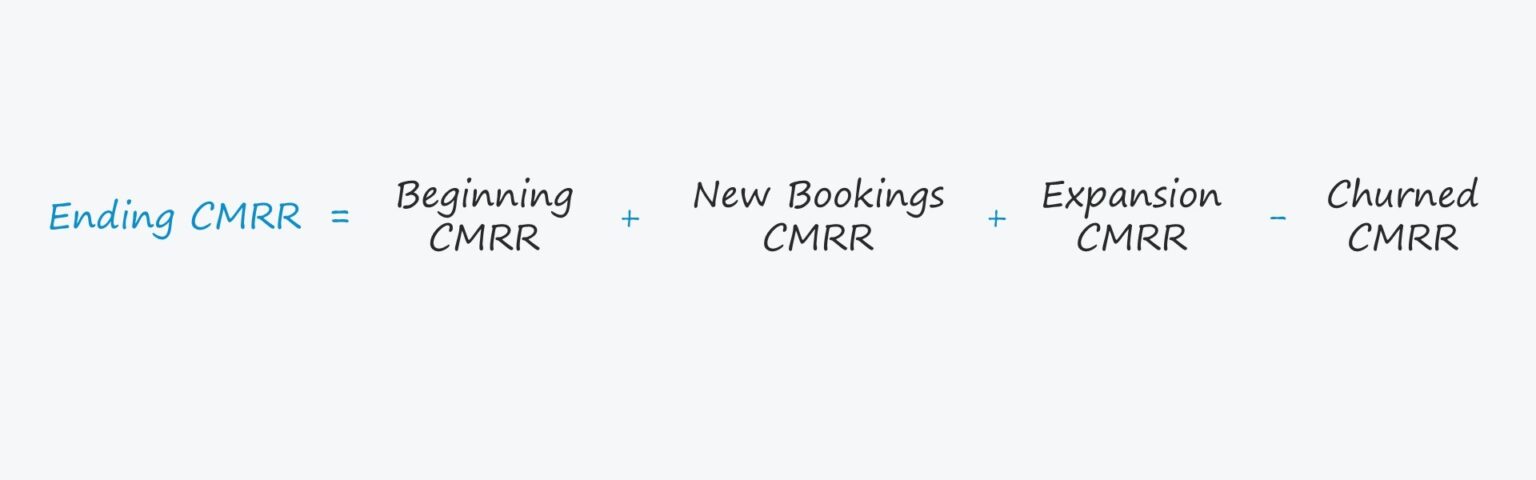
Committed monthly recurring revenue (CMRR) is a SaaS KPI metric that is a derivation of the monthly recurring revenue (MRR) metric.
The CMRR and MRR are closely intertwined metrics used to better understand a SaaS company's revenue quality.
CMRR fixes the shortcomings of the MRR metric by accounting for the impact of new customer bookings, expansion revenue, and customer (and MRR) churn.
The CMRR calculation is a three-step process:
The formula for calculating the committed monthly recurring revenue (CMRR) is as follows.
The details surrounding each formula input are provided below.
The point that each adjustment must be near guaranteed is a critical aspect of the metric’s credibility.
Note: The fees received for services such as one-time installations or consultations are excluded.
The committed monthly recurring revenue metric is perceived as more informative than monthly recurring revenue (MRR) because the metric includes all factors that affect MRR.
The MRR neglects churn, upgrades, and downgrades, which is why MRR is impractical for forecasting purposes.
CMRR is a forward-looking measure suited for setting future growth targets and tracking progress, whereas MRR is more of a trailing measure of past performance.
In particular, upholding the renewal rate and managing customer churn are key determinants of a SaaS company's long-term viability (and thus valuation).
We’ll now move to a modeling exercise, which you can access by filling out the form below.


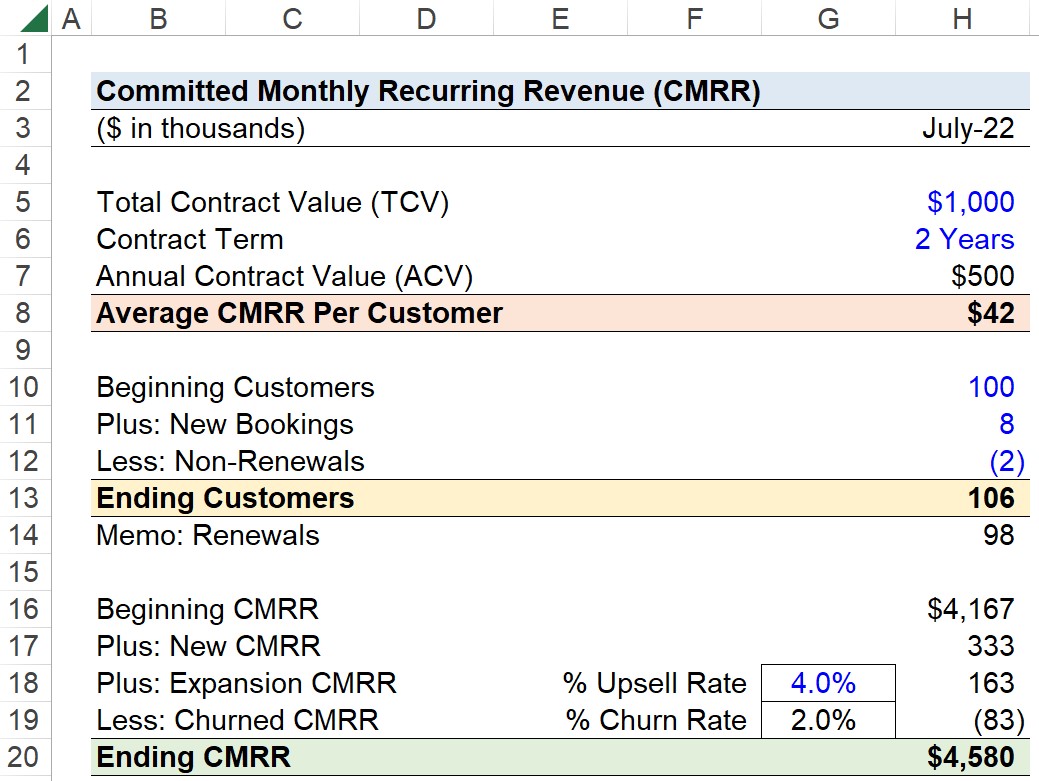
Suppose a SaaS company's business model is oriented around selling two-year long contracts priced at a total contract value (TCV) of $1 million.
Given the total contract value (TCV), the implied annual contract value (ACV) is $500k.
With that being said, it is safe to assume that the company is in the later stages of its growth cycle, i.e. growth equity stage.
If we divide the ACV by the duration of the customer contract expressed on a monthly basis, the average CMRR per customer is $42k.
At the start of the next month, July 2022, the total number of clients is 100. Per company records and customer reports from the sales and marketing team, the projected number of new bookings is 8, while the number of non-renewals is only 2.
The total number of customers was 51 by the end of July, a net increase of 3 customers.
From the customer roll-forward schedule for July, we can see that 98 customers decided to renew.
We now have the necessary inputs to build the schedule, starting with the beginning committed monthly recurring revenue (CMRR) of $4.2 million.
Of course, the calculation would be far more complex in reality because each customer contract varies in price and is customized to meet the specific needs of the customers (and factors such as discounts by team size can further complicate these matters), but this simplification is acceptable for illustrative purposes.
Since only one customer churned, the churned CMRR equals $4k (and the churn rate is thus approximately 2.0%)
The following values are the inputs to calculate our hypothetical company’s ending CMRR.
In the final step of our modeling exercise, we’ll adjust the beginning committed monthly recurring revenue (CMRR) for each input to arrive at an ending CMRR of $220k, which reflects a $20k month-over-month increase for July.


No comments yet.