The Product Adoption Rate in SaaS measures the percentage of new users who become active and engaged with a product or feature in a specified timeframe.
The product adoption rate is a user engagement metric, calculated by dividing the number of new users who adopt the product by the total number of new users, expressed as a percentage.
How to Calculate Product Adoption Rate
Product adoption refers to the progression scheme by which consumers (and enterprises) become familiar with a particular product or application.
Once adept at navigating the interface and accessing the product features, the user can start to derive more value from the tool itself and achieve their objectives at a much higher efficiency.
The term product adoption is distinct from the activation rate, as the latter refers to a single event in the initial stage of the product lifecycle.
In contrast, user adoption occurs from a user decides to completely integrate a product into their day-to-day workflow on the job.
On that note, the higher the product adoption rate, the higher the customer retention (and lower the churn rate).
If the customer churn rate is high, customers are lost because the product falls short in delivering sufficient value (and meeting customer needs).
Therefore, companies must prioritize contributing continuous value to their customer base to acquire repeat, long-term customers and generate recurring revenue.
The step-by-step process to calculate the product adoption rate is as follows:
Step 1 ➝ Define “Active User” (Criteria)
Step 2 ➝ Determine Number of New Active Users
Step 3 ➝ Divide New Active Users by Total Number of Sign-Ups
Product Adoption Rate Formula
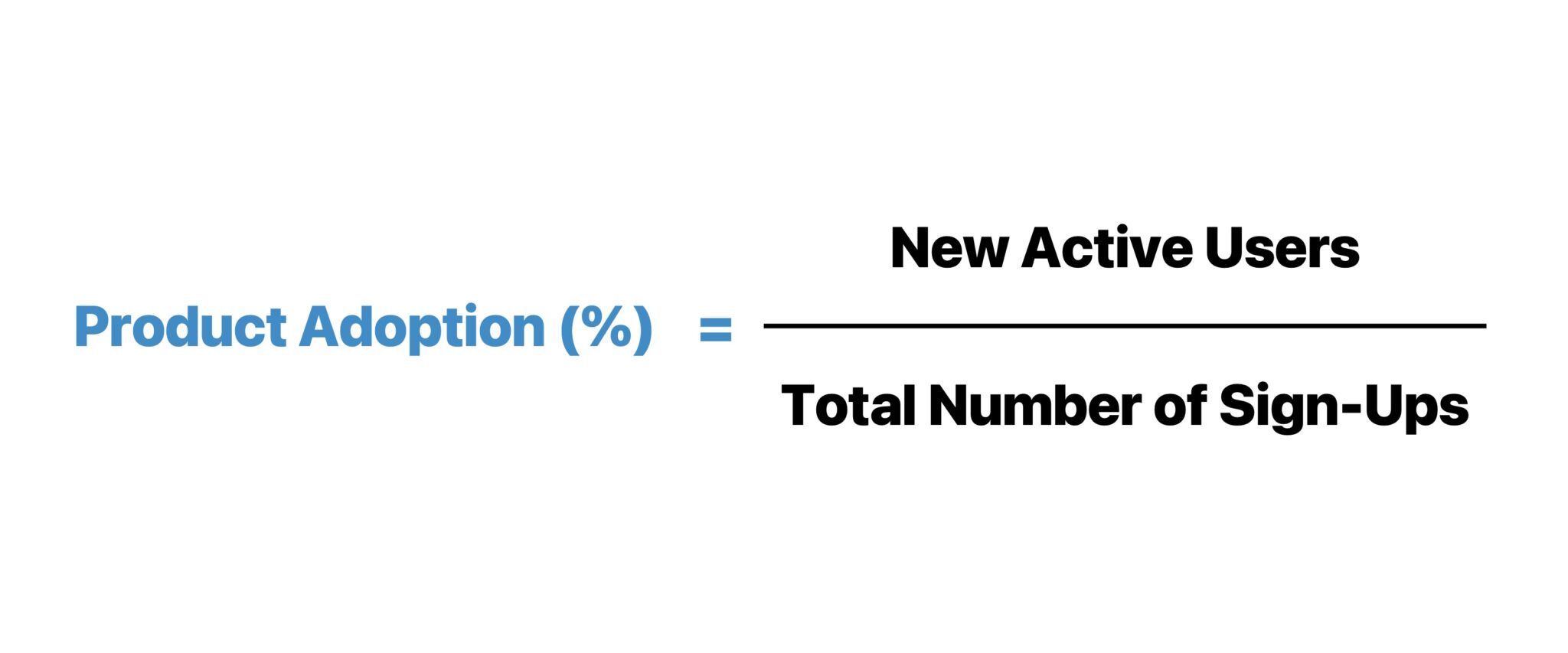
The product adoption rate is the number of new active users divided by the total number of sign-ups, expressed as a percentage.
Product Adoption Rate (%) = New Active Users ÷ Total Number of Sign-Ups
Since the product adoption rate is expressed as a percentage, the output must be multiplied by 100 to convert the metric from decimal notation to percentage form.
Newly acquired customers are the targets for a company's revenue expansion strategies via upselling, cross-selling, product bundling, and implementing new features.
How to Improve Product Adoption Rate
The common strategies that companies utilize to improve upon their product adoption rates are as follows:
Strategy
Implementation Details
Simplify Onboarding
Create a smooth, intuitive onboarding experience
Design interactive tutorials or step-by-step walkthroughs
Offer personalized onboarding paths based on user roles, goals, or experience levels
Communicate Core Values
Demonstrate primary benefits and common use cases within first few interactions
Enable users to achieve quick "wins" or tangible results
Build user confidence by showcasing product utility early
Collect and Act on User Feedback
Utilize surveys, user interviews, and analytics for comprehensive input
Prioritize improvements based on identified pain points
Develop features based on frequent user requests
Optimize User Experience (UX)
Analyze user behavior data (i.e. heat maps, session recordings)
Conduct usability testing to identify friction points
Streamline workflows and refine the user interface (UI) for intuitive navigation
Improve Customer Support
Offer multi-channel support (live chat, email, phone, social media)
Develop self-service resources (FAQs, video tutorials, knowledge base)
Offer users the optionality to find solutions independently
Use Targeted Marketing and Education
Create diverse content (blog posts, webinars, case studies)
Segment user base for personalized messaging
Address specific needs, industries, or use cases in communications
Implement Gamification Elements
Add progress tracking, achievement badges, or level systems
Align gamification with core product functionality
Motivate continued usage and adoption of advanced features
Establish Community
Create dedicated spaces (forums, Slack channels, social groups)
Encourage peer learning and support
Highlight user success stories and innovative use cases regularly
Product Adoption Rate Calculation Example
To illustrate the calculation of product adoption rate in SaaS, suppose we're tasked with calculating the adoption rate on behalf of a SaaS company that recently launched a new project management tool and tracks user adoption across a 30-day period after the initial sign-up stage.
The total number of new sign-ups in August 2024 was 1,000, while the number of new active users was 250.
Total New Sign-Ups = 1,000
New Active Users = 250
The term “active users” is contingent on the company and must be understood to comprehend and analyze the data set.
The product adoption rate is 25%, which was determined after dividing the new active users by the total number of sign-ups.
Product Adoption Rate (%) = 250 ÷ 1,000 = 25.0%
The product adoption rate of 25% implies that out of 1,000 new sign-ups, 250 users became active within the 30-day period.
The fact that 25% of new users perceived value in the product and integrated the tool into their workflow reflects strong user engagement, but the industry benchmark must be considered.
In closing, the periodic measurement of the product adoption rate facilitates data-driven decisions by SaaS companies to improve the user experience (UX), enhance product features, and ultimately drive revenue growth.



No comments yet.