What is Total Order Value (TOV)?
Total Order Value (TOV) represents the gross monetary value of all orders placed by customers over a specified period.

Total Order Value (TOV) represents the gross monetary value of all orders placed by customers over a specified period.
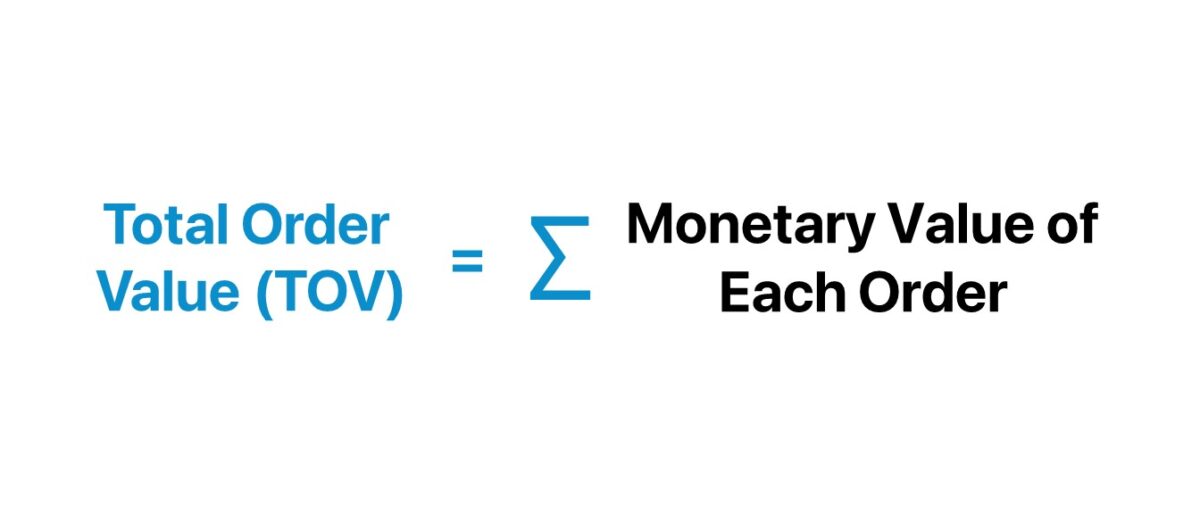
The total order value (TOV), or “gross order value”, measures the cumulative value of all customer orders across a given time period.
The total order value is inclusive of all completed customer orders, without any deductions for returns, cancellations, or discounts.
By tracking the total order value (TOV), a company can obtain insights regarding its revenue trajectory and identify trends in customer spending over time.
The sum of the value of all orders placed within a stated time period must be determined to calculate the total order value (TOV).
For each order placed in the selected period, record the total monetary value that the customer paid in all transactions, inclusive of the taxes, payment processing fees, and shipping costs incurred by customers.
Because the total order value (TOV) is a gross figure, without any adjustments for the incurred costs to deliver the goods or services, it is used to help understand the revenue growth of the company, as opposed to profitability.
The company can also segment customers by order value to grasp the spending patterns of their end market, e.g. the traits shared by customers with higher order values.
Further, the effectiveness of a company’s strategies to incentivize greater spending by customers, such as upselling and cross-selling strategies, can be monitored through the trends in its total order value (TOV).
The total order value (TOV) formula is straightforward, as it is the sum of the monetary values of all customer orders over a pre-specified period.
For example, if an online retailer had 50 orders in a day — of which thirty transactions were $40, while the remaining twenty amounted to $50 — the total order value comes out to $220.
The total order value (TOV) measures the total value of all orders across a chosen period, while the average order value (AOV) estimates the average amount spent per order by customers.
The formula to compute the average order value (AOV) is as follows.
We’ll now move to a modeling exercise, which you can access by filling out the form below.


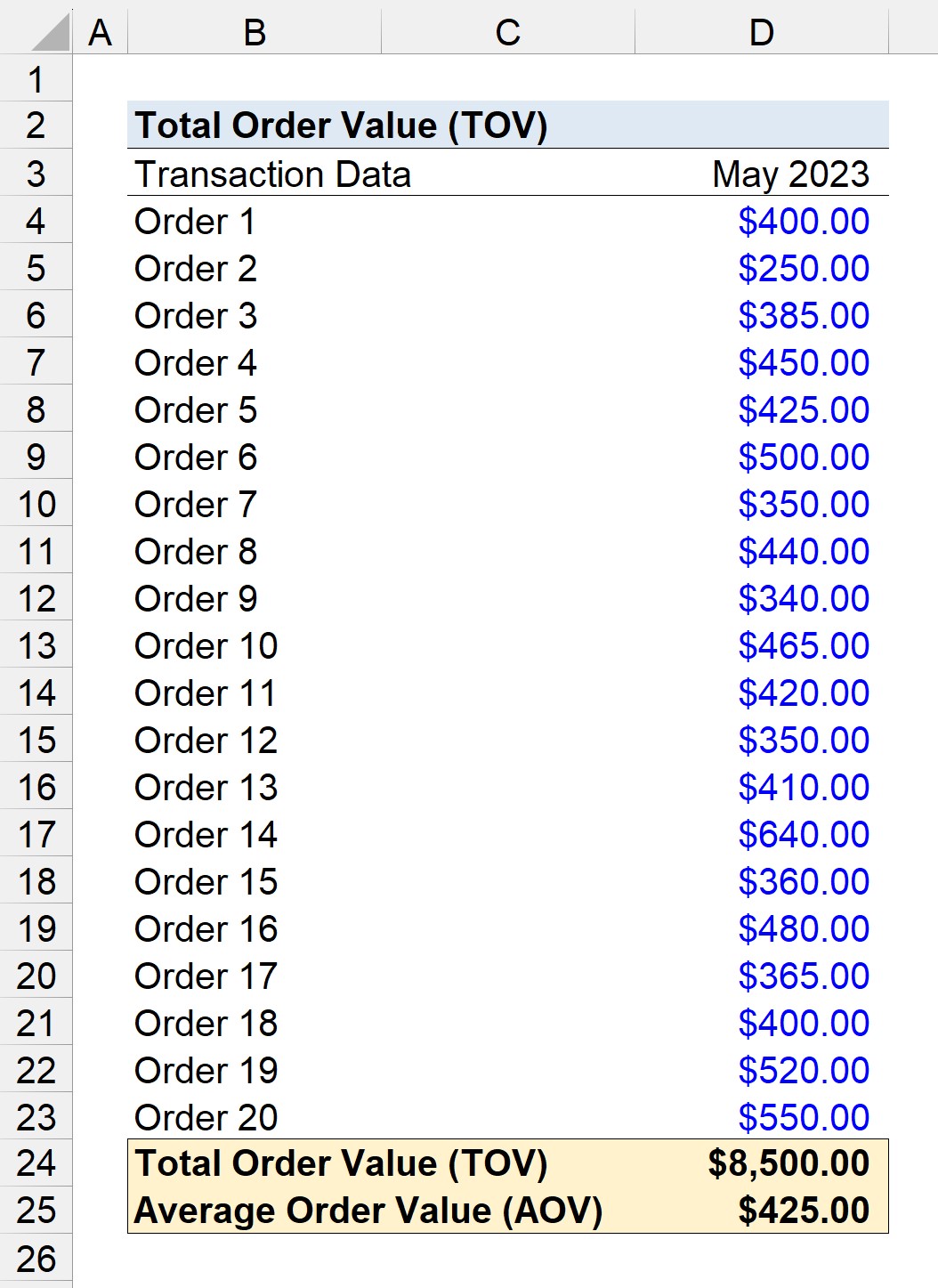
Suppose an eCommerce retailer is calculating its total order value (TOV) for the month of May 2023 given the following transaction data.
Customer Transaction Data
The total order value (TOV) for the month of May is the sum of all the listed orders, which comes out to $8,500. The average order value (AOV) can be derived from the total order value by dividing the TOV ($8,500) by the total number of transactions (20 Orders), resulting in an AOV of $425.00.

Enroll in The Premium Package: Learn Financial Statement Modeling, DCF, M&A, LBO and Comps. The same training program used at top investment banks.


No comments yet.