What is Months to Recover CAC?
The Months to Recover CAC is the time required by a SaaS business to recoup the initial capital spent to acquire a customer on average.

The Months to Recover CAC is the time required by a SaaS business to recoup the initial capital spent to acquire a customer on average.
The months to recover CAC is a SaaS metric used to understand the rate at which capital is spent under their current growth strategy.
Often used interchangeably with the term “CAC Recovery Period”, the months to recover CAC metric measures the time needed for a SaaS business to recoup the amount of initial capital invested to acquire new customers.
Using this metric, a SaaS business can derive insights relevant to the break-even point (BEP) and implied cash runway.
In the SaaS industry, the customer acquisition cost (CAC) refers to the average cost incurred in the process of acquiring a new customer.
Since the sales and marketing (S&M) expense is essentially an investment, the customer acquisition cost (CAC) can be used to analyze the cost efficiency of a particular company.
The step-by-step process of computing the months to recover CAC metric is as follows.
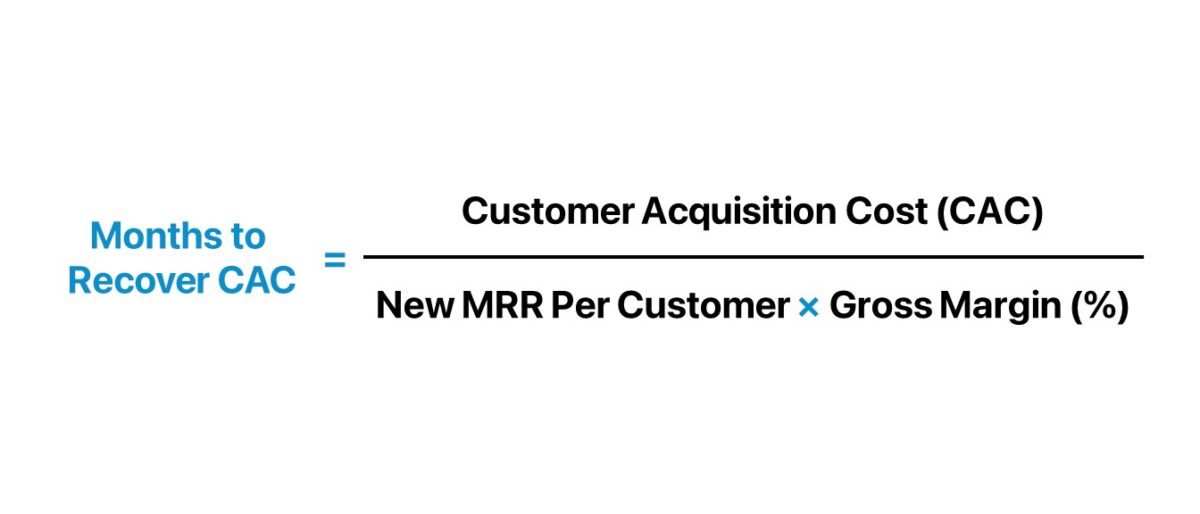
The formula to calculate months to recover CAC divides the sales and marketing (S&M) expense by the product of the new MRR acquired and subscription gross margin.
Where:
Note that the new MRR is a standalone metric and does not include expansion MRR, i.e. the new MRR earned from existing customers.
Expansion MRR is also technically “new” MRR but is instead achieved via upselling, cross-selling, product bundling, and related selling tactics targeted to existing customers.
With that said, if the objective is to analyze the unit economics of new customers in isolation, only new MRR should be included (and the same rule applies for the customer acquisition cost, e.g. exclude the spending on the existing customer base from CAC).
The months to recover CAC—or “CAC recovery period”—will vary across the different segments within the SaaS industry.
Other factors that can affect the CAC recovery period are the customer type (B2B vs. B2C), pricing, and business model (i.e. contract-based revenue vs. one-time purchase).
The months to recover CAC should be fewer than 12 months for the business model of a SaaS company to be viable over the long term.
But of course, there are exceptions to this where SaaS startups – often encouraged by their investors, i.e. venture capital (VC) firms – decide to increase the pace of their spending.
Why? The software industry is a hyper-competitive market, especially for less established startups, where falling behind competitors is frequently the beginning of the end.
The SaaS startups that adopt that sort of single-minded, “growth at all costs” mentality tend to operate in niche, “winner-takes-all” industries.
In addition, the SaaS startup is currently in the growth stage with regard to its lifecycle, i.e. it achieved initial validation of product-market fit (PMF), identified the target end market (and customer profile), and optimized the customer acquisition strategies.
For instance, suppose a B2B SaaS startup sells software products on a contractual basis using multi-year commercial licenses. If the market is currently crowded with providers competing for customers, the loss of one client to a competitor removes the potential customer from the pool of acquisition targets until the date of contract renewal.
If the step-up in S&M spending pays off in terms of the number of new customer acquisitions, the startup should have no issue raising capital from existing and new investors (and the metric is far less of a concern given the circumstances).
There are two metrics in particular that SaaS investors and operators closely measure to determine the long-term viability of a software business.
The formula to calculate the LTV to CAC ratio is as follows.
Where:
Learn how institutional investors identify high-potential undervalued stocks. Enrollment is open for the upcoming cohort.
We’ll now move to a modeling exercise, which you can access by filling out the form below.


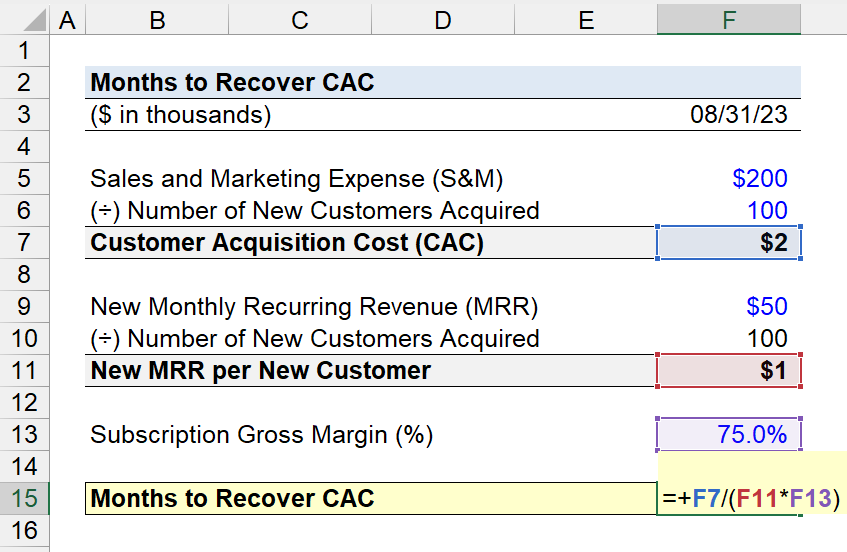
Suppose a SaaS business is computing its months to recover CAC for the month of August 2023 to track its most recent operating performance and cost efficiency.
In the month of August, the SaaS provider incurred a total of $200k in sales and marketing (S&M) expenses, while acquiring a total of 100 new customers.
Therefore, the customer acquisition cost (CAC) comes out to $2k per new customer, which we determined by dividing the sales and marketing (S&M) expense by the total number of new customers acquired.
The 100 new customers generated $50k in new monthly recurring revenue (MRR) for the month, which we'll divide by the new customer count to determine $1k as the new MRR per new Customer.
The new MRR per new customer is then multiplied by our subscription gross margin assumption of 75.0%.
Given the two inputs necessary to estimate the months to recover CAC metric, the final step is to divide the customer acquisition cost (CAC) by the gross margin adjusted new MRR per new customer.
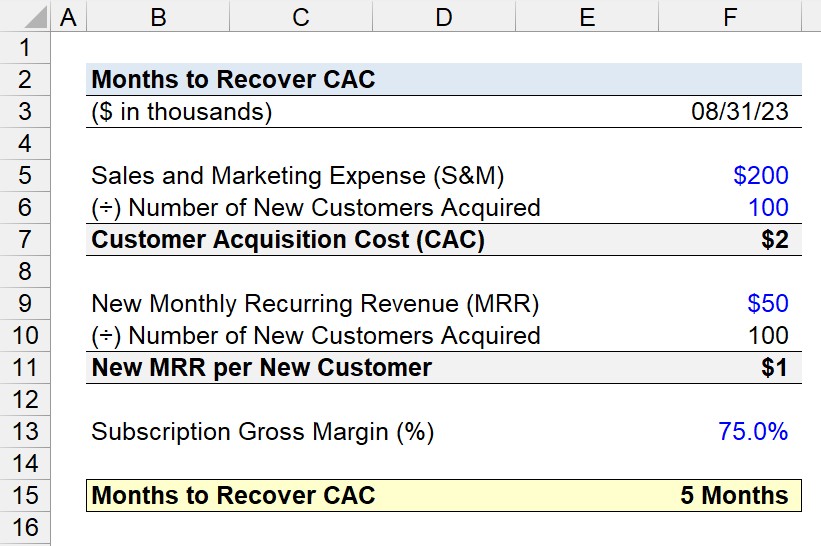
After plugging in our figures into the formula, the months to recover CAC (or CAC recovery period) is implied to be approximately 5 months.


No comments yet.