What is Price to Sales?
The Price to Sales Ratio (P/S) measures the market value of a company in relation to the total amount of annual sales it has recently generated.

The Price to Sales Ratio (P/S) measures the market value of a company in relation to the total amount of annual sales it has recently generated.
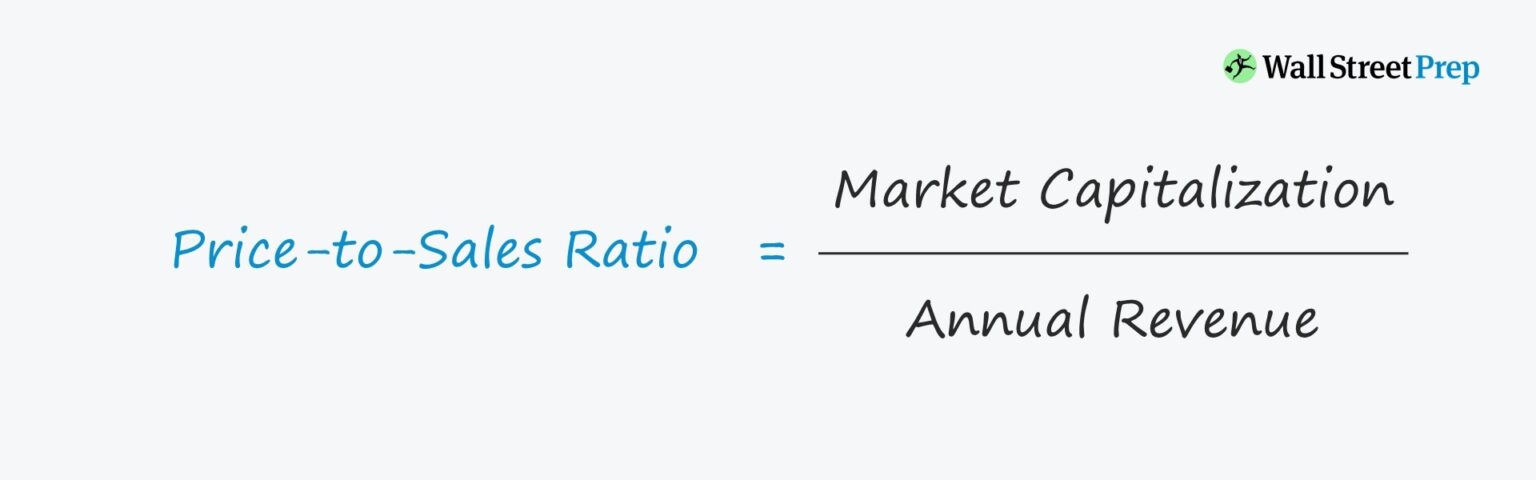
Often referred to as the “sales multiple”, the P/S ratio is a valuation multiple based on the market value that investors place on the revenue belonging to a company.
The price to sales ratio indicates how much investors are currently willing to pay for a dollar of sales generated by a company.
In short, the price to sales ratio (P/S) reflects the value that the market places on the sales of a specific company, which is determined by its revenue quality (i.e. customer type, recurring vs. one-time), as well as expected performance.
Higher price to sales ratios (P/S) can often serve as an indication that the market is currently willing to pay a premium for each dollar of sales.
In contrast, lower price to sales ratios (P/S) imply that the underlying companies are trading at a discount, which could either be an opportunity to invest or underpriced for a rational reason.
The price to sales ratio (P/S) can be calculated by dividing the latest closing share price by its sales per share as of the latest reporting period — which is ordinarily the latest fiscal year, or an annualized figure (i.e. trailing twelve months with a stub-period adjustment).
Another method to calculate the P/S ratio involves dividing the market capitalization (i.e. total equity value) by the total sales of the company.
A low price-to-sales ratio relative to industry peers could mean that the shares of the company are currently undervalued.
The standard acceptable range of the P/S ratio varies across industries. Hence, benchmarking the ratio must be done among similar, comparable companies.
Alternatively, a P/S ratio in excess of its peer group could indicate the target company is overvalued.
The major downside of the price-to-sales ratio that tends to reduce its reliability is that the P/S ratio does NOT factor in the profitability of companies.
While the main advantage of using the P/S ratio is that it can be used to value companies that are yet to be profitable at the operating income (EBIT), EBITDA, or net income line, this fact is also the main drawback.
Since the price-to-sales ratio neglects the current or future earnings of companies, the metric can be misleading for unprofitable companies.
Additionally, the P/S ratio fails to account for the leverage of the company being evaluated – which is why many prefer to use the EV/Revenue multiple.
We’ll now move to a modeling exercise, which you can access by filling out the form below.

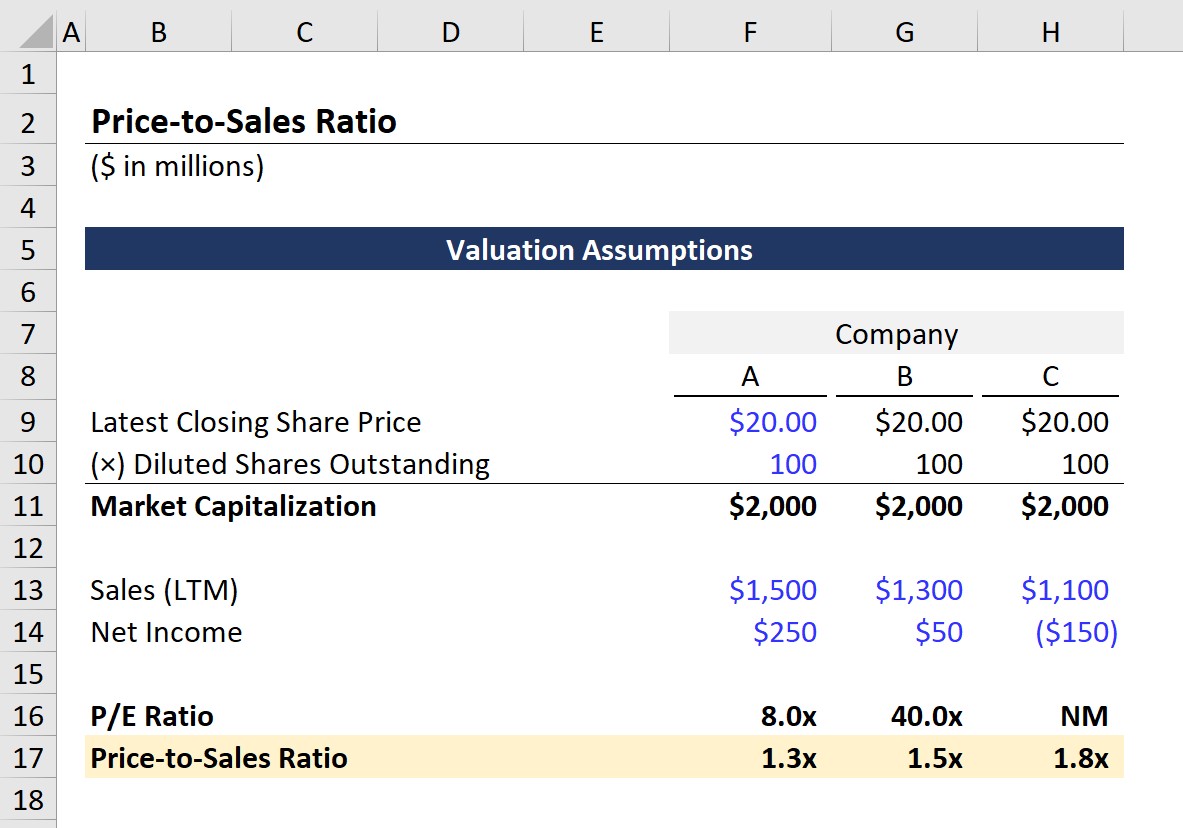
In our hypothetical scenario, in which we'll calculate the price-to-sales ratio, we'll compare three different companies.
For all three companies – Company A, B, and C – we'll use the following assumptions:
With those two assumptions, we can calculate the market capitalization for each company.
Next, we'll list the assumptions related to each company's sales and net income in the last twelve months (LTM).
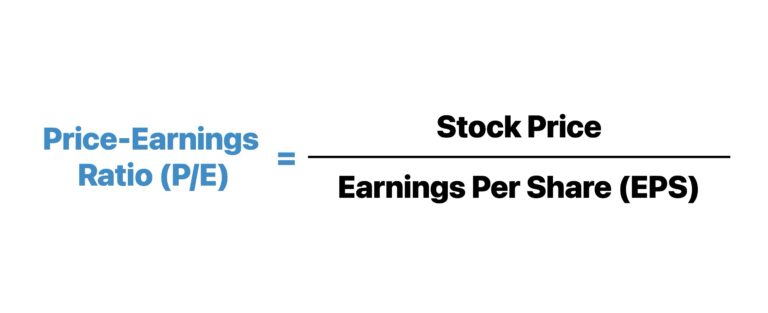
If we compute the P/E ratio for our example peer group, we'd get:
From the list above, the P/E ratios provide minimal insight into the valuation of the three companies.
The P/E ratio tends to be most useful for mature, stable companies. But here, Company B and C each have P/E ratios that are not meaningful due to being barely profitable or not profitable.
If we calculate the P/S ratios for these same three companies, we can obtain a better understanding of how the market is valuing each in comparison to one another.
In closing, we can see how the price-to-sales ratios are typically in a more compact range, which helps make comparisons more practical, unlike the P/E ratios that can deviate far from one another.
From the example we just completed, it's clear why the price-to-sales ratio is frequently used (or oftentimes is the only option) for companies struggling to get past the break-even point or are unprofitable.
Enroll in The Premium Package: Learn Financial Statement Modeling, DCF, M&A, LBO and Comps. The same training program used at top investment banks.

No comments yet.