What is the Justified P/E Ratio?
The Justified P/E Ratio is a variation of the price-to-earnings ratio linked to the Gordon Growth Model (GGM) in an effort to better understand a company’s underlying performance.

The Justified P/E Ratio is a variation of the price-to-earnings ratio linked to the Gordon Growth Model (GGM) in an effort to better understand a company’s underlying performance.
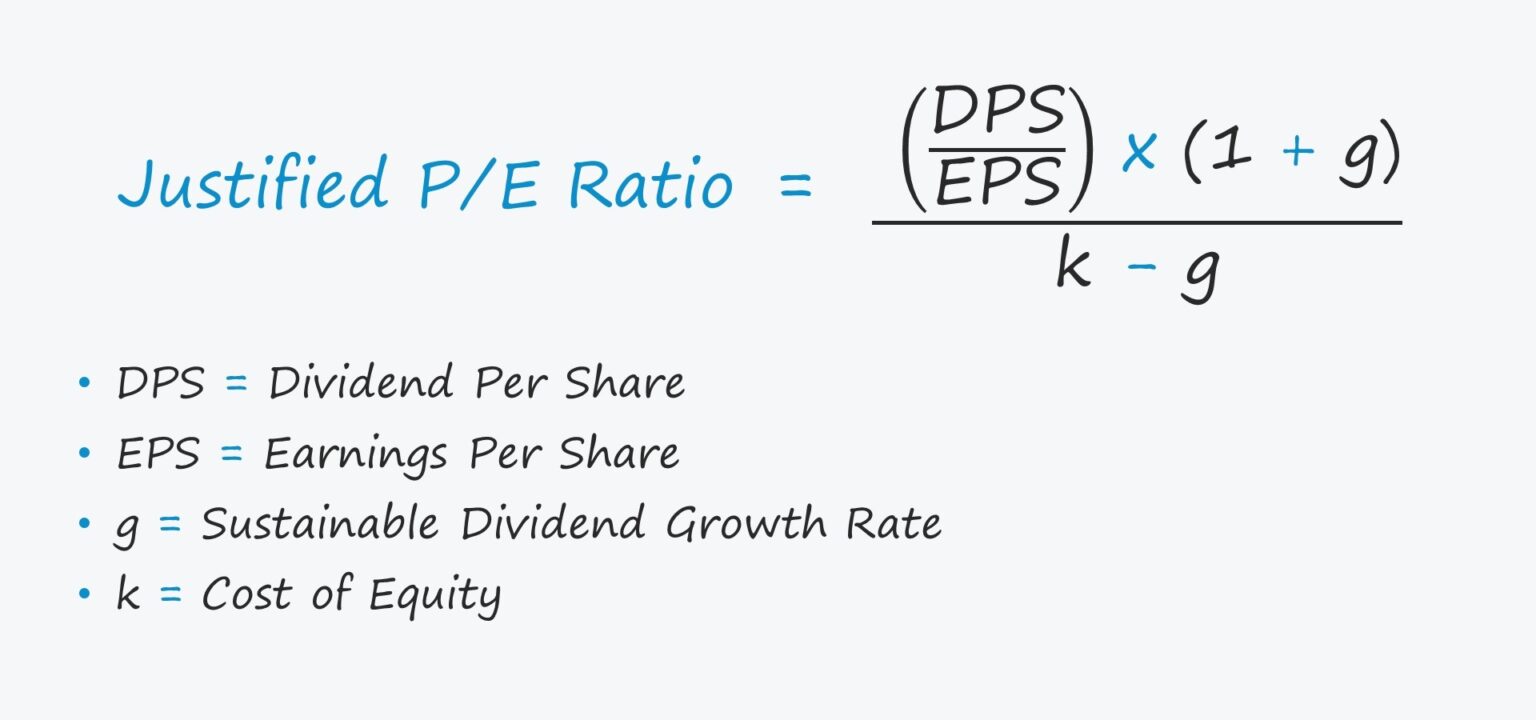
The justified P/E ratio can be thought of as an adjusted variation of the traditional price-to-earnings ratio that aligns with the Gordon Growth Model (GGM).
The Gordon Growth Model (GGM) states that a company’s share price is a function of its next dividend payment divided by its cost of equity less the long-term sustainable dividend growth rate.
Where:
Moreover, if we divide both sides by the EPS – the current share price and the dividend per share (DPS) – we are left with the justified P/E ratio.
The formula to calculate the justified P/E ratio is as follows.
Note how the “(DPS / EPS)” component is the dividend payout ratio %.
Since the payout ratio is expressed in the form of a percentage, the GGM formula is effectively converted into the justified P/E ratio.
The fundamental drivers that impact the justified P/E are the following:
1) Inverse Relationship with Cost of Equity
2) Direct Relationship with Dividend Growth Rate
3) Direct Relationship with Dividend Payout Ratio (%)
Therefore, the justified P/E ratio indicates that a company's share price should rise from a lower cost of equity, higher dividend growth rate, and higher payout ratio.
We’ll now move to a modeling exercise, which you can access by filling out the form below.


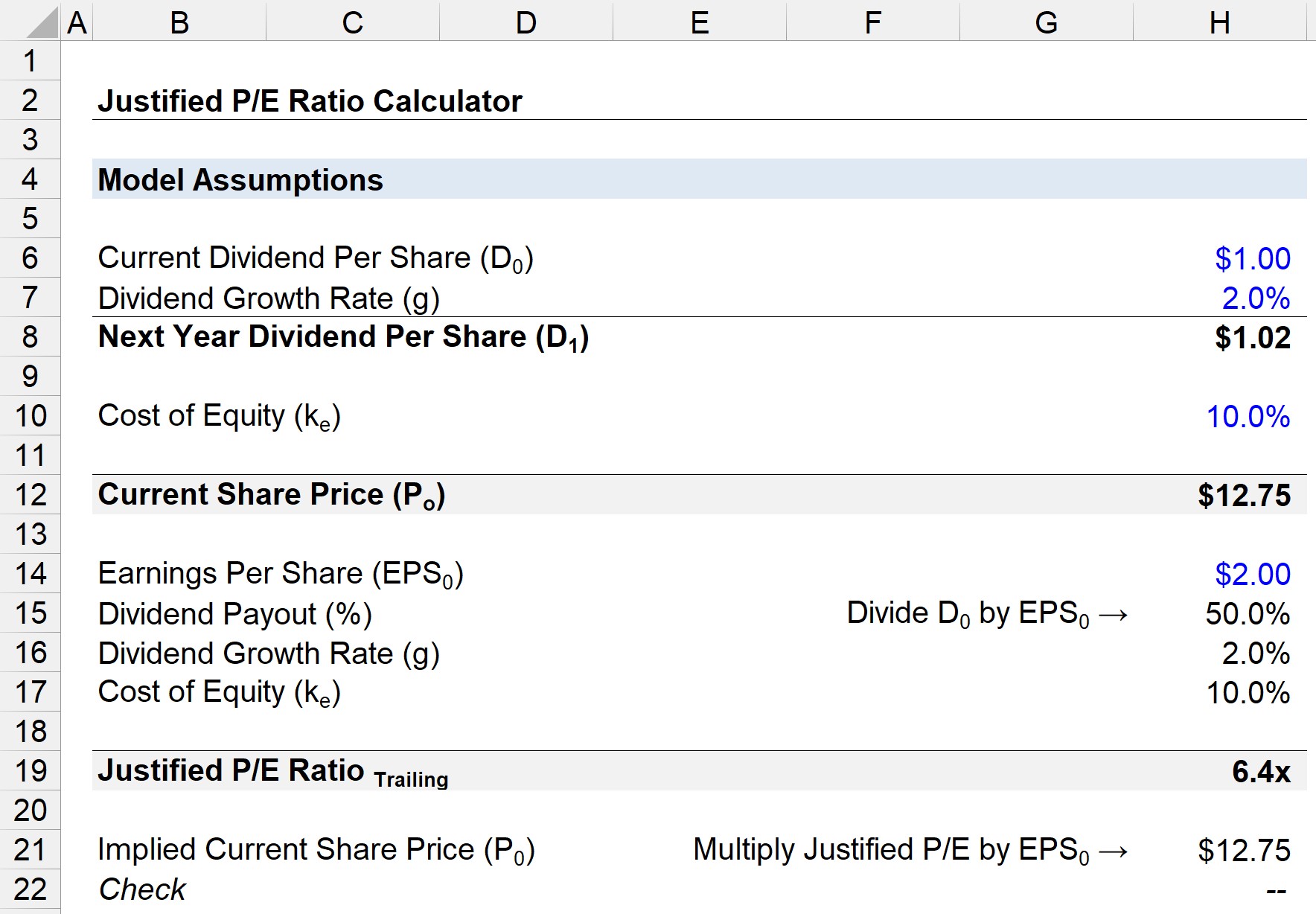
Suppose a company paid a dividend per share (DPS) of $1.00 in the most recent reporting period.
As for the rest of our model assumptions, the company’s cost of equity is 10% and the sustainable dividend growth rate is 2.0%
If we grow the current dividend by the growth rate assumption, the next year's dividend is $1.02.
Using those assumptions, the justified share price comes out as $12.75.
In the next part, we will calculate the justified P/E ratio.
However, we are missing one assumption, the reported earnings per share (EPS) of our company in the past year – which we’ll assume was $2.00.
But if we were to divide both sides by EPS, we can calculate the justified P/E ratio.
In closing, we can cross-check the implied share price from the justified P/E and the current share price to ensure our calculation is correct.
After multiplying the justified P/E of 6.4x by the historical EPS of $2.00, we calculate the implied current share price as $12.75, which matches the Po from earlier.

Enroll in The Premium Package: Learn Financial Statement Modeling, DCF, M&A, LBO and Comps. The same training program used at top investment banks.


No comments yet.