What is Forward Multiple?
A Forward Multiple is a valuation ratio that reflects a company’s value on the basis of an estimated financial metric, i.e. forecasted earnings performance.

A Forward Multiple is a valuation ratio that reflects a company’s value on the basis of an estimated financial metric, i.e. forecasted earnings performance.

The forward multiple is most often used to determine the valuation of a high growth company that is either unprofitable as of the present date, or the market is valuing the company based on its expected earnings in the future.
Given this context, it can be reasonable – or sometimes the only choice – to value a high-growth, unprofitable company based on its expected future profitability as opposed to its actual historical performance.
The formula to calculate a forward multiple is as follows.
Where:
The rule for all valuation multiples, whether on a historical or forward basis, is that the numerator and denominator must match in terms of the capital providers represented.
Forward multiples tend to be most common for software companies (SaaS), where the abundance of capital from venture capital (VC) and growth equity firms – coupled with their disruptive business models – results in prioritizing growth at all costs and capturing as much market share from existing incumbents as plausible.
For example, a SaaS company can be valued at a relatively high forward multiple because the market’s expectation is that the company can achieve its goals in terms of growth and market share, followed by becoming more profitable over time as its business model becomes more efficient.
Furthermore, the market might anticipate its margins to expand as a result of reduced spending as its nearest competitors become less of a concern over time (i.e. competition cools down) as well as the company coming up with more effective strategies at monetizing their user bases (and recurring revenue via long-term customer contracts).
In certain markets, a consolidation phase can occur where competitors can become acquisition targets, as in the case of Postmates and Uber in late 2020.
In 2020, venture capitalist Tomasz Tunguz performed a linear regression analysis on sixty publicly traded SaaS companies to identify which factors determined the forward multiple of these high-growth software companies.
The key takeaways from the findings were that revenue growth and sales efficiency had the highest correlation, 0.81 and 0.75, respectively.
On the other hand, the other factors like cash flow margin, net income margin, and gross margin were irrelevant, for the most part.
Over the long run, improvements to profit metrics certainly become critical, but growth and sales efficiency dictate forward multiples in the market, even for publicly-listed companies.
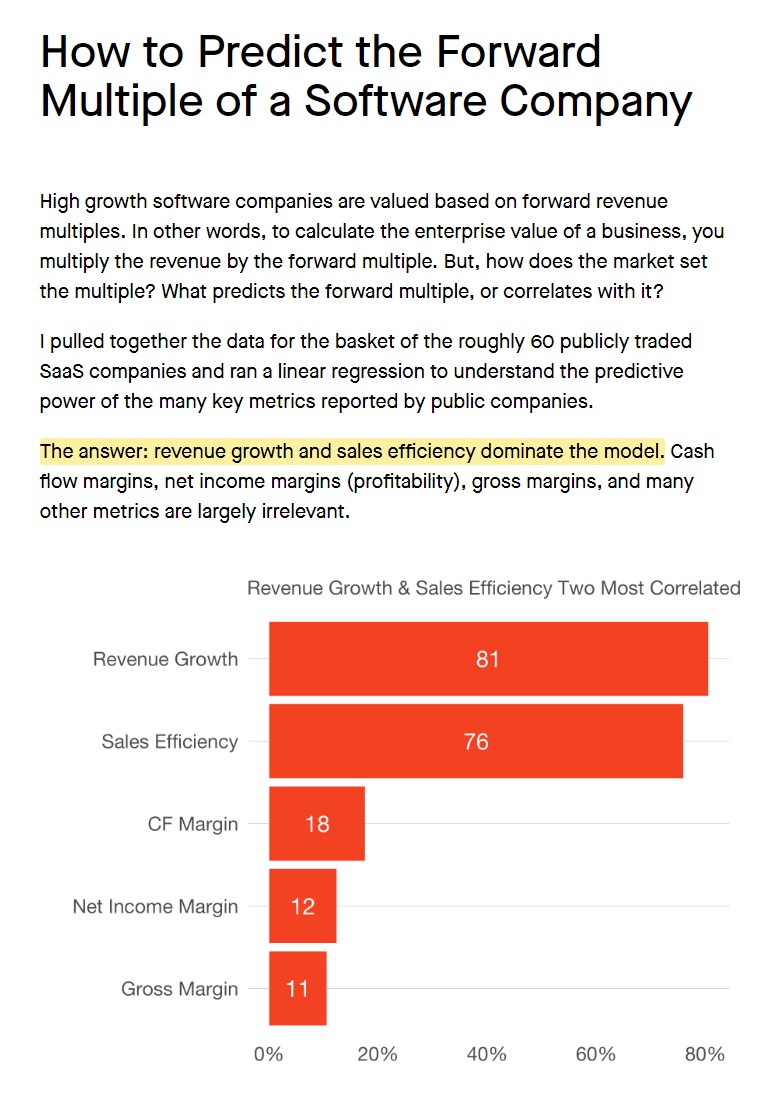
“How to Predict the Forward Multiple of a Software Company” (Source: Tomasz Tunguz)
We’ll now move on to a modeling exercise, which you can access by filling out the form below.


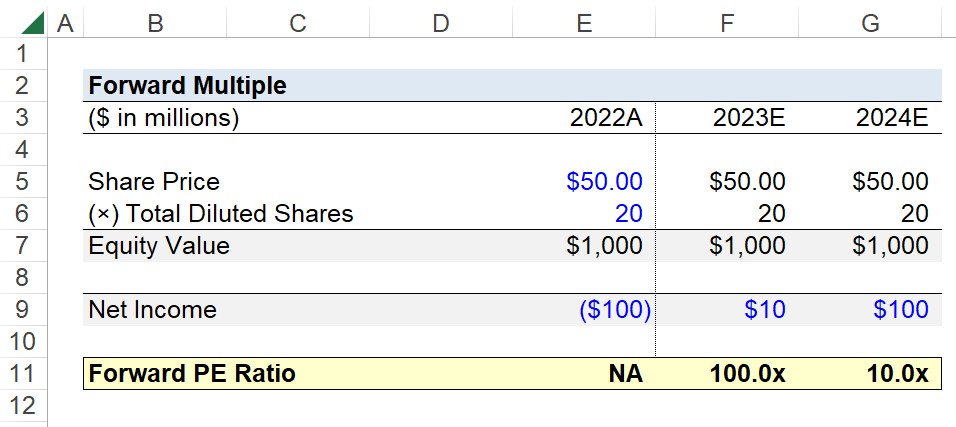
Suppose you’re tasked with calculating the forward multiples of a SaaS company that is currently unprofitable.
The company’s market share price – as of the latest closing date – is $50.00, with a total of 20 million shares in circulation.
By multiplying the share price and diluted share count, the implied equity value of our software company is $1 billion.
In fiscal year 2022, the company incurred a net loss of $100 million, but the consensus among equity analysts is that management’s plans to increase profitability in the coming years are promising and likely to materialize.
In the next fiscal year, 2023, the expected earnings is $10 million – thus, the company will barely break even – but its net earnings will expand significantly and reach $100 million in 2024.
The forward PE ratio can be calculated by dividing the company’s equity value (or “market cap”) by the net income in each period.

Enroll in The Premium Package: Learn Financial Statement Modeling, DCF, M&A, LBO and Comps. The same training program used at top investment banks.


No comments yet.