What is Calendarization?
Calendarization is the adjustment of a company’s financial data and operating performance to align with the calendar year-end date, i.e. December 31.

Calendarization is the adjustment of a company’s financial data and operating performance to align with the calendar year-end date, i.e. December 31.
Calendarization is the process of adjusting a company's financials for the ending fiscal dates to match the calendar year.
Under U.S. GAAP accounting, public companies must file quarterly reports on their financial performance (10-Q), including a comprehensive end-of-year report (10-K).
Most companies file their year-end reports with December 31 as the fiscal year (FY) ending date, aligning with the calendar year.
Certain companies, however, opt to report on a different schedule, such as Apple (NASDAQ: AAPL), which files its 10-K at the end of September.
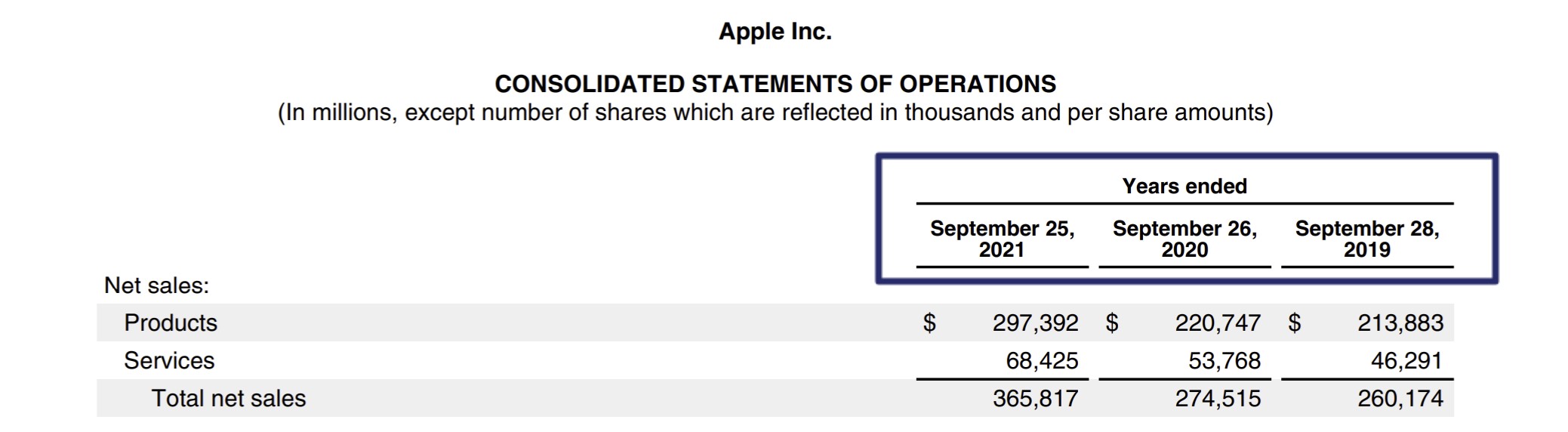
Apple Fiscal Year Ending Date (Source: 10-K)
To compare the financial data among different companies – particularly in comparable company analysis – it is necessary to align the fiscal year ending dates among the entire peer group.
In such cases, the operating metric in the valuation multiple – e.g. EBITDA, EBIT – must be adjusted so that the metric covers identical time frames among companies.
Without normalized year-end dates, the valuation multiples will be skewed and likely cause less reliable conclusions due to the inconsistencies, i.e. the performance reflected is spread across different periods (and thus, not truly “comparable”).
Calendarization is especially important for industries with high seasonality (e.g. retail), as full-year performance tends to be heavily concentrated around the holidays and may vary from year to year.
The steps involved in calendarization are relatively straightforward, as illustrated by the formula for revenue shown below.
Formula
- Calendarized Revenue = [Month × FYA Revenue ÷ 12] + [(12 – Month) × NFY Revenue ÷ 12]
Where:
Here, the term "Month" refers to the month the company's fiscal year ends, e.g. if the fiscal year ends on June 30, the month will be six.
We’ll now move to a modeling exercise, which you can access by filling out the form below.


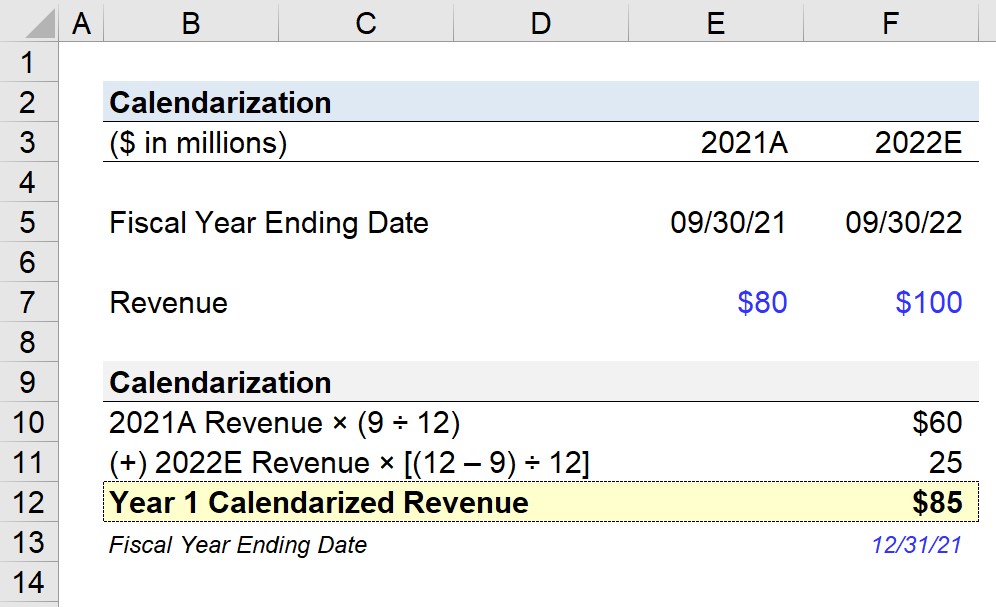
Suppose a company has a fiscal year ending date of September 30, and you are given the task of calendarizing its revenue.
In FY-2021, the company generated $80 million in revenue, which is projected to grow to $100 million in the following year.
To calculate the "Year 1 Calendarized Revenue" – i.e. fiscal year ending 12/31/21 – we must adjust the financials so that 75% of the data is contributed by 2021A and the remaining 25% stems from 2022E.
Given those adjustment factors (%), we’ll multiply the percentage by the corresponding revenue amount.
The calendarized revenue for the first adjusted year equals the sum of the two figures above, which comes out to $85 million.

Enroll in The Premium Package: Learn Financial Statement Modeling, DCF, M&A, LBO and Comps. The same training program used at top investment banks.


No comments yet.