What is P/FCF?
The P/FCF multiple compares a company’s equity value (i.e. market capitalization) relative to its free cash flow to equity (FCFE), or levered free cash flow.

The P/FCF multiple compares a company’s equity value (i.e. market capitalization) relative to its free cash flow to equity (FCFE), or levered free cash flow.
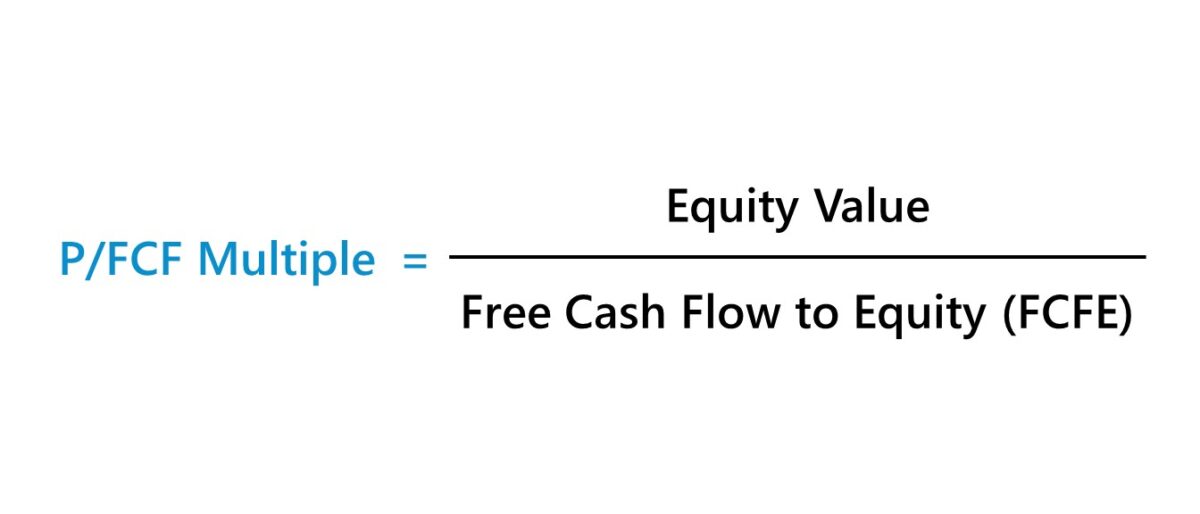
The P/FCF multiple, or "price to free cash flow", is the ratio between a company’s equity value and free cash flow.
In order for a valuation multiple to be practical, the stakeholder(s) represented must match between the numerator and denominator; otherwise, there is an inconsistency in the ratio.
The equity value of a company is equal to the product of a company’s share price and its total number of diluted shares outstanding, i.e. debt in the capital structure is not part of the calculation.
On that note, the free cash flow to equity (FCFE) is the right metric to use alongside equity value, since FCFE is also attributable to solely common shareholders.
Unlike the free cash flow to firm (FCFF) – the cash flows applicable to all stakeholders in a company’s capital structure – FCFE is calculated after adjusting for non-equity payments such as mandatory debt amortization and interest expense (and the residual cash flows then belong to the equity holders).
The formula to calculate the P/FCF multiple is as follows.
The numerator, equity value, is calculated by multiplying the latest closing share price by the total diluted share count.
As for the denominator, free cash flow to equity (FCFE), the calculation starts with net income – a post-interest profit metric – which is then adjusted for non-cash items (D&A), change in net working capital (NWC), capital expenditure (Capex), and debt repayments.
Note: If the company raised more debt capital, the proceeds are a net addition to FCFE, since the newly obtained cash can be used to issue shareholders dividends or repurchase shares.
The P/FCF ratio answers the question, “For each dollar of a company’s levered free cash flow (FCFE), how much are investors in the market currently willing to pay?”
Therefore, the higher the P/FCF multiple, the more of a premium at which the market values the company on a FCFE-basis (and vice versa for a lower P/FCF multiple).
There are two downsides to using the P/FCF multiple:
The EV/FCF multiple is the inverse of the levered FCF yield metric.
The levered FCF yield metric, expressed as a percentage, represents the remaining cash flows that can benefit equity shareholders, after any debt payments.
We’ll now move on to a modeling exercise, which you can access by filling out the form below.


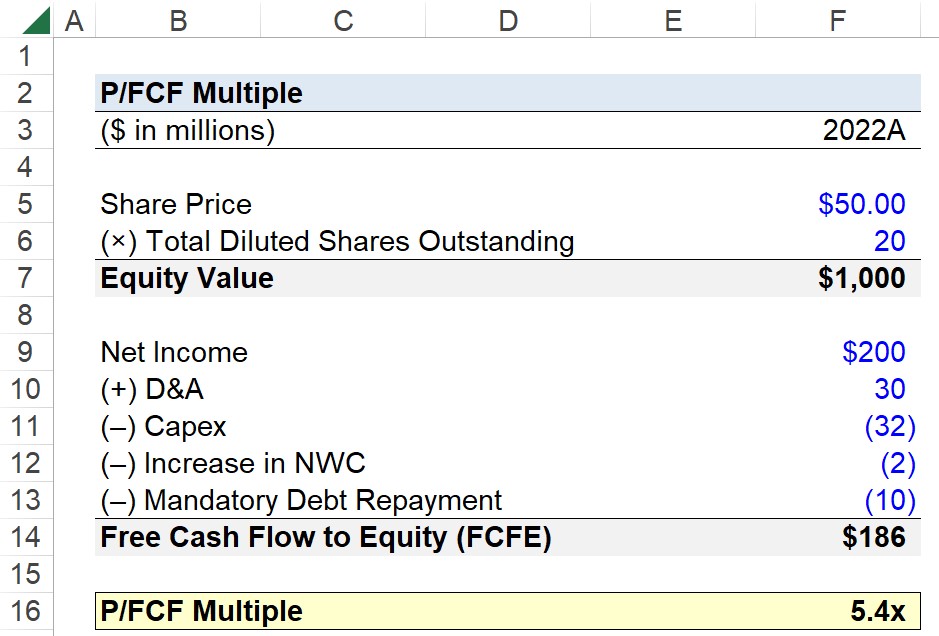
Suppose you’re tasked with calculating the P/FCF multiple of a company using the following assumptions.
Upon multiplying the company’s current market share price by its total number of diluted shares outstanding, the equity value of the company comes out to $1 billion.
With the calculation of our numerator complete, we’ll now determine our company’s free cash flow to equity (FCFE).
The assumptions we’ll use in our calculation are the following:
Upon entering our assumptions into the free cash flow to equity (FCFE) formula, we get a result of $186 million.
In the final section of our exercise, we’ll divide our company’s equity value by its free cash flow to equity (FCFE).

Enroll in The Premium Package: Learn Financial Statement Modeling, DCF, M&A, LBO and Comps. The same training program used at top investment banks.


No comments yet.