What is Market to Book Ratio?
The Market to Book Ratio compares a company’s market capitalization, or “equity value,” to its book value of equity (BVE).

The Market to Book Ratio compares a company’s market capitalization, or “equity value,” to its book value of equity (BVE).
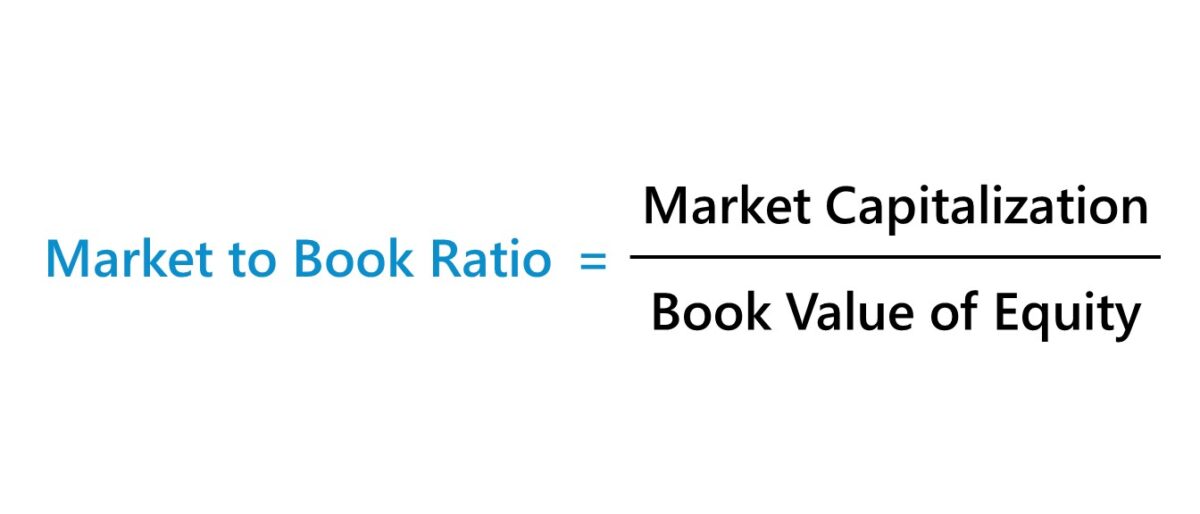
The market to book ratio, also known as the price-to-book ratio (or P/B ratio), measures a company's market capitalization relative to its book value of equity (BVE), which is the recorded value of its shareholders' equity for bookkeeping purposes.
The two components of the market to book ratio are the following metrics:
The market to book ratio formula is as follows.
Conversely, the market to book ratio can be calculated using the same metrics, expressed on a per-share basis.
The ratio between a company's market cap to its book value of equity can be useful for investors in determining whether a company is undervalued, overvalued, or fairly priced.
But of course, the market to book ratio cannot be used as a standalone metric and must be used in conjunction with various other financial ratios to support an investment thesis.
The market value of equity is a function of a company's share price, which is actively traded in the open markets, with forward-looking assumptions regarding the company's outlook priced in.
Barring unusual circumstances, the market value of a publicly traded company's equity is greater than its book value of equity in most cases unless the company is in a state of financial distress and/or on the verge of filing for bankruptcy protection.
In fact, the practicality of the market to book ratio tends to be limited to being used as a screening tool to identify potentially undervalued companies prior to performing more in-depth diligence on the company's fundamentals, the relevant industry or secular trends, and other factors that can impact its share price.
Because the book value of equity (BVE) is a "levered" metric (i.e. post-debt) that pertains only to the equity holders, the corresponding metric to use in the ratio is the market capitalization as opposed to the enterprise value. Otherwise, there would be a mismatch between the group of capital provider(s) represented.
We’ll now move on to a modeling exercise, which you can access by filling out the form below.


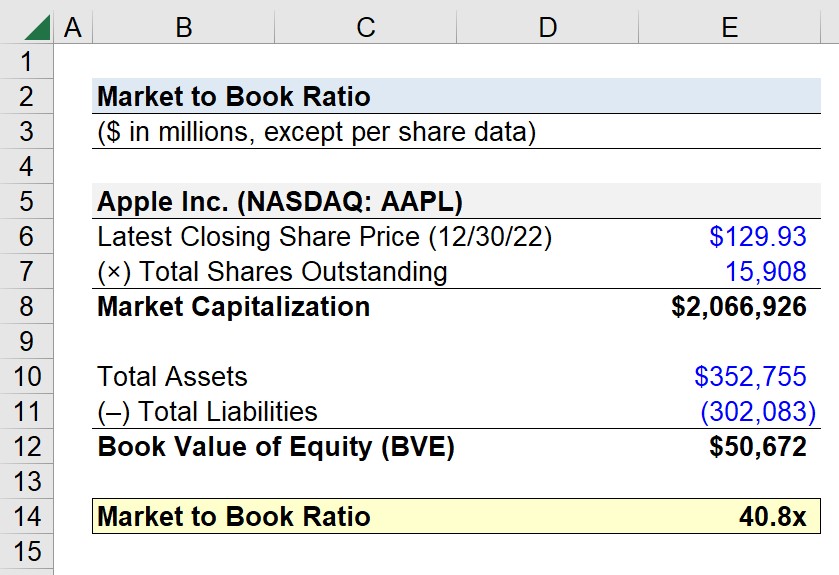
Suppose you're tasked with calculating the market to book ratio of Apple (NASDAQ: AAPL) using the following assumptions.
By multiplying those two metrics, we can calculate our company's market capitalization, which comes out to be approximately $2.1 trillion.
In the next step, we'll calculate Apple's book value of equity (BVE) by subtracting its total liabilities from its total assets, per its latest reported balance sheet for fiscal year ending 2022.
The difference between total assets and total liabilities is $50,672 million, which represents Apple's book value of equity (BVE).
Note that the calculation can be adjusted to include the value of only tangible assets, i.e. excluding intangible assets such as goodwill.
But for the sake of simplicity, we'll calculate our market to book ratio without any adjustments.
Upon dividing Apple's market cap by its book value of equity (BVE), we arrive at a market to book ratio of 40.8x.
Enroll in The Premium Package: Learn Financial Statement Modeling, DCF, M&A, LBO and Comps. The same training program used at top investment banks.


No comments yet.