What is EV/Invested Capital?
EV/Invested Capital is a valuation multiple that compares the enterprise value of a company in relation to its invested capital, i.e. the sum of fixed assets and net working capital (NWC).

EV/Invested Capital is a valuation multiple that compares the enterprise value of a company in relation to its invested capital, i.e. the sum of fixed assets and net working capital (NWC).
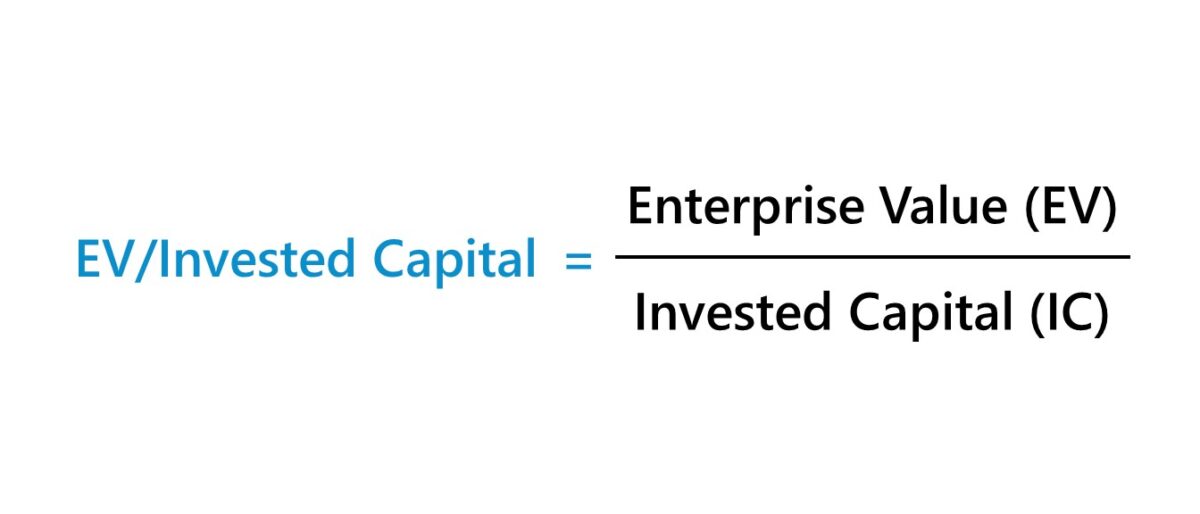
The EV/Invested Capital (EV/IC) multiple is the ratio between a company’s enterprise value and its invested capital.
The numerator and denominator in a valuation multiple must match in terms of the represented stakeholders, e.g. debt lenders, preferred stockholders, and/or common shareholders.
Since the invested capital (IC) metric – i.e. the sum of a company’s fixed assets and net working capital (NWC) – pertains to all providers of capital, the rule is met.
The EV/invested capital multiple can be thought of as the enterprise value of a company, expressed on the basis of each dollar of invested capital – i.e. the capital provided by its stakeholders – spent on fixed assets (i.e. capital expenditure) and net working capital (NWC).
The formula to calculate the EV/invested capital multiple is as follows.
Note that there is an alternative calculation of the EV/IC multiple, where “Invested Capital” is the sum of total shareholders' equity and total debt.
In that case, the EV/IC multiple describes enterprise value on the basis of each and every dollar provided by shareholders and lenders, whereas the prior method – where invested capital is the sum of a company's fixed assets and net working capital (NWC) – only accounts for the spending on operating items that actually drive future revenue generation.
Compared to other enterprise value multiples, such as EV/EBITDA or EV/EBIT, the EV/invested capital multiple is not used as frequently.
The enterprise value to invested capital multiple is most applicable to companies with capital-intensive business models, in which its historical and future revenue generation stems primarily from the productivity of its fixed asset base.
The EV/IC multiple remains more stable in periods of cyclicality when the cash flows and earnings of an entire industry – most often in capital-intensive industries such as oil and gas (O&G) – fluctuate substantially.
While other valuation multiples like the price to earnings ratio (P/E) and EV/EBITDA can easily become distorted from the prevailing market conditions, the EV/IC multiple has historically proven to be a more independent (and thus a more reliable) measure of the state of current market pricing.
We’ll now move on to a modeling exercise, which you can access by filling out the form below.


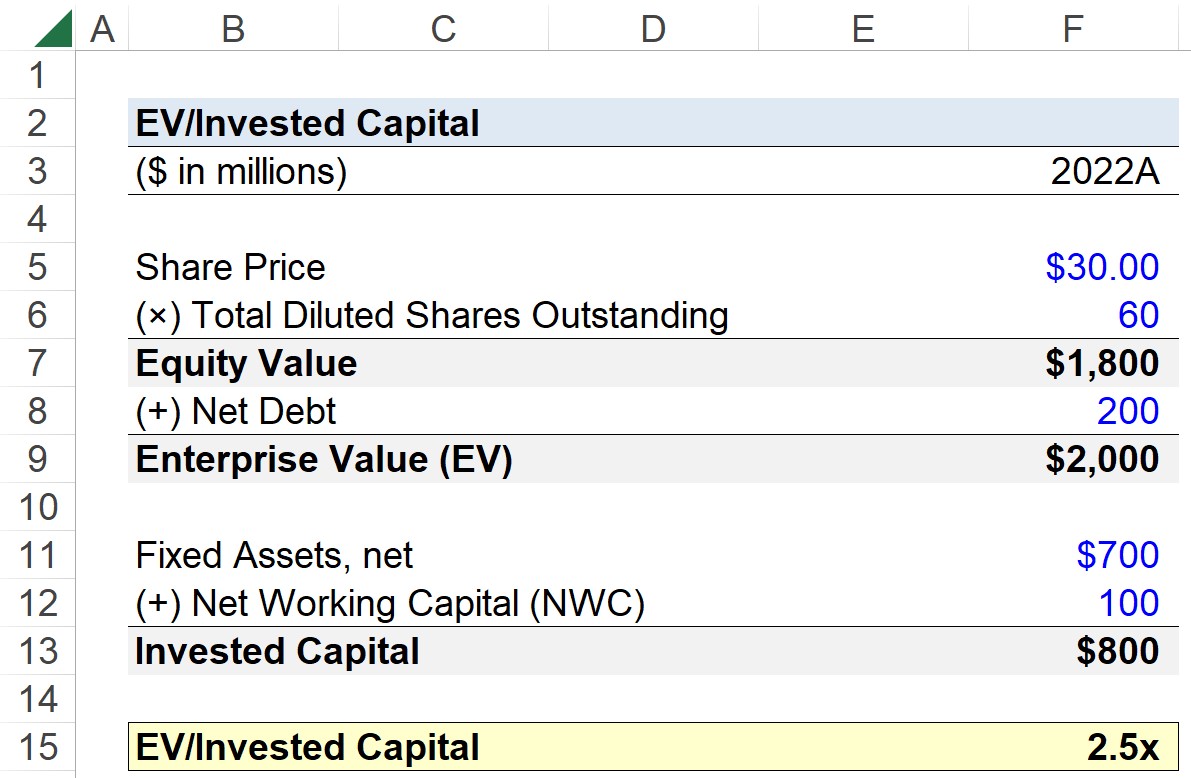
Suppose you’re tasked with calculating the EV/Invested Capital of a manufacturing company given the following assumptions.
The equity value of the manufacturer can be determined by multiplying the share price by its total diluted share count, which comes out to $1.8 billion.
Next, adding net debt to the company's equity value results in an enterprise value (EV) of $2 billion.
For our assumptions regarding invested capital, we'll assume the manufacturer has an outstanding fixed asset balance of $700 million and net working capital (NWC) of $100 million.
The sum of the two items is $800 million, which represents the invested capital portion of the calculation.
Upon dividing the manufacturer's enterprise value (EV) by its invested capital (IC), the resulting EV/invested capital multiple is 2.5x.
Learn how institutional investors identify high-potential undervalued stocks. Enrollment is open for the upcoming cohort.


No comments yet.