What is Sustainable Growth Rate?
The Sustainable Growth Rate (SGR) is the approximate rate at which a company could grow if its current capital structure – i.e. the mixture of debt and equity – is maintained.

The Sustainable Growth Rate (SGR) is the approximate rate at which a company could grow if its current capital structure – i.e. the mixture of debt and equity – is maintained.
The sustainable growth rate is a company’s growth rate that can continue under its current capital structure.
Conceptually, the sustainable growth rate represents the rate at which a company can maintain its growth without requiring additional financing from external sources.
The capital structure refers to how a company is funding its current growth (and future growth), i.e. the mixture of debt and equity to fund operations and asset purchases.
Most early-stage companies that are either unprofitable or barely profitable are self-funded until reaching the point where external financing becomes an absolute necessity, typically in the form of equity issuances.
Mature companies that are profitable and have more established market positions can opt to fund themselves from three sources:
The sustainable growth rate (SGR) can be a useful indicator of which stage of its life cycle a company is currently in. In general, the higher the sustainable growth rate (SGR), the greater its potential upside.
But greater potential returns cannot come without more downside risks, e.g. earnings volatility and default risk. If the sustainable growth rate (SGR) is adequate to management and investors, there is likely no reason to take on further leverage.
Once companies approach the later stages in their life cycle, maintaining a high SGR over the long run can be challenging, as the opportunities for expansion and growth eventually fade with time.
Plus, consumer demands continuously change, and new entrants will inevitably attempt to disrupt the market to steal market share from existing incumbents, resulting in higher capital expenditures (CapEx) and research & development (R&D).
The formula for calculating the sustainable growth rate (SGR) consists of three steps:
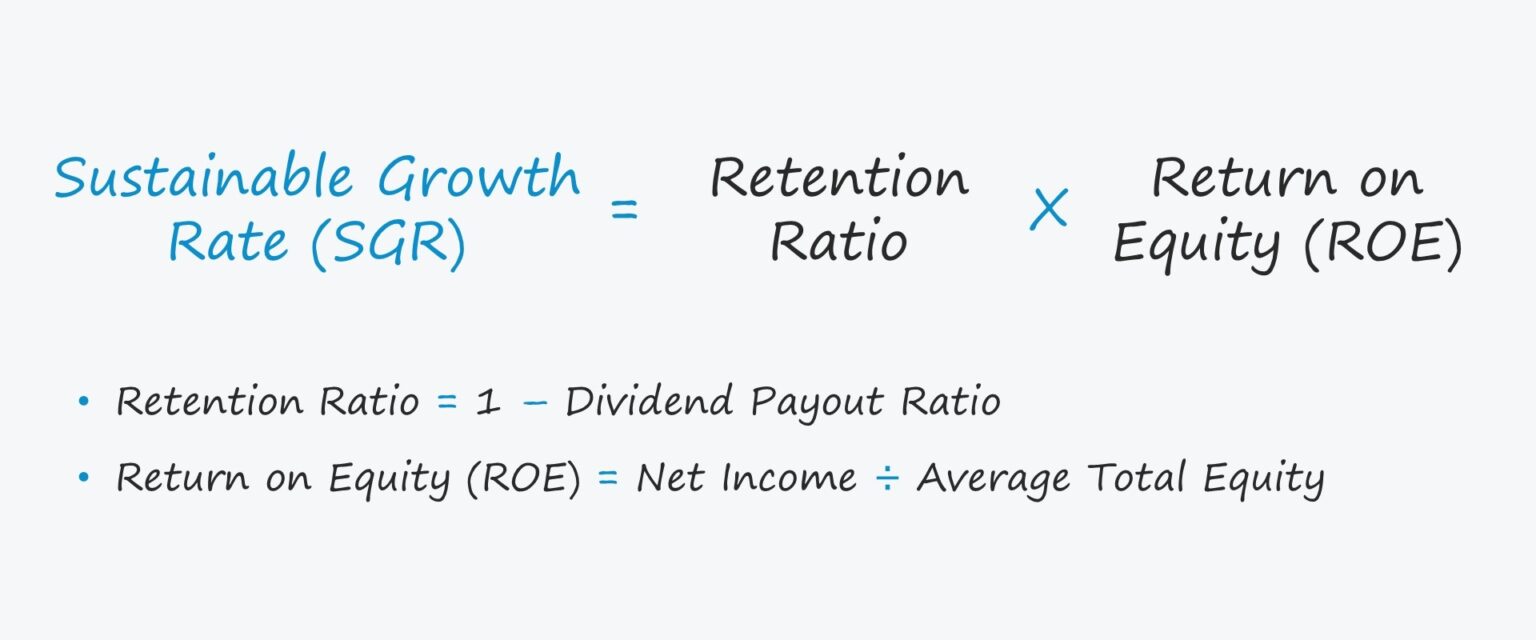
The formula to calculate the sustainable growth rate (SGR) is shown below.
Where:
The dividend payout ratio is the percentage of earnings per share (EPS) paid to shareholders as dividends – thus, if we subtract the percentage paid out as dividends from one, we are left with the retention ratio.
The retention ratio is the portion of net income that is retained, as opposed to being paid out as dividends to compensate shareholders.
The return on equity (ROE) measures a company’s profitability based on each dollar of equity investment contributed by its shareholder base.
For example, if a company has a return on equity (ROE) of 10% and a dividend payout ratio of 20%, the sustainable growth rate is 8%.
Here, the company can grow at 8% per year if the capital structure is left unadjusted by management and operations remain consistent with historical performance.
We’ll now move to a modeling exercise, which you can access by filling out the form below.


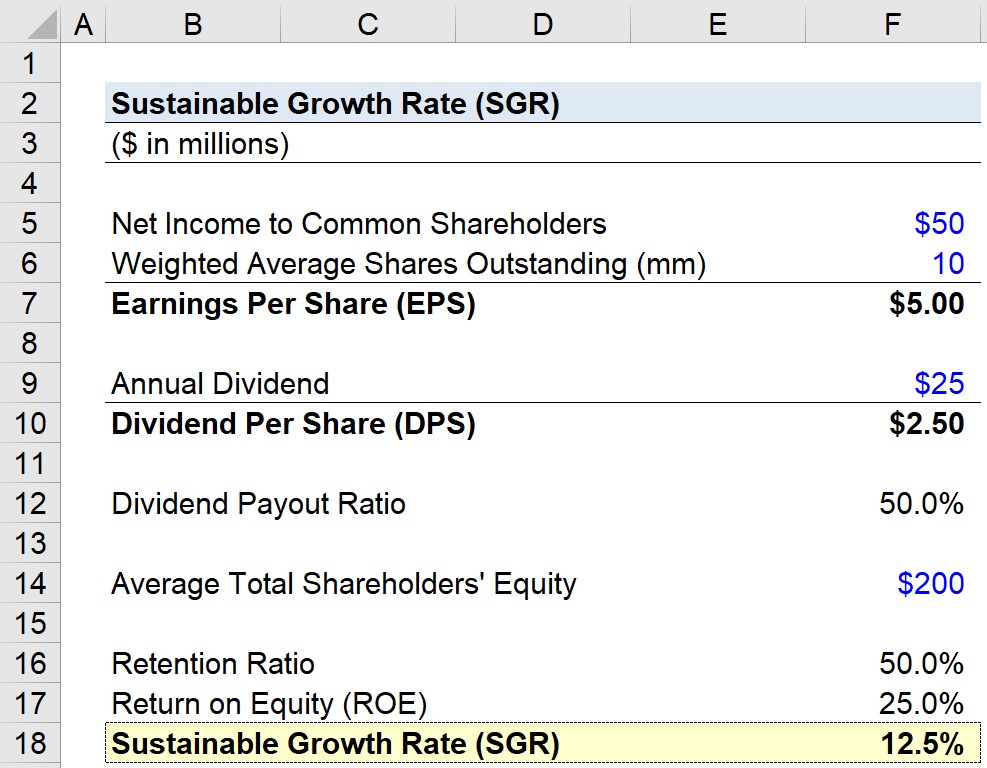
Suppose a company has the following financials.
The earnings per share (EPS) and dividend per share (DPS) can be calculated using those assumptions.
Side Note: The reason we're using "Net Income to Common Shareholders" rather than just "Net Income" is that the net income attributable to preferred stockholders should not be included (e.g. preferred dividends).
Next, the retention ratio can be calculated by subtracting the payout ratio from one:
Considering that high payout ratios are often signs of a highly profitable company with a stable outlook, it is safe to assume that our company is relatively mature.
Moving on, we’ll calculate the return on equity (ROE) next by dividing net income by the average shareholder’s equity, which we’ll assume to be $200 million.
Finally, the sustainable growth rate (SGR) can be calculated by multiplying the retention ratio by the ROE.
Learn how institutional investors identify high-potential undervalued stocks. Enrollment is open for the upcoming cohort.


No comments yet.