What is Porter’s 5 Forces Model?
Porter’s 5 Forces Model provides a structured framework for industry analysis and the competitive dynamics impacting an industry’s profitability.

Porter’s 5 Forces Model provides a structured framework for industry analysis and the competitive dynamics impacting an industry’s profitability.
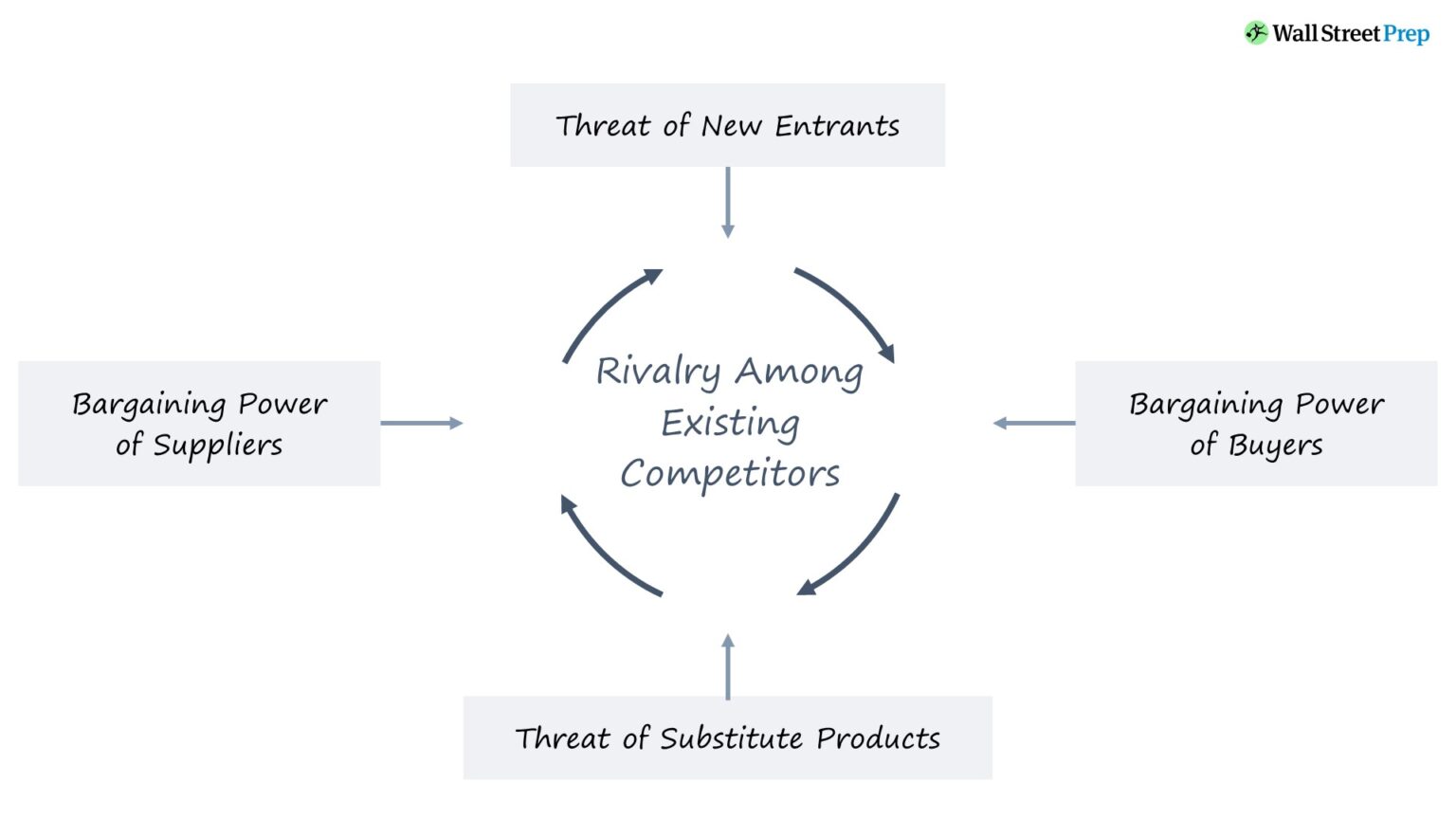
The originator of the 5 Forces Model is Michael Porter, a Harvard Business School (HBS) professor whose theories remain instrumental to business strategy even today.
Porter’s 5 forces model framework is utilized for strategic industry analysis, and focuses on the following:
Competitive industry structures can be analyzed utilizing Porter’s five forces model, as each factor influences the profit potential within the industry.
Moreover, for companies that are considering whether to enter a particular industry, a five forces analysis can help determine whether the profit opportunity exists.
If there are substantial risks making the industry unattractive from a profitability perspective and negative industry trends (i.e. “headwinds”), it may be better for the company to forgo entering a given new industry.
“Understanding the competitive forces, and their underlying causes, reveals the roots of an industry’s current profitability while providing a framework for anticipating and influencing competition (and profitability) over time."
– Michael Porter
The premise of the 5 forces model is that for a company to obtain a sustainable, long-term competitive advantage, i.e. "moat", the profitability potential within the industry must be identified.
However, identification is not sufficient, as it must be followed up with the right decisions to capitalize on the proper growth and margin expansion opportunities.
By analyzing the prevailing competitive environment, a company can objectively recognize where it currently stands within an industry, which can help shape corporate strategy going forward.
Certain companies will identify their competitive advantages and attempt to extract as much value as possible from them, whereas other companies might focus more on their weaknesses – and neither approach is right or wrong as it depends on each company's particular circumstances.
Learn how institutional investors identify high-potential undervalued stocks. Enrollment is open for the upcoming cohort.
Industries constantly undergo disruption or are prone to it, especially given the modern pace of technological growth.
Seemingly every year, new features or updates to existing technology are introduced to the market with claims of more efficiency and improved capabilities to accomplish difficult tasks.
No company is entirely protected from the threat of disruption, but differentiation from the market provides more control to the company.
Hence, many of the market leaders nowadays allocate a significant amount of capital each year into research and development (R&D), which makes it more challenging for others to compete while protecting themselves from being blindsided by new breakthrough technologies or trends.
Potential barriers to entry include:
On the topic of the bargaining power of buyers, the first question to ask is if the company is:
In general, commercial customers (i.e. SMBs, enterprises) are more likely to have more bargaining power due to having more spending power, whereas everyday consumers typically have far less money to spend.
However, the universe of commercial clients is limited compared to that of consumers.
For reputable buyers with significant purchase volumes or order sizes, suppliers tend to be willing to accept lower offer prices to retain the customer.
By contrast, if a B2C company with millions of individual customers were to lose a single customer, the company would likely not even notice.
The bargaining power of suppliers stems from selling raw materials and products that other suppliers do not carry (i.e. more scarcity results in greater value).
If the items provided by the supplier constitute a significant proportion of the product as sold by the buyer, the bargaining power of the supplier directly increases, as the supplier is a major component of the buyer’s operations.
On the other hand, if the suppliers for a certain product are not differentiated, the competition will be more heavily based around pricing (i.e. a “race to the bottom” – which benefits the buyers, not the sellers).
Often, products or services can have substitutes that make them more vulnerable, as customers in these instances have more optionality.
More specifically, if a certain condition is met – e.g. an economic downturn – customers could opt for cheaper products despite lower quality and/or lower-tier branding.
The degree of rivalry within an industry is a direct function of two factors:
The two are closely linked, as the greater the revenue opportunity, the more companies will enter the industry to grab a piece of the pie.
Furthermore, if the industry is growing, there are likely going to be more competitors (and vice versa for stagnant or negative growth industries).


No comments yet.