What is SWOT Analysis?
The SWOT Analysis is a framework for evaluating a company’s competitive positioning, typically completed for purposes of internal strategic planning.

The SWOT Analysis is a framework for evaluating a company’s competitive positioning, typically completed for purposes of internal strategic planning.
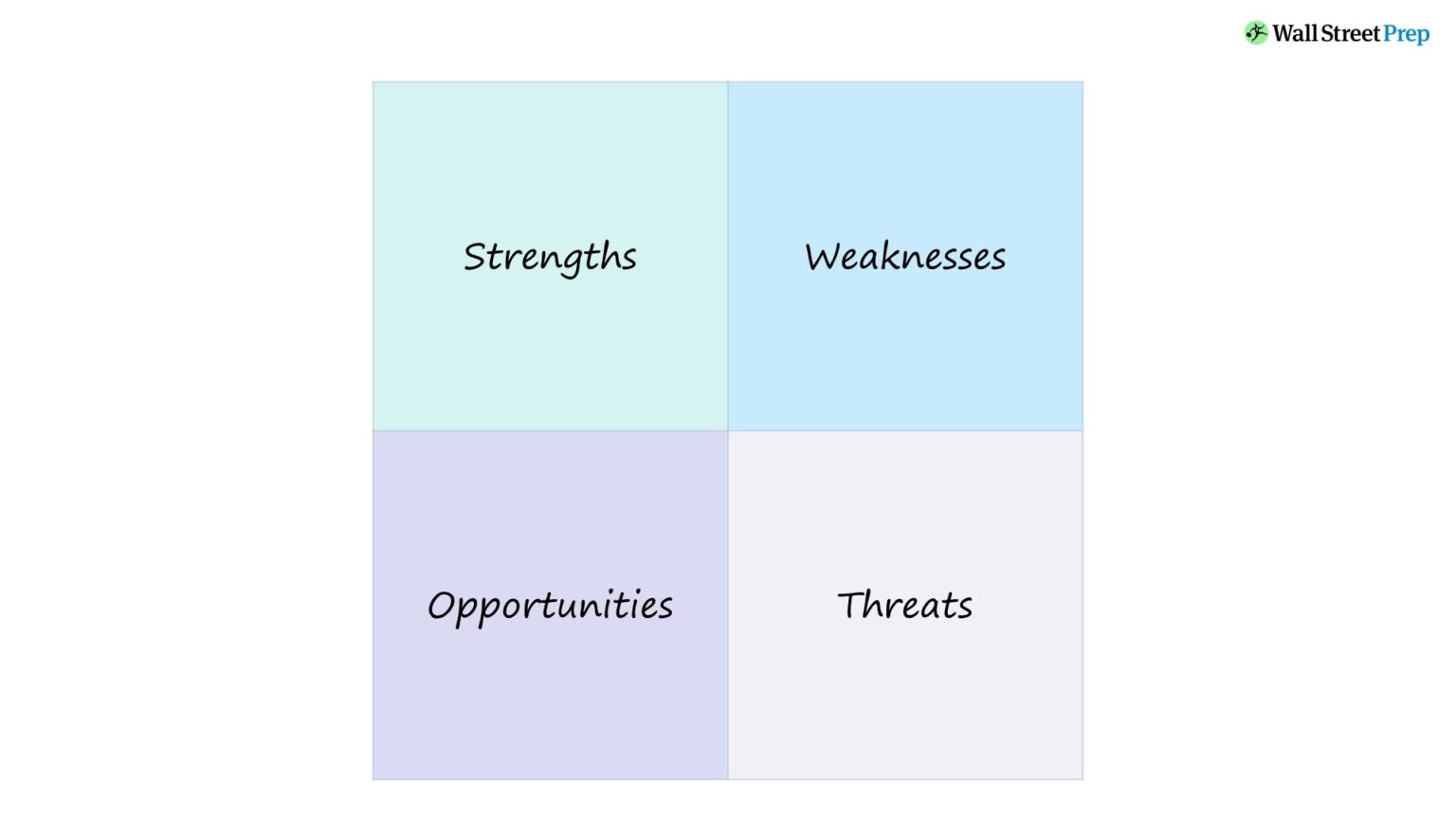
SWOT stands for Strengths, Weaknesses, Opportunities, and Threats.
Simply put, a SWOT analysis is performed to determine the internal and external factors contributing to a company’s relative competitive advantage (or disadvantage).
SWOT analysis is presented in the form of a square, which is segmented into four distinct quadrants – with each quadrant representing a factor that measures:
The visual arrangement of the four quadrants helps facilitate simple, structured assessments of companies.
The type of diligence conducted by practitioners in front-office roles in corporate finance such as investment banking and private equity often overlaps with the concepts found in a SWOT analysis.
However, a pitch book or client deliverable with a slide explicitly titled “SWOT Analysis” is a rare sight (and is not recommended).
SWOT analysis is taught in the academic setting and is meant to influence the internal mental models and general thought processes used for assessing companies.
Therefore, even if you find the SWOT analysis framework useful, it is best to come up with your own process of evaluating companies (and investment opportunities).
Learn how institutional investors identify high-potential undervalued stocks. Enrollment is open for the upcoming cohort.
The SWOT analysis structure is split between internal and external factors:
Internal factors can be improved upon, whereas external factors are largely out of the direct control of the company.
Strengths pertaining to a SWOT analysis refer to the positive attributes of a company and the initiatives that perform particularly well, which allows the company to distinguish itself from the rest of the market.
By contrast, weaknesses are the aspects of a company that detract from its value and place it at a competitive disadvantage relative to the market.
To compete with market leaders, the company must improve upon these areas to decrease the odds of losing market share or falling behind.
Opportunities refer to the external areas to allocate capital that represents potential profits for the company if properly capitalized upon.
Threats are the negative, external factors that are beyond the control of a company, yet could disrupt the current strategy or put the future of the company itself at risk.


No comments yet.