What are Network Effects?
Network Effects refer to the incremental benefits gained from new users joining the platform, which results in the product becoming more valuable for all users.

Network Effects refer to the incremental benefits gained from new users joining the platform, which results in the product becoming more valuable for all users.
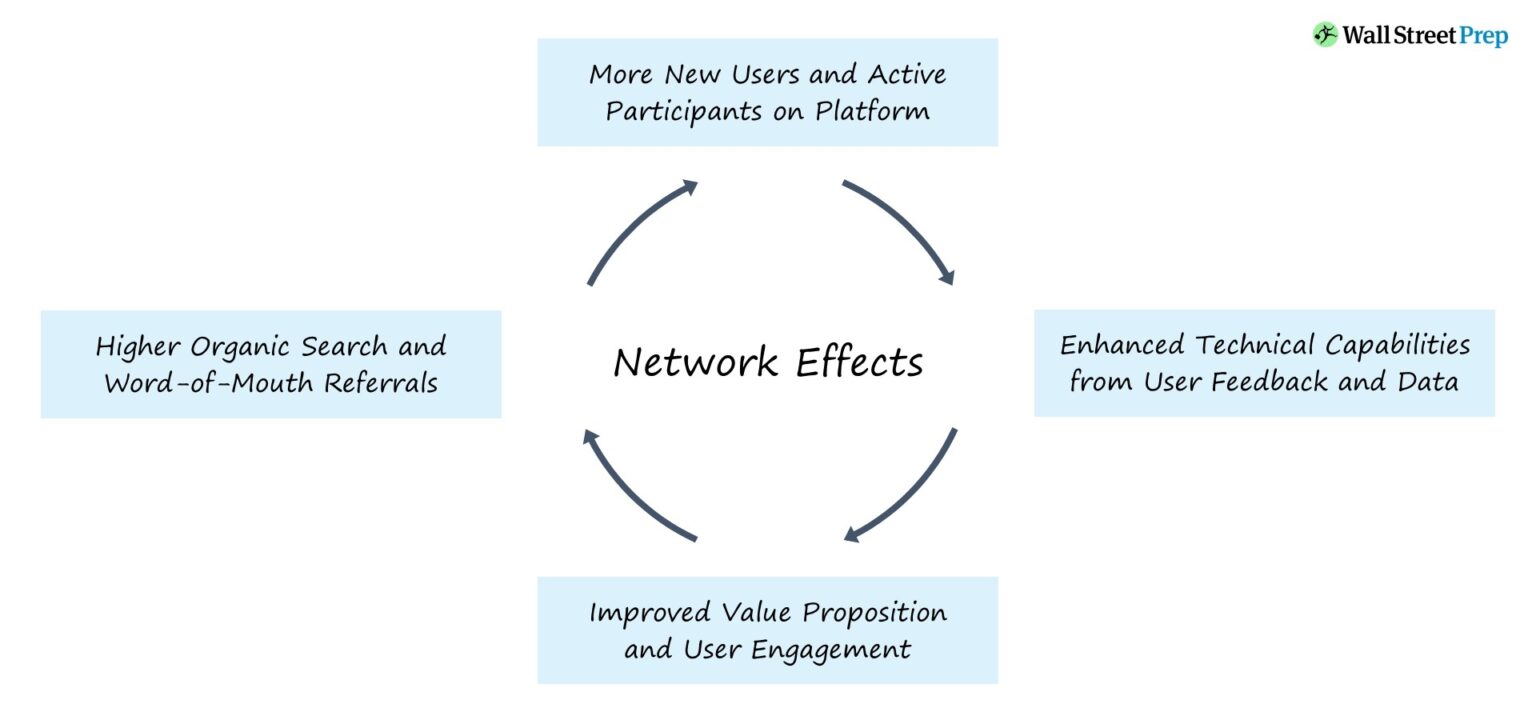
Network effects describe the phenomenon in which the value of a product improves for all users as more users join a platform, even for the existing user base.
The concept of network effects is particularly important in the digital age, given continued technological disruption amid rapid globalization.
The core premise of network effects is that each new user improves the value of a product/service for both new and existing users alike.
Specifically, companies pay attention to network effects because of the possibility of establishing barriers to entry (i.e. “moats”) that can protect their long-term profit margins from competitors.
Companies with network effects observe that more product usage is beneficial for their entire user base. However, “usage” refers to customers that actively use a product or participate on the platform.
Therefore, the impact of network effects is contingent on the total number of potential buyers and sellers in the market and how much the company can leverage its user base.
In particular, there are two different types of network effects: Direct Network Effects and Indirect Network Effects.
To elaborate on the latter type of network effects, suppose a new customer joins Grubhub to order food delivery.
The incremental value to other users (and most drivers) is near zero in theory. Yet, drivers within the same location, i.e. one subgroup of existing or potential future drivers, could someday benefit from that user joining as they can service the new user.
Another example of indirect network effects would be upselling/cross-selling of software tools (e.g. Microsoft 365, G Suite), as the positive benefits emerge later on from a different product, after an upgrade, or from the collaboration between the tools.
Two-sided network effects occur when more product usage by one distinct group of users increases the value of a complementary offering to a different set of users (and vice versa).
The value creation can stem from various sources, with some causes of network effects being the following examples:
Learn how institutional investors identify high-potential undervalued stocks. Enrollment is open for the upcoming cohort.
Most, if not all, of the leading technology companies and startups nowadays benefit from network effects.
The pattern from these companies and their products is that positive feedback loops form the basis of their network effects.
For example, Google’s search engine platform is one of the best examples of a durable moat created by network effects, as far more accurate search results are provided because of more user data collection.
Google’s search capabilities benefit not only the core search engine but also all product offerings (e.g. YouTube, Google Maps) within its portfolio of offerings, as well as on the advertising side.
Hence, Google has consistently retained 90%+ of the global search engine market share.

Global Search Engine Market Share (Source: StatCounter)
Metcalfe's Law is frequently brought up when discussing the phenomenon, as it states that the value of a network grows in proportion to the square of the number of users within the network.
The theory originally emerged from telecommunications networks, as Robert Metcalfe (Ethernet, 3Com) attempted to explain the cause of non-linear exponential growth.
In the best-case scenario, a company can capitalize on a network effect once connectivity is established, i.e. the network appears to market itself as organic user growth continues to climb upward.
However, one distinction is that growth by itself is not always a sign of network effects – instead, user engagement and retention are just as important (i.e. growth merely sets the effects into motion).
Generally speaking, the more users and sellers there are, the greater the network effects are (and the value offered to all sides).
In contrast, a “negative network effect” is when a platform's value declines after growth in usage or scale.
For instance, an overwhelming number of users could lead to network congestion, i.e. a noticeable drop-off in product quality and customer service.
In the case of negative network effects, the capacity of the platform is unable to handle the volume of active users to deliver its products or services at optimal quality.
For platforms in the sharing (or “gig”) economy like Uber and Lyft to attain exponential growth, asset purchases and spending more on marketing are not sufficient.
But rather, acquiring more users is the only real pathway to achieving scale and eventual profitability – especially within highly competitive markets with significant burn rates.
Once user traction takes off, ideally, new customer acquisitions can be practically nothing for platform companies, typically due to word-of-mouth marketing among users.
For example, after Uber and Lyft built out the user interface and app development – i.e. incurred substantial costs, largely funded by venture capital (VC) and growth equity – the marginal costs related to distribution diminished with increased scale.
More drivers do not necessarily improve the user experience, but demand does attract more drivers to submit applications, which indirectly improves ride quality for all users.
The five stages of Uber's outlined network effect cycle are as follows:
For both Uber and Lyft, if there were not enough supply (i.e. the drivers) to match the demand (i.e. the riders), both companies would have failed.
Both appear to have moved past the near-term risks and the major hurdle of establishing strong network effects, which continues to serve as a competitive edge to this day, especially with their other divisions (i.e. UberEats) now generating revenue.
Uber Liquidity Network Effect
"Our strategy is to create the largest network in each market so that we can have the greatest liquidity network effect, which we believe leads to a margin advantage."
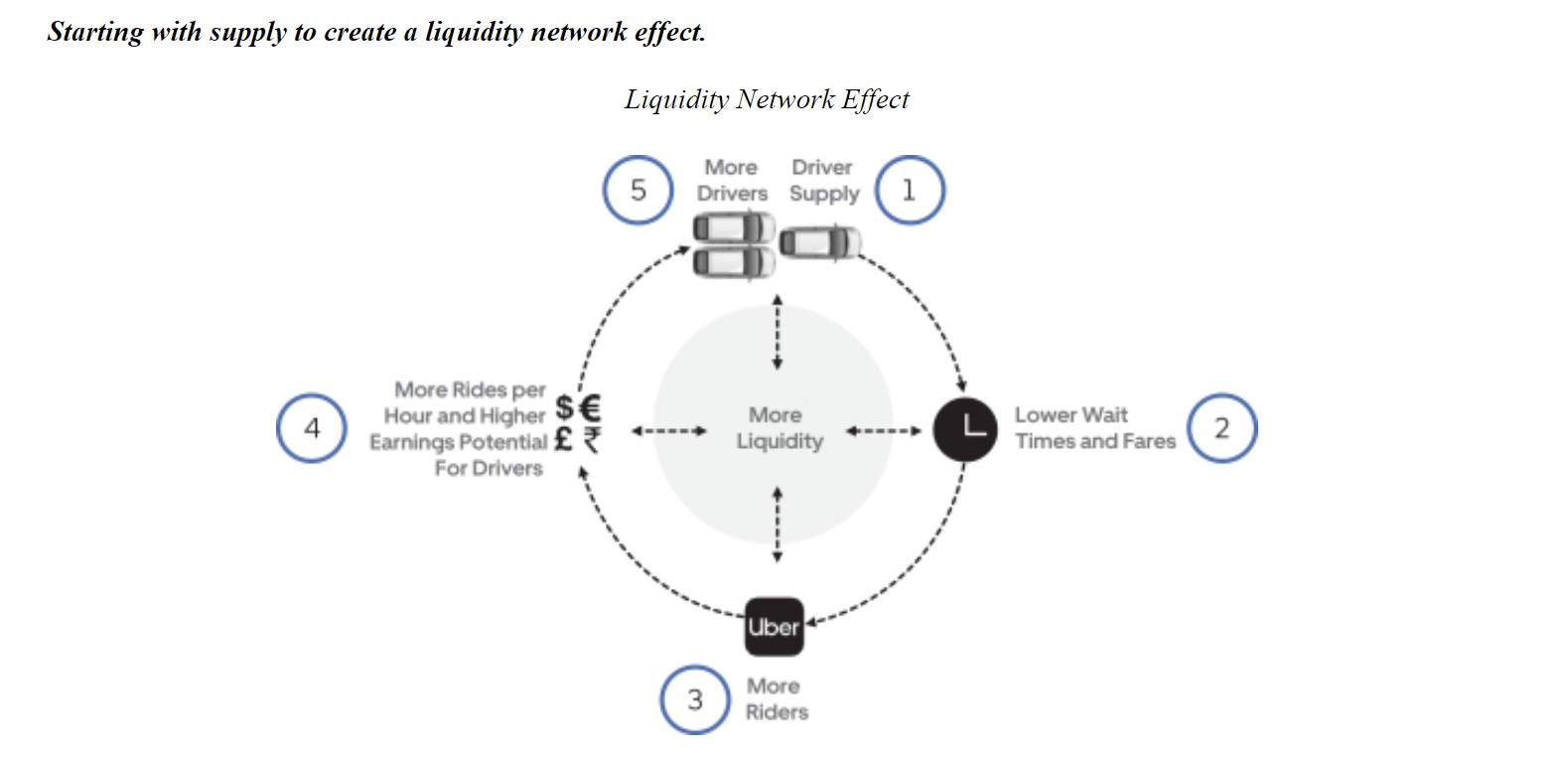
Uber Network Effect (Source: S-1)


No comments yet.