How to Achieve Organic Growth in Business
The premise of organic growth is the optimization of a company's business model from the collective efforts of the management team and their employees.
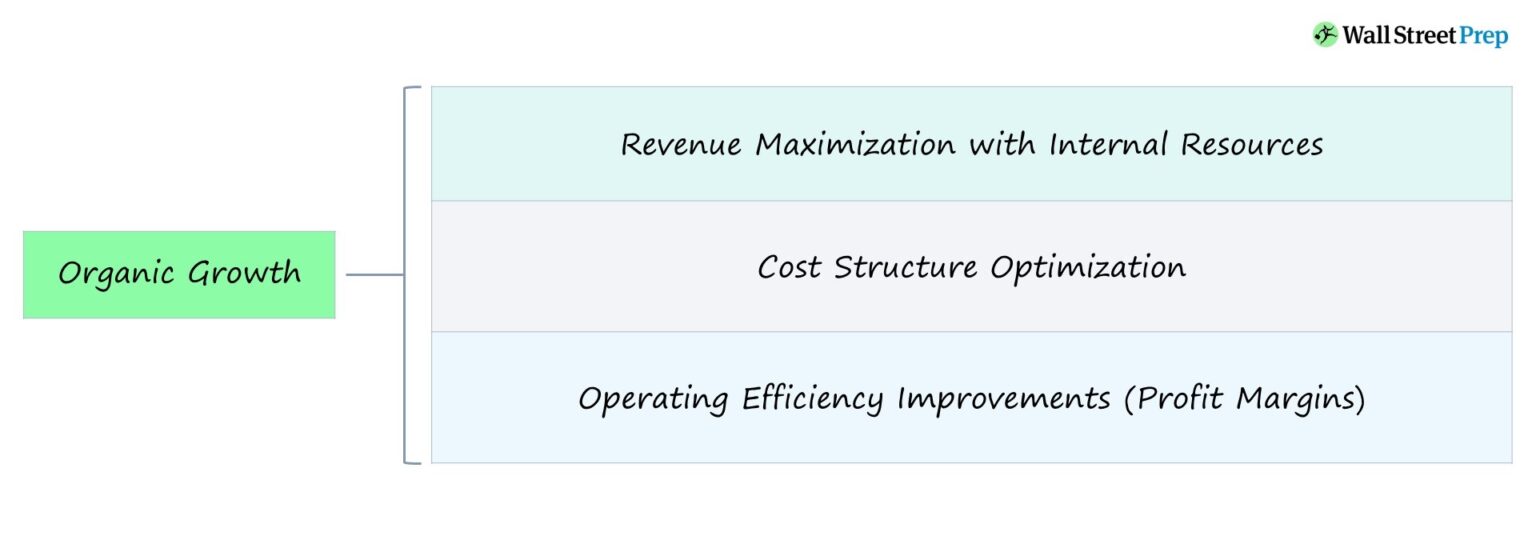
Generally, most strategies that fall under this category are oriented around the maximization of a company's current revenue trajectory, cost structure optimization, and operational improvements to increase profit margins.
- Revenue Maximization
- Cost Structure Optimization
- Operating Efficiency Improvements
The primary appeal is that management can control the process more closely and plan the strategies using a “hands-on” approach internally – albeit, all business plans must remain flexible, given unanticipated changes to prevailing market conditions.
Management possesses more control over the business model and can implement changes appropriately using their own judgment. Therefore, it is important to have a reliable leadership team to properly delegate tasks and put the business plan into action.
Organic Growth vs. Inorganic Growth: What is the Difference?
Usually, a business turns to inorganic growth strategies (M&A) once its organic growth opportunities have been depleted.
Companies undertake two approaches to achieve growth:
- Organic Growth
- Inorganic Growth
Inorganic growth arises from activities related to mergers and acquisitions (M&A), rather than growth from internal improvements to existing operations. The drawback to organic growth, however, is that the process can be slow, and the upside can be limited (i.e. "capped").
In comparison, inorganic growth is often perceived as the route a company pursues once it is in the later stages of its life cycle, and the potential opportunities to drive future organic growth have diminished, i.e. inorganic growth comes once organic growth is no longer attainable, at least in theory.
But in reality, the competitive nature of certain markets – particularly those oriented around technical capabilities – has caused M&A to be used as a defensive tactic to obtain an edge in terms of intellectual property (IP) and patents, even if the acquirer's organic growth outlook is still positive.
Inorganic growth is frequently considered to be a quicker and more convenient approach to increasing revenue, while organic growth can be time-consuming (and challenging) to achieve.
After the completion of an acquisition (or merger), the combined company can benefit from synergies – either revenue or cost synergies – such as greater access to potential new customers (and end markets), upselling or cross-selling products, creating complementary product bundles, improved per unit margins from economies of scale, and revenue diversification.
However, reliance on M&A for growth is easier said than done because of the difficulty to realize expected synergies, particularly revenue synergies.
In fact, M&A can easily backfire, as improper integration can be costly and disruptive to the core operations of all participants.



No comments yet.