What is Quality of Earnings Ratio?
The Quality of Earnings Ratio (QoE) is a profitability ratio that can determine the reliability of a company’s reported net income.

The Quality of Earnings Ratio (QoE) is a profitability ratio that can determine the reliability of a company’s reported net income.
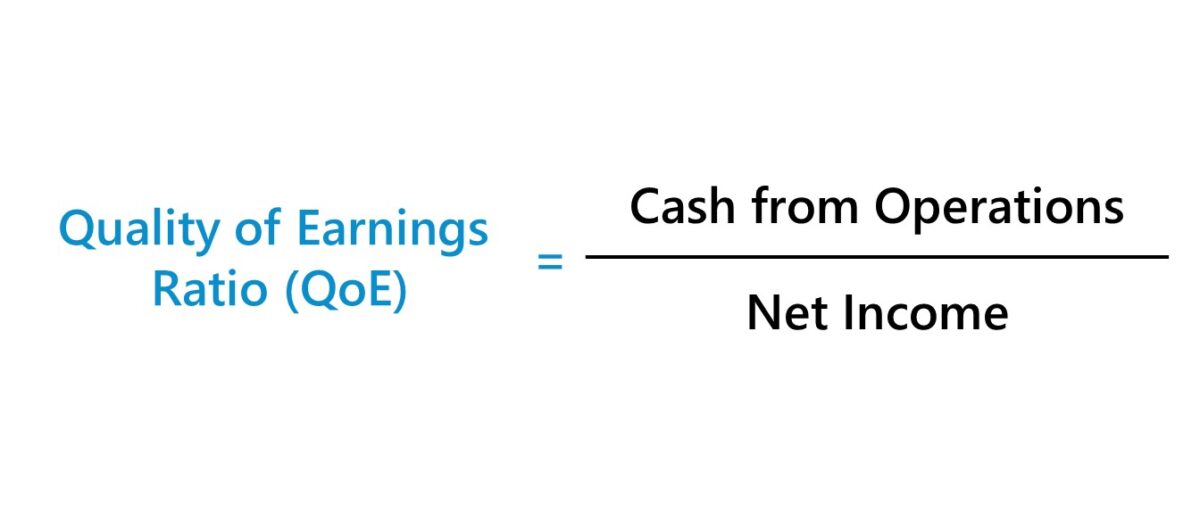
The quality of earnings ratio, or “QoE ratio”, is utilized to measure how reliable a company's reported net income is by comparing it to its cash from operations.
The reporting guidelines set under U.S. GAAP represent the standardized methodology by which public companies located in the U.S. must abide. However, accrual accounting remains an imperfect system that is still prone to earnings manipulation, wherein a company's net income can be misleading to the true state of its profitability.
For instance, the accrual-based net income can be misconstrued by the following accounting adjustments:
The net income of a company can be artificially inflated via deceitful tactics by management intentionally, or it can also stem from accounting conventions that reflect the shortcomings of accrual accounting, rather than a deliberate attempt by management to mislead investors.
The premise of quality of earnings (QoE) reports, which are prepared by independent accountants and auditors, is that not all earnings are equal, i.e. earnings are not equal to cash flow.
Therefore, financial metrics such as the QoE ratio are used to ensure the reported net income can in fact be relied upon to evaluate the historical performance of a company, which can form the basis of a forecast model (and its implied valuation).
In practice, determining the earnings quality of a company is a time-consuming process in which detailed analysis and various techniques are necessary to truly grasp the quality of a company's earnings profile.
Such a task is most often outsourced to an accounting firm that specializes in performing detailed diligence on a company's earnings, but there are several “quick and dirty” approaches to estimating a company's earnings quality.
The formula to calculate the quality of earnings ratio (QoE) is as follows.
The general rules for interpreting the quality of earnings (QoE) ratio are the following:
The practicality of the quality of earnings ratio (QoE) is that a company's net income recorded per accrual accounting standards is separated from non-operating items that are not part of a company's core business activities or related to accounting conventions.
A higher QoE ratio—i.e. cash from operations exceeds net income—implies that the company's reported earnings are more reliable and not distorted by earnings manipulation.
In contrast, a lower QoE ratio indicates that the company's cash from operations is less than its net income, meaning that more of the reported earnings are attributable to accounting adjustments, which is often a red flag with regard to corporate governance and internal policies.
Since the earnings are of higher quality, the result is a more dependable forecast model.
We’ll now move on to a modeling exercise, which you can access by filling out the form below.


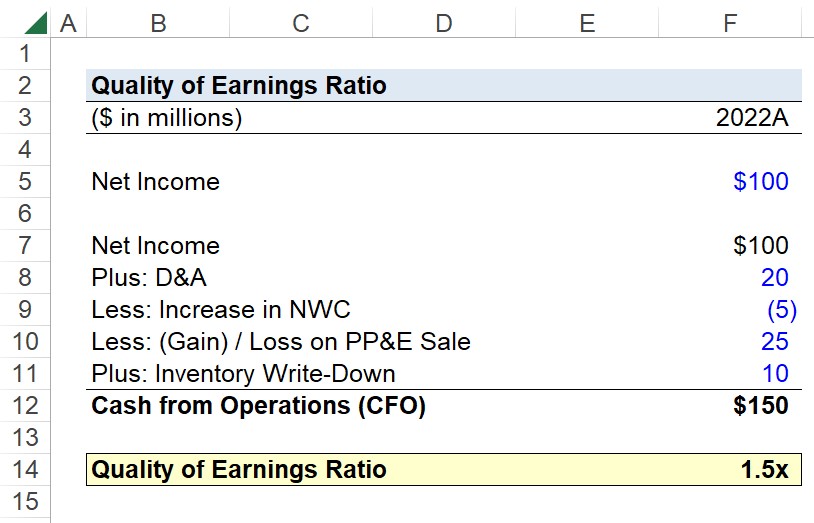
Suppose you're tasked with calculating the quality of earnings ratio (QoE) of a company given the following set of financial assumptions for the fiscal year ending 2022.
2022 Financial Data
Since net income—the denominator in the calculation of our ratio—is provided, the only remaining steps are to reconcile net income to determine the company's cash from operations.
Depreciation and amortization expense (D&A) is a non-cash expense, so the $20 million recorded on the income statement must be treated as an add-back since no actual movement of cash occurred.
From there, we'll subtract the increase in net working capital of $5 million. An increase in net working capital (NWC) is an outflow of cash (i.e. “use”), whereas a decrease in net working capital (NWC) is an inflow of cash (i.e. “source”).
The next two adjustments are a $25 million loss on a PP&E sale and a $10 million inventory write-down.
In neither scenario, however, does the company actually incur a loss of cash in the current period. Thus, the loss on the PP&E sale and inventory write-down reduced the company's net income on the income statement, but both items are treated as non-cash adjustments in our CFO calculation.
Once we enter our inputs into the formula from earlier, we arrive at a quality of earnings ratio of 1.5x for our hypothetical company, which implies the company's actual earnings are understated (and of higher quality) relative to the net income recorded on its income statement.
Learn how institutional investors identify high-potential undervalued stocks. Enrollment is open for the upcoming cohort.


No comments yet.