What is Degree of Financial Leverage?
Degree of Financial Leverage (DFL) quantifies the sensitivity of a company’s net income (or EPS) to changes in its operating profit (EBIT) attributable to debt financing.

Degree of Financial Leverage (DFL) quantifies the sensitivity of a company’s net income (or EPS) to changes in its operating profit (EBIT) attributable to debt financing.

The degree of financial leverage (DFL) is a financial metric that measures the sensitivity of the net income (or earnings per share, EPS) of a company to fluctuations in its operating income (EBIT) as caused by reliance on debt financing, or “leverage”.
Financial leverage refers to the costs of financing — e.g. interest expense — funding a company’s reinvestment needs like working capital and capital expenditures (Capex).
Companies can finance the purchase of assets using two sources of capital:
Debt financing comes with fixed financial costs – i.e. periodic interest expense obligations and principal amortization – that must be fulfilled, regardless of a company’s performance in a given period.
The higher the degree of financial leverage (DFL), the more volatile a company’s net income (or EPS) will be — all else being equal.
Like operating leverage, financial leverage amplifies the potential returns from positive growth, as well as the losses from declining growth.
The degree of financial leverage (DFL) is a measure of financial risk, i.e. the potential losses from the presence of leverage in a company’s capital structure.
DFL is used to understand the relationship between two variables:
The degree of financial leverage (DFL) refers to the sensitivity of a company’s net income — i.e. the cash flows available to equity shareholders — if its operating income were to change.
The formula for the degree of financial leverage compares the % change in net income (or earnings per share, “EPS”) relative to the % change in operating income (EBIT).
Alternatively, DFL can be calculated using earnings per share (EPS) rather than net income.
For example, assuming that a company’s DFL is 2.0x, a 10% increase in EBIT should result in a 20% rise in net income.
A more in-depth process of calculating the degree of financial leverage (DFL) comprises the following five steps.
If we combine those steps into a formula, we are left with the following for the formula to calculate the degree of financial leverage (DFL).
Where:
We’ll now move to a modeling exercise, which you can access by filling out the form below.


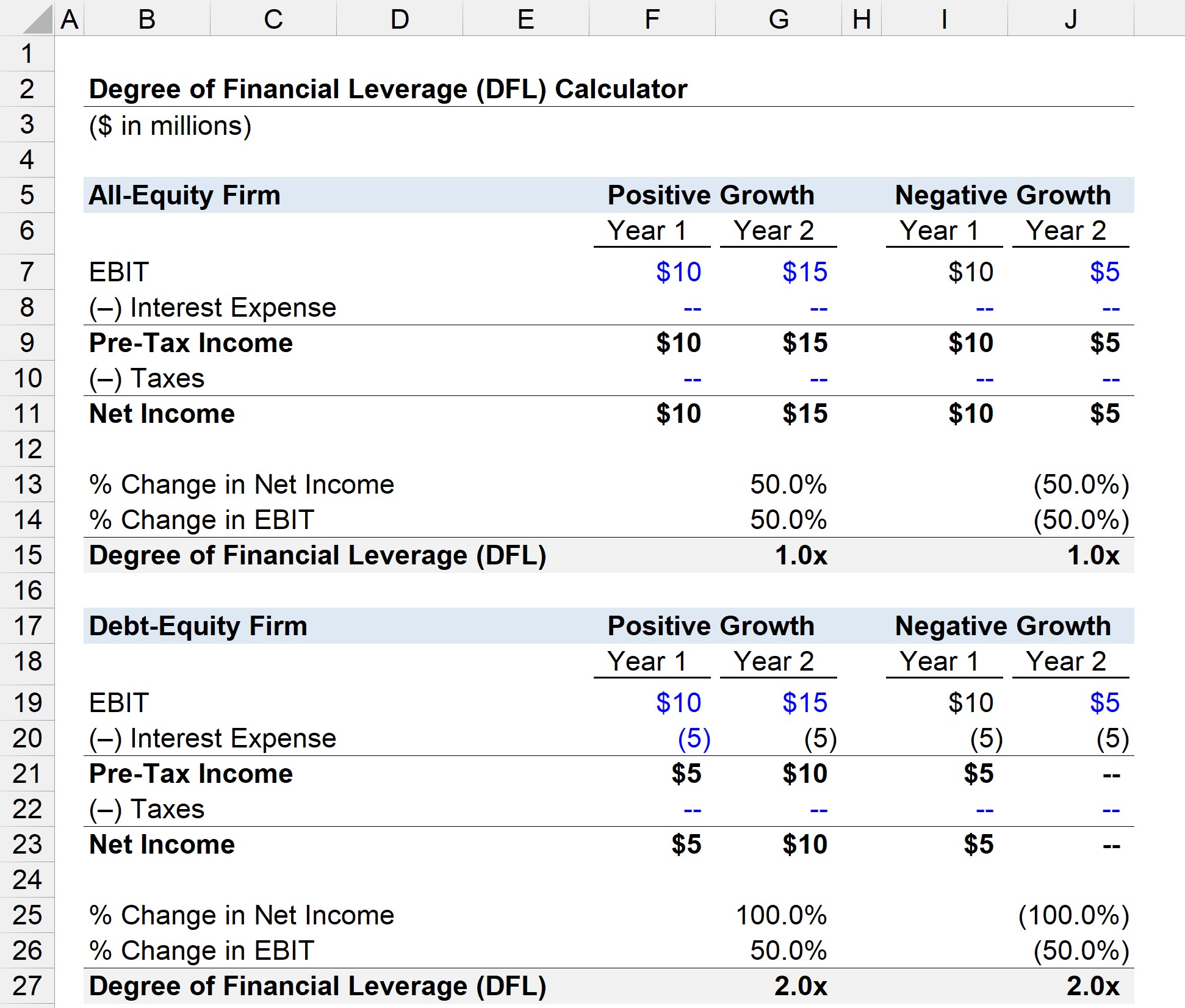
Suppose we have two virtually identical companies with just one exception — one is an all-equity firm whereas the other company has a capital structure with a mixture of debt and equity.
In Year 1, the two companies both brought in $10 million in operating income (EBIT).
As for Year 2, we’ll assess the degree of financial leverage under two cases.
That being said, the Year 2 EBIT values are as follows.
The next step is to calculate the pre-tax income, which requires deducting the annual interest expense.
For the all-equity firm, the pre-tax income is equal to EBIT because there is no debt in the company’s capital structure.
But for the debt-equity firm, the interest expense is equal to the $50 million in debt multiplied by the 10% interest rate, which comes out to $5 million.
The $5 million interest expense can be extended across the two-year periods in both scenarios, as interest is a “fixed” cost, i.e. whether the company performs well or underperforms, the interest due remains unchanged.
The final line item to deduct from pre-tax income before reaching net income is taxes, which we'll assume is equal to zero for the sake of isolating the impact of leverage.
After that, we’ll calculate the % change in net income and % change in EBIT — the two inputs in our DFL formula — for all four sections.
If we divide the % change in net income by the % change in EBIT, we can calculate the degree of financial leverage (DFL).
All-Equity Firm
Debt-Equity Firm
From our illustrative example, we can see when a company exhibits positive growth in EBIT, debt financing contributes towards greater net income growth (1.0x vs. 2.0x).
However, the same impact on our hypothetical company's degree of financial leverage (DFL) is seen under negative growth, just in the opposite direction (i.e. the leverage causes greater losses).
Therefore, companies must be cautious when adding debt into their capital structure, as both the favorable and unfavorable effects are magnified.

Enroll in The Premium Package: Learn Financial Statement Modeling, DCF, M&A, LBO and Comps. The same training program used at top investment banks.


No comments yet.