What is Default Risk Premium?
The Default Risk Premium (DRP) measures the incremental return that investors require as compensation for undertaking the risk of holding a risky security, such as a corporate bond.

The Default Risk Premium (DRP) measures the incremental return that investors require as compensation for undertaking the risk of holding a risky security, such as a corporate bond.
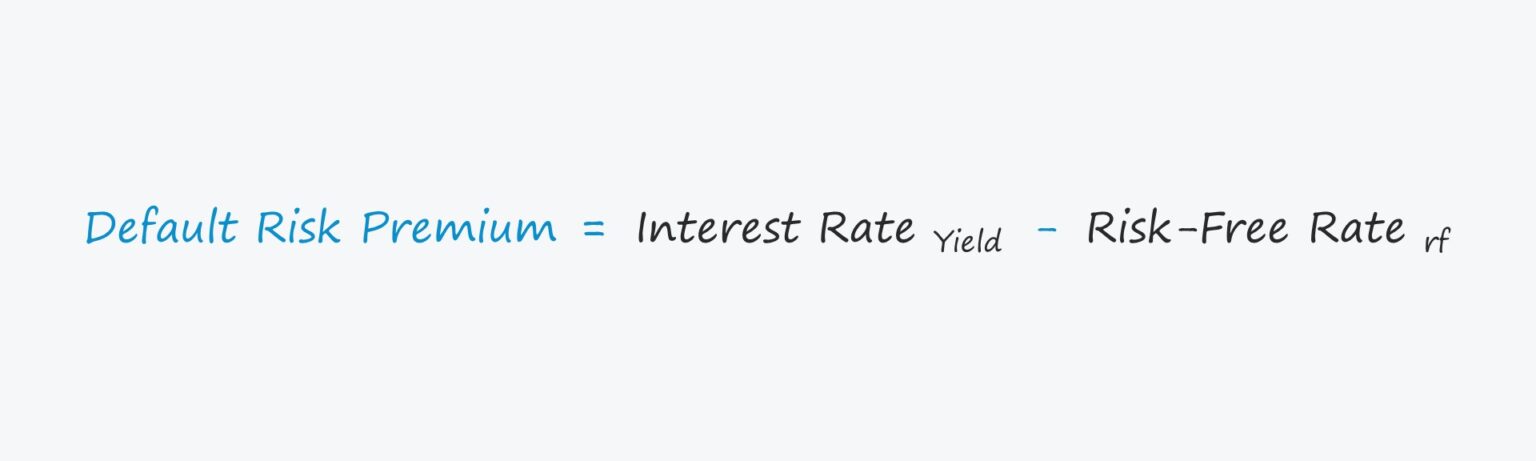
The default risk premium (DRP) represents the compensation that investors demand for bearing the risk that a given security might default.
Default risk is a major component of credit risk that captures the likelihood of a company failing to make timely payments on its financial obligations, namely:
The default risk premium (DRP) refers to the incremental return required by lenders in exchange for assuming more risk by providing debt capital to a specific borrower.
The inclusion of the default risk premium in lending is to provide more compensation for a lender in proportion to the additional assumed risk.
Simply put, the default risk premium is defined as the difference between the interest rate pricing on a debt instrument (e.g. loan, bond) and the risk-free interest rate.
Therefore, one method for lenders to earn greater yields by providing capital to borrowers with higher risk profiles (i.e. chance of default) is by demanding higher interest rates.
The default risk premium (DRP) calculation requires two inputs:
The formula for estimating the default risk premium is as follows.
The interest rate charged by the lender, i.e. the yield received by providing the debt capital, is subtracted by the risk-free rate (rf), resulting in the implied default risk premium, i.e. the excess yield over the risk-free rate.
For example, if the yield on a corporate bond is 6.0% while a comparable U.S. Treasury bond is yielding 3.0%, the default risk premium is 3.0%
However, please note the formula described above is a simplified variation meant to help conceptualize how the risk of default is priced into the interest rate by lenders.
In reality, there are far more variables at play that can determine the interest rate charged than the risk of default.
There are often country-specific risks and industry-specific risks like regulations that can impact the default risk of a company.
All forms of investing, whether it be in equity or debt securities, come down to a trade-off between risk and return.
That said, if there is more risk taken on by the investor, there must be more returns in exchange.
Conceptually, the default risk premium captures the perceived risk that a borrower might be unable to fulfill its obligation to meet required debt payments (e.g. interest expense) in a timely manner, or fail to repay the principal in-full at maturity.
A higher likelihood of default not only increases the risk to debt investors but to equity shareholders, as well.
If a company defaults on financial obligations and undergoes forced liquidation, the proceeds from the sale are distributed by order of priority. Furthermore, all debt is placed higher than both preferred and common equity in the capital structure.
In effect, the relationship between default risk and equity holders is that an increase in the risk of default causes the cost of equity (i.e. the required rate of return by equity investors) to rise.
The default risk premium (DRP) is a core component in the pricing of debt instruments and a critical part of understanding the risk-return tradeoff in investing.
We’ll now move on to a modeling exercise, which you can access by filling out the form below.


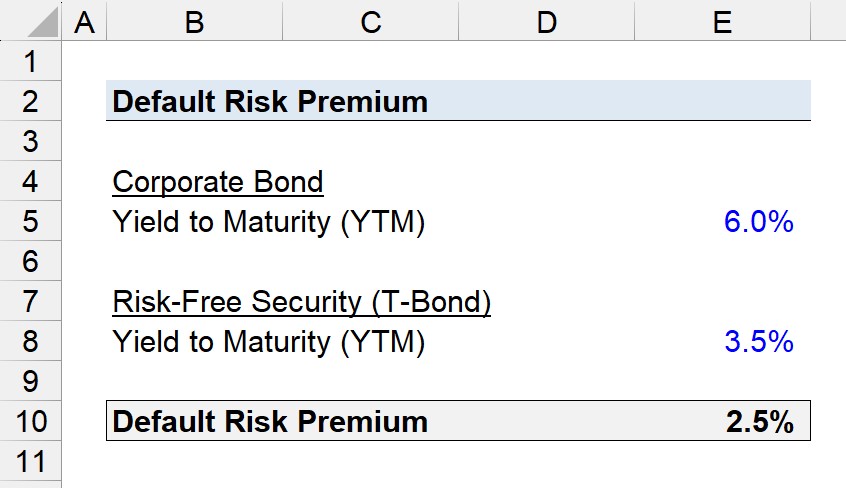
Suppose a corporate bond issuance has an expected yield to maturity (YTM) of 6.0%.
In contrast, a comparable U.S. Treasury bond has a yield of 3.5%.
The default risk premium is simply the difference between the yield on the corporate bond and the U.S. T-Bond, which comes out to 2.5%.
In conclusion, the default risk premium (DRP) of 2.5% is the additional compensation required by investors in the market to purchase the corporate bond rather than the risk-free U.S. Treasury bond.
Enroll in The Premium Package: Learn Financial Statement Modeling, DCF, M&A, LBO and Comps. The same training program used at top investment banks.


No comments yet.