What is Debt to Tangible Net Worth?
Debt to Tangible Net Worth is a credit ratio that compares a company’s total debt outstanding relative to the value of its total assets minus intangible assets.

Debt to Tangible Net Worth is a credit ratio that compares a company’s total debt outstanding relative to the value of its total assets minus intangible assets.

The debt to tangible net worth metric is the ratio between a company’s total outstanding debt balance and its tangible net worth.
From the viewpoint of a management team amid liquidity risk management, tangible assets are viewed more favorably than intangible assets because tangible assets tend to be more marketable and more likely to possess some value post-liquidation, which would then be distributed to claim holders.
The formula for calculating the debt to tangible net worth is as follows:
Where:
The debt to tangible net worth ratio is regarded as a more conservative measure of a company’s financial state.
For instance, the debt to equity ratio (D/E) is one of the most common methods to evaluate the credit risk profile of a company. Unlike the debt to tangible net worth metric, however, the D/E ratio makes no adjustments to remove the value of intangible assets.
The D/E ratio measures the amount of debt financing utilized by a company to finance its asset base (i.e. resources) relative to the value of shareholders' equity.
Generally, a responsible, risk-averse borrower should strive to maintain a ratio of total debt to tangible net worth of less than 1.0x (or 100%).
If a company’s debt to tangible net worth exceeds 1.0x, that would be viewed as a potential red flag and a cause for concern to lenders in terms of the perceived credit risk.
Since the total debt outstanding belonging to the company exceeds its tangible net worth, the risk of default increases substantially, i.e. the company may have a sub-optimal capital structure.
We’ll now move to a modeling exercise, which you can access by filling out the form below.


Suppose you’re tasked with calculating the debt to tangible net worth ratio of a company given the following operating assumptions for fiscal year 2022.
Financial Leverage Assumptions:
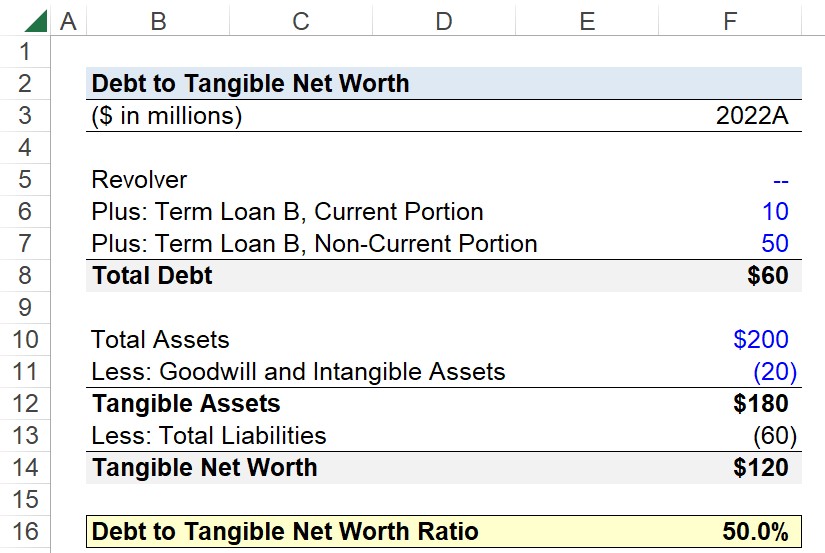
The revolving credit facility was extended by a corporate bank, but the company has not needed to draw from the revolver. Hence, the balance of zero.
The next debt tranche is the term loan B, which is split into two categories based on the maturity date.
The sum of the current and non-current portion of the term loan B is the total debt outstanding, which we’ll assume is the only liability on the company’s balance sheet, for the sake of simplicity.
The calculation of our company’s tangible net worth starts with total assets, which we’ll assume is $200 million.
Of the $200 million in asset value, $20 million is attributable to goodwill and other intangible assets.
Balance Sheet Assumptions:
Given those two inputs, the difference represents the value of our company's tangible assets.
From there, we’ll subtract total liabilities (i.e. the total debt balance) from the tangible assets balance, which results in a tangible net worth of $120 million.
In closing, we’ll divide our company’s total outstanding debt balance by its tangible net worth, which comes out to 50%.
The debt to tangible net worth ratio of 0.5x, or 50.0%, implies that approximately half of the company’s tangible net worth was funded using debt capital provided by lenders.

Enroll in The Premium Package: Learn Financial Statement Modeling, DCF, M&A, LBO and Comps. The same training program used at top investment banks.


No comments yet.