What is Variable Expense Ratio?
The Variable Expense Ratio is an accounting metric that compares a company’s variable costs to its net sales, expressed as a percentage.

The Variable Expense Ratio is an accounting metric that compares a company’s variable costs to its net sales, expressed as a percentage.
The variable expense ratio, or “variable cost ratio,” measures the proportion of a company’s cost structure composed of variable costs.
Since the variable expense ratio expresses variable costs as a percentage of net sales, the metric is useful for analyzing the break-even point (BEP) and performing cost-volume-profit analysis (CVP).
Based on the insights derived from the metric, a company’s management team can set pricing rates and production scheduling appropriately to maximize its profit margins.
Therefore, the variable expense ratio measures the amount a company must pay in variable costs to produce a specific number of product units, relative to the revenue generated from selling those products.
The expenses incurred by companies can be classified as either: 1) fixed expenses or 2) variable expenses.
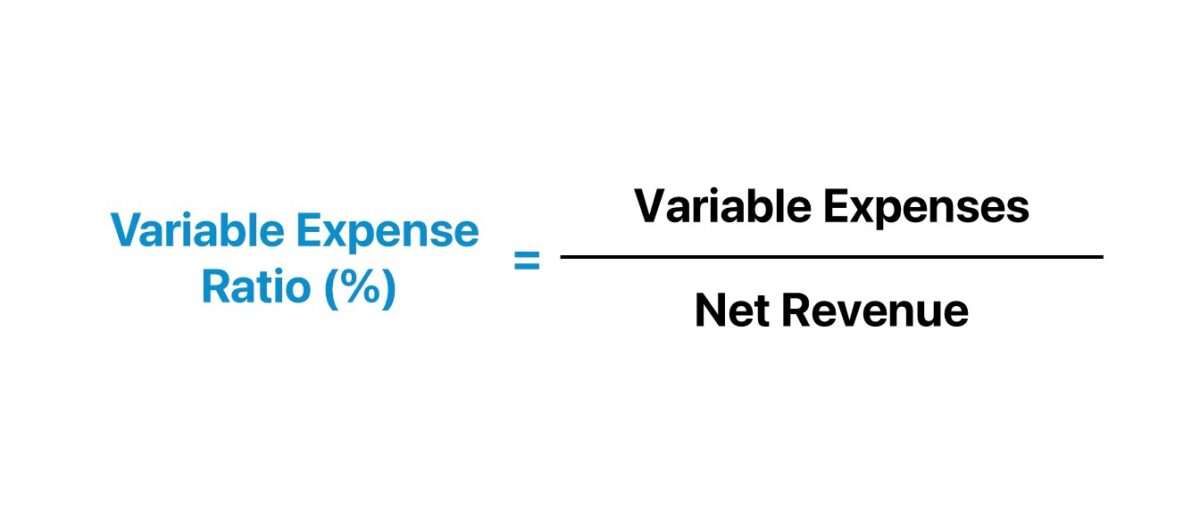
The variable expense ratio is equal to the total variable expenses of a company divided by its total net sales, expressed in percentage form.
The formula to calculate the variable expense ratio is as follows.
To convert the output into percentage form, simply multiply by 100.
Conversely, the variable expense ratio can be calculated using the contribution margin.
The contribution margin is the difference between net sales and total variable costs, expressed as a percentage, to quantify the amount of revenue remaining that can be allocated toward fixed costs.
We’ll now move to a modeling exercise, which you can access by filling out the form below.


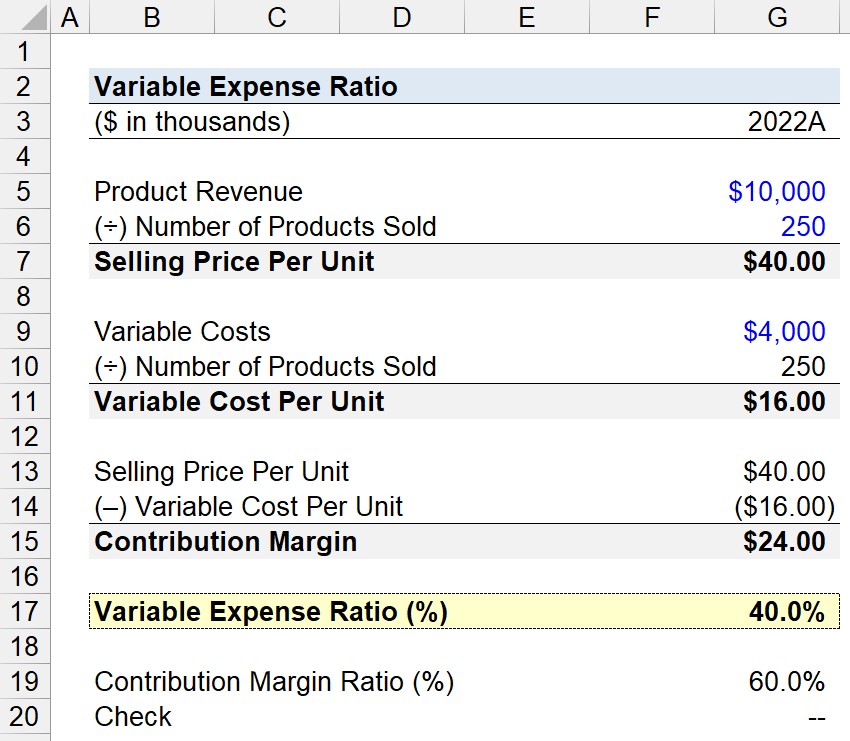
Suppose we're tasked with calculating the variable expense ratio of a company that generated $10 million in product revenue in fiscal year 2022.
The total number of products sold was 250k units, while the variable costs were $4 million.
By dividing the product revenue by the number of products sold, the selling price per unit is calculated to be $40.
If we repeat the same step, but switch out product revenue with variable costs, the variable cost per unit is $16.
The variable expense ratio is 40%, which we determined by dividing the selling price per unit by the variable cost per unit.
In conclusion, we can check our work using the alternative formula with the contribution margin, which yields a variable expense ratio of 40.0%.

Enroll in The Premium Package: Learn Financial Statement Modeling, DCF, M&A, LBO and Comps. The same training program used at top investment banks.


No comments yet.