What is Cost Structure?
The Cost Structure of a business model is defined as the composition of fixed costs and variable costs within the total costs incurred by a company.

The Cost Structure of a business model is defined as the composition of fixed costs and variable costs within the total costs incurred by a company.
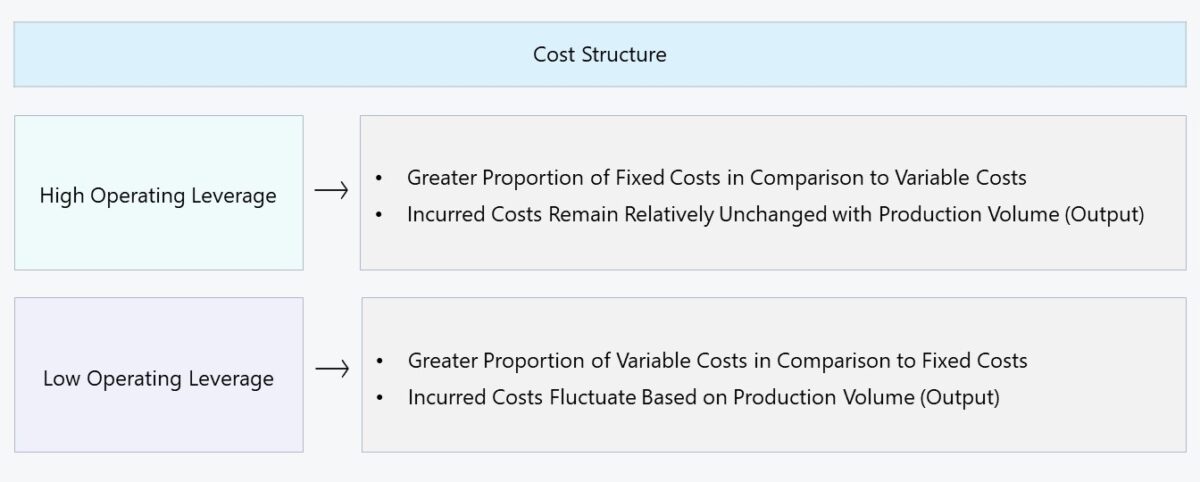
The cost structure of a business model categorizes the total costs incurred by a company into two distinct types of costs, which are fixed costs and variable costs.
If the ratio between fixed costs and variable costs is high, i.e. the proportion of fixed costs exceeds variable costs, high operating leverage characterizes the business.
In contrast, a business with a lower proportion of fixed costs in its cost structure would be considered to possess low operating leverage.
The cost structure of a company is comprised of two components: fixed costs and variable costs.
The difference between fixed costs and variable costs is that fixed costs are independent of production volume in the given period.
Therefore, whether the business production volume increases to meet the higher-than-anticipated customer demand, or its production volume is reduced (or maybe even halted) by lackluster customer demand, the cost incurred remains relatively the same.
| Fixed Costs | Variable Costs |
|---|---|
|
|
|
|
|
|
|
|
Unlike variable costs, fixed costs must be paid regardless of output, resulting in less flexibility in the option to reduce costs and uphold profit margins.
For example, a manufacturer that rented equipment as part of a multi-year contractual agreement with a third party must pay the same fixed amount in monthly fees, whether its sales outperform or underperform.
Variable costs, on the other hand, are output-dependent, and the amount incurred is subject to change based on the production output each period.
The formula to calculate the cost structure of a business adds its total fixed costs to its variable costs.
Note: The cost structure formula is a highly simplified variation, with the implicit assumption that all costs incurred by a company can be categorized as either a fixed or variable cost.
Learn how institutional investors identify high-potential undervalued stocks. Enrollment is open for the upcoming cohort.
Thus far, we’ve discussed what the term “cost structure” describes in a company’s business model and the differences between fixed and variable costs.
The reason the cost structure, i.e. the ratio between fixed and variable costs, matters for a business is tied to the concept of operating leverage, which we briefly alluded to earlier.
Operating leverage is the proportion of the cost structure comprised of fixed costs, as we briefly mentioned earlier.
Suppose a company is characterized by high operating leverage. Given that assumption, each incremental dollar of revenue can potentially generate more profits, since most of the costs remain constant.
Beyond a specific inflection point, the excess revenue generated is reduced by fewer costs, resulting in a more positive impact on the company’s operating income (EBIT). Therefore, a company with high operating leverage in periods of strong financial performance tends to exhibit higher profit margins.
In comparison, suppose a company with low operating leverage were to perform well. The same positive effects on profitability would likely not be seen because the company’s variable costs would offset a substantial portion of the incremental increase in revenue.
If the company’s revenue increases, its variable costs would also increase in tandem, thereby limiting the capacity for its profit margins to expand.
The implicit assumption of the effects discussed in the prior section is under favorable market conditions, wherein each company’s revenue is performing well.
Suppose the global economy enters a long-term recession, and the sales of all companies falter. In such a case, those with low operating leverage, like consulting firms, are in a far more favorable position than those with high operating leverage.
While companies with cost structures comprised of high operating leverage, such as manufacturers, can outperform those with low operating leverage, speaking purely from a profitability standpoint (i.e. the impact on profit margins), the reverse occurs in periods of underperformance.
A manufacturing company with high operating leverage is not afforded much flexibility in terms of areas for cost-cutting to mitigate the losses.
The cost structure is relatively fixed, so the areas in which operational restructuring could be done are limited.
Despite the reduction in customer demand and revenue, the company is restricted in mobility, and its profit margins should soon begin to contract in a downturn.
Using a consulting firm as an example for a service-oriented company, the consulting firm can reduce headcount and only retain its “essential” workers on its payroll during hard times.
Even with the expenses related to the severance packages taken into account, the long-term benefit of the firm’s cost-cutting efforts would offset those payments, especially if the recession is a long-lasting economic downturn.
Because the consulting industry is a service-oriented industry, the direct labor costs contribute the most significant percentage of a consulting firm’s expenses.
Any other cost-cutting initiatives, such as shutting down offices, establish a “cushion” for the firm to withstand the recession.
In fact, the consulting firm’s profit margins could even increase in these periods, albeit the cause is not “positive” per se, since it stems from urgency.
The consulting firm's revenue and earnings have likely dropped significantly, so the cost-cutting is done out of necessity to avoid the risk of financial distress (and potential bankruptcy) during the recession.
The pricing strategy within a company’s business model is a complex subject, where variables such as the industry, the target customer profile, and competitive landscape contribute to the “optimal” strategy.
But generally speaking, two common pricing strategies are cost-based pricing and value-based pricing.


No comments yet.