What is Overhead Rate?
The Overhead Rate represents the proportion of a company’s revenue allocated to overhead costs, directly affecting its profit margins.

The Overhead Rate represents the proportion of a company’s revenue allocated to overhead costs, directly affecting its profit margins.

Overhead costs represent the indirect expenses incurred by a company amidst its day-to-day operations.
Overhead costs are recurring cash outflows required for a company to remain open and “keep the lights on." However, overhead costs are not directly tied to revenue generation, i.e. indirect costs.
In spite of not being attributable to a specific revenue-generating component of a company’s business model, overhead costs are still necessary to support core operations.
Companies with fewer overhead costs are more likely to be more profitable – all else being equal.
Calculating the overhead rate begins with determining which expenses of the company can be classified as overhead costs. Once the specific costs have been identified, the sum of all the costs is divided by revenue in the corresponding period.
The list below includes common examples of overhead costs:
The formula for calculating the overhead rate is as follows.
The first input, overhead costs, can be determined using the following formula.
Effectively, the metric allocates a company's overhead costs across its revenue to arrive at a per-unit percentage.
However, please note that the overhead rate we've explained thus far uses revenue as the allocation measure, but there are other variations that compare overhead costs to metrics such as:
We’ll now move to a modeling exercise, which you can access by filling out the form below.


Suppose a manufacturing company is trying to determine its overhead rate for the past month.
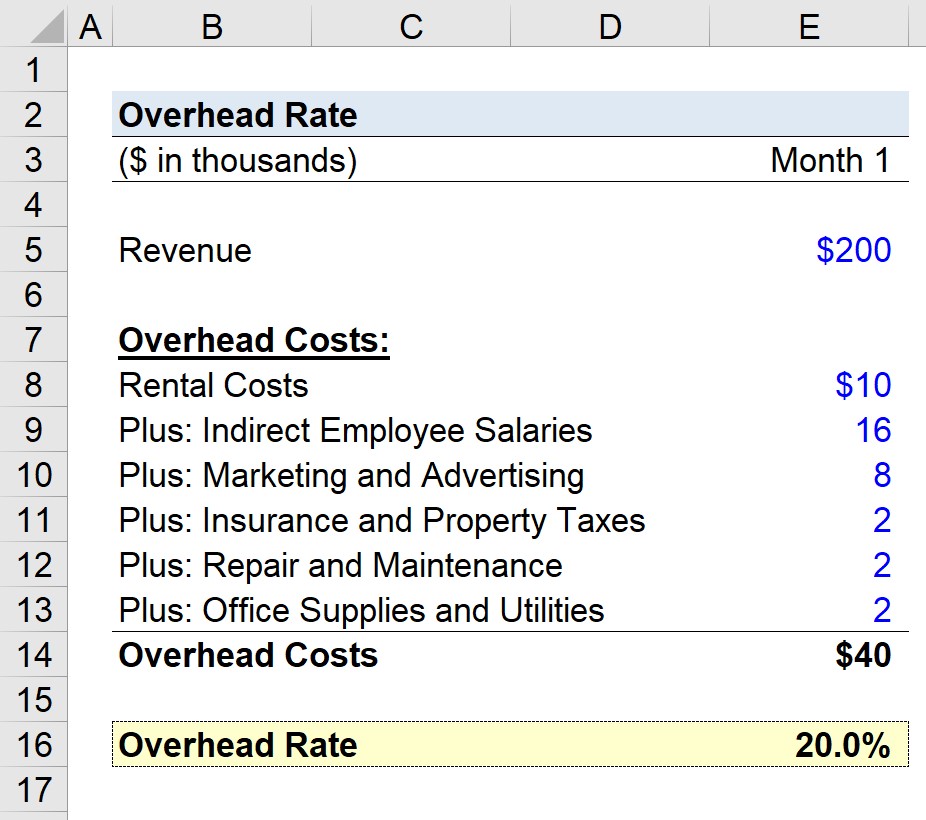
In our hypothetical scenario, we’ll assume the manufacturer brought in $200k in total monthly sales (Month 1).
The company has also determined the month's overhead costs as the following:
If we add all of our company’s overhead costs from above, we arrive at a total of $40k in overhead costs.
We must now take the $40k in overhead costs and divide it by the $200k in monthly revenue assumption.
The resulting figure, 20%, represents our company’s overhead rate, i.e. twenty cents is allocated to overhead costs per each dollar of revenue generated by our manufacturing company.

Enroll in The Premium Package: Learn Financial Statement Modeling, DCF, M&A, LBO and Comps. The same training program used at top investment banks.


No comments yet.