What is Contribution Margin Ratio?
The Contribution Margin Ratio is the product revenue remaining after deducting all variable costs, expressed on a per-unit basis.

The Contribution Margin Ratio is the product revenue remaining after deducting all variable costs, expressed on a per-unit basis.
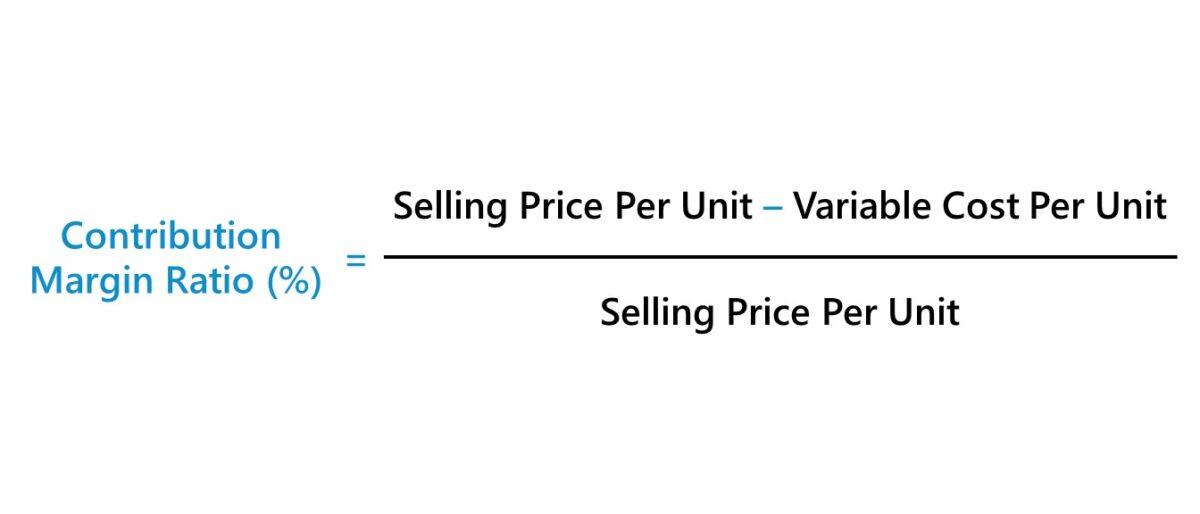
The contribution margin ratio, often abbreviated as “CM ratio”, expresses the residual profits generated from each unit of product sold, once all variable costs are subtracted from product revenue.
The difference between variable costs and fixed costs is as follows.
The calculation of the contribution margin ratio is a three-step process.
The formula to calculate the contribution margin ratio (or CM ratio) is as follows.
The resulting ratio compares the contribution margin per unit to the selling price of each unit to understand the specific costs of a particular product.
Since the incremental profit earned on each product sale can be derived from the ratio, the ratio offers useful information that can help guide decisions, such as setting product pricing appropriately to ensure a minimum margin is met (and the business model is sustainable).
We’ll now move on to a modeling exercise, which you can access by filling out the form below.


Suppose you're tasked with calculating the contribution margin ratio of a company's product.
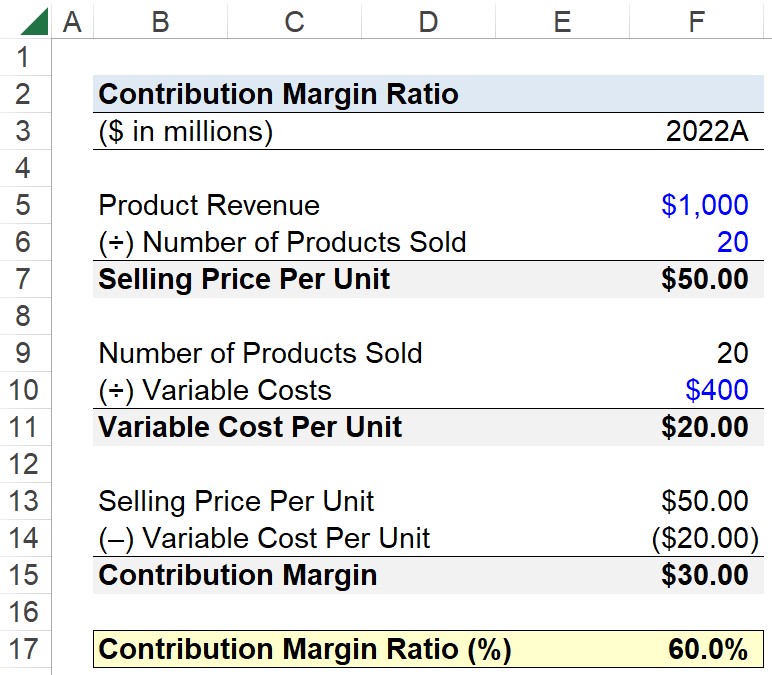
In 2022, the product generated $1 billion in revenue, with 20 million units sold, alongside $400 million in variable costs.
The product revenue and number of products sold can be divided to determine the selling price per unit, which is $50.00 per product.
In the next part, we must calculate the variable cost per unit, which we'll determine by dividing the total number of products sold by the total variable costs incurred.
Only two more steps remain in our quick exercise, starting with the calculation of the contribution margin per unit – the difference between the selling price per unit and variable cost per unit – which equals $30.00.
The $30.00 represents the earnings remaining after deducting variable costs (and is left over to cover fixed costs and more).
In conclusion, we'll calculate the product's contribution margin ratio (%) by dividing its contribution margin per unit by its selling price per unit, which returns a ratio of 0.60, or 60%.

Enroll in The Premium Package: Learn Financial Statement Modeling, DCF, M&A, LBO and Comps. The same training program used at top investment banks.


No comments yet.