The Return on Invested Capital (ROIC) measures the percentage return of profitability earned by a company using the capital contributed by equity and debt providers.
Conceptually, the return on invested capital (ROIC) is a measure of value creation. In practice, ROIC is commonly used to determine the efficiency at which capital is allocated because the consistent generation of a positive value is perceived positively as a necessary attribute of a quality business.
Generate Key Takeaways
How to Calculate ROIC
ROIC, or "Return on Invested Capital", represents the efficiency at which a company uses its capital to generate profitable returns on behalf of its shareholders and debt lenders.
Fundamentally, the return on invested capital (ROIC) answers the question, “How much in returns is the company earning per dollar of invested capital?”
Therefore, the ROIC concept reflects the rate of return generated by a company using the funds contributed by its capital providers.
Since the return metric is presented in the form of a percentage, the metric can be used to assess a company’s profitability as well as make comparisons to peer companies.
For companies attempting to raise capital from outside investors for the first time or raise additional funding, the ROIC is a critical KPI that can serve as validation (i.e. a track record of "proof") that management is competent and can be relied upon to pursue and capitalize on profitable opportunities.
The return on invested capital (ROIC) calculation comprises the following steps:
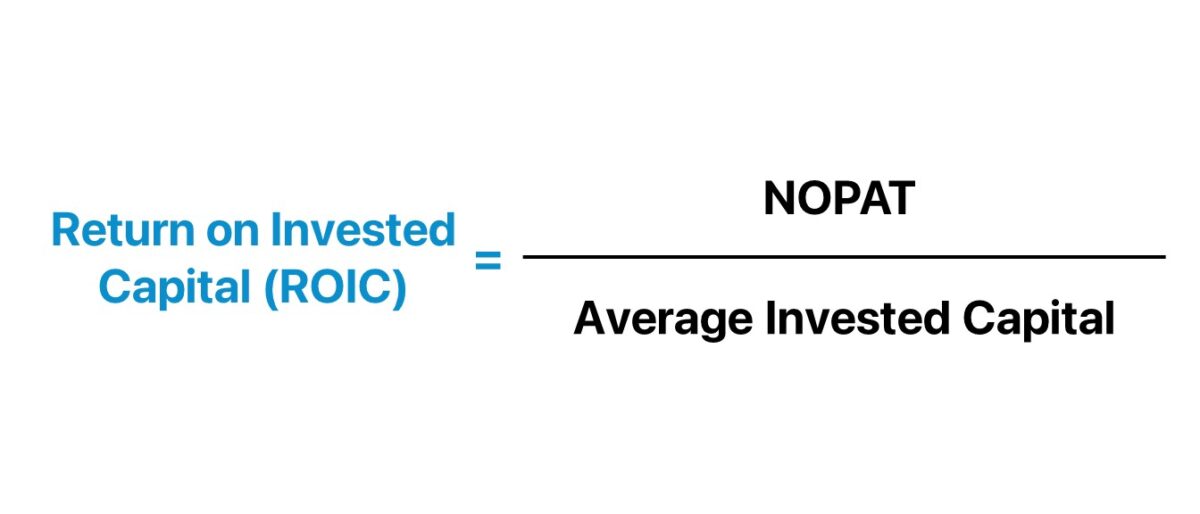
Return on Invested Capital (ROIC) = NOPAT ÷ Average Invested Capital
Where:
Net Operating Profit After Tax (NOPAT) ➝ NOPAT is used in the numerator because the cash flow metric captures the recurring core operating profits and is an unlevered measure (i.e. unaffected by the capital structure). Unlike metrics such as net income, NOPAT is a company's tax-affected operating profit (EBIT) and thus represents what is available for all equity and debt providers.
Invested Capital (IC) ➝ As for the denominator, the invested capital represents the sources of funding raised to grow the company and run the day-to-day operations.
The ROIC ratio quantifies the profits that the company can generate for each dollar of capital invested in the company in a percentage.
The two common sources of funds for companies that are used to invest in cash flow generative assets and derive economic benefits are debt and equity.
Debt Financing ➝ The capital obtained by a company in exchange for the obligation to pay periodic interest expense throughout the borrowing term and the return on the original principal at maturity.
Equity Financing ➝ The capital raised by a company by issuing ownership stakes, i.e. shares representing partial ownership, to institutional investors such as venture capital or growth equity firms, or the secondary markets if the company is publicly traded.
ROIC Example
Suppose a company generated $10 million in NOPAT in Year 1 and invested an average of $100 million from the end of Year 0 to the end of Year 1.
NOPAT = $10 million
Average Invested Capital (IC) = $100 million
Given the NOPAT and average invested capital, the ROIC comes out to 10%.
Return on Invested Capital (ROIC) = $10 million ÷ $100 million = 10.0%
The 10% ROIC implies that the company generates $10 of net earnings per $100 invested in the company.
Improving ROIC Accuracy Through AI
Accurately measuring Return on Invested Capital (ROIC) is essential for evaluating how effectively a company allocates its resources and creates value. Artificial intelligence dramatically improves the precision of ROIC analysis, empowering finance professionals to quickly interpret financial data, assess operational efficiency, and identify sustainable competitive advantages. Recognizing the strategic advantage offered by AI, Wall Street Prep created the AI for Business & Finance Certificate Program in partnership with Columbia Business School Executive Education. Participants learn how AI can streamline the calculation of complex metrics, highlight operational improvements, and forecast future performance with enhanced accuracy. Explore how leveraging AI-driven analysis tools can improve your ability to make insightful investment decisions, identify high-quality businesses, and optimize capital allocation strategies.
The two core components of the ROIC calculation are NOPAT and invested capital.
NOPAT ➝ NOPAT, or "EBIAT," is the tax-affected operating income (EBIT) of the company
Invested Capital (IC) ➝ Invested capital, on the other hand, is the sum of fixed assets, net working capital (NWC), and acquired intangibles, including goodwill.
The formula to calculate NOPAT and invested capital is as follows.
NOPAT = EBIT × (1 – Tax Rate %)
Invested Capital = Fixed Assets + Net Working Capital (NWC) + Acquired Intangibles + Goodwill
The calculation of NOPAT is relatively straightforward since EBIT (or "operating income") is taxed as if there is no debt in the company's capital structure (and, thus, no interest expense).
In contrast, invested capital (IC) can become a rather onerous calculation.
There are two routes to think about invested capital, but either approach is ultimately identical to the other due to double-entry accounting.
Net Working Capital (NWC) ➝ The net assets that a business needs to continue operating day-to-day.
Capital Expenditure (Capex) ➝ The funding provided by creditors and shareholders to finance the purchase of the company's assets, which can be categorized as either growth or maintenance capex.
The alternative, simpler method of calculating invested capital is to calculate net debt—which is equal to gross debt subtracted by cash and cash equivalents—and add net debt to equity from the balance sheet.
Cash and Cash Equivalents ➝ Since cash and cash equivalents (e.g. marketable securities) are not operating assets, the line item is thus excluded. Cash is considered to be "sitting idle" on the B/S and is thus not part of the core operations of a company.
Debt and Interest-Bearing Securities ➝ A similar logic is applied to debt and interest-bearing securities, which are not considered operating liabilities, either. Hence, the appropriate treatment of those sorts of borrowings is to ignore them in the computation.
The complications with invested capital (IC) arise for intangible-intensive industries, in which the intangible assets belonging to the companies that operate in the industry are not recognized yet.
While the inclusion of acquired intangibles and goodwill – the premium paid in excess of the fair value of the acquired assets – is intuitive since such corporate actions reflect the capital allocation of management (i.e. the decision to pay a premium counts), the value attributable to unacquired intangible assets is far more challenging.
One method is to capitalize intangible investments—i.e. the incurred research and development (R&D) expense—but the issue is that the subjective adjustments make the ROIC metric less reliable as a measure of comparability.
Why? There is less standardization, and the comparisons can easily become distorted from the discretionary adjustments.
What is a Good ROIC Ratio?
The return on invested capital (ROIC) is one method to determine whether or not a company has a defensible economic moat.
The term "moat" refers to a sustainable competitive advantage belonging to a particular business that protects its long-term profit margins and market share from new market entrants (and other external threats) over the long run.
The overall objective of calculating the metric is to grasp a better understanding of how efficiently a company has been utilizing its operating capital (i.e. capital deployment).
For investors in the public markets, the metric is frequently used to screen for potential investments, not just for retail investors but for institutional investors such as hedge funds – especially funds utilizing long-only, value-oriented strategies.
Finding public companies in the stock market with an actual "moat" and consistently above-market ROICs is, without a doubt, easier said than done, but one that can yield high investment returns.
The reason the ROIC concept tends to be prioritized by value investors is that most investors purchase shares under the mindset of a long-term holding period.
Hence, current earnings and cash flows are a relatively small component of the total net return. Instead, the ability to reinvest those earnings to build real value is much more important.
Continue Reading Below
The Wharton Online & Wall Street Prep Applied Value Investing Certificate Program
Learn how institutional investors identify high-potential undervalued stocks. Enrollment is open for the upcoming cohort.
The return on invested capital (ROIC) and return on capital employed (ROCE) are returns-based metrics used to analyze the profitability of a company and the efficiency at which its management team allocates capital.
Return on Invested Capital (ROIC) ➝ The distinction between ROIC and ROCE is that the numerator in the ROIC formula is NOPAT, whereas the denominator is invested capital.
Return on Capital Employed (ROCE) ➝ On the other hand, the numerator in ROCE is also NOPAT, but the denominator is capital employed.
Return on Capital Employed (ROCE) = NOPAT ÷ Capital Employed
Where:
Capital Employed = Total Assets – Current Liabilities
Therefore, ROIC and ROCE offer different perspectives on a company's operating efficiency and capital allocation.
ROIC vs. WACC: What is the Difference?
One common way to use ROIC as an investment decision-making tool is to compare the investment's ROIC to its weighted average cost of capital (WACC).
Comparing the ROIC to the WACC can help decide whether the company creates sufficient value for its stakeholders.
If the ROIC is higher than the WACC, that means the company creates positive value, whereas if the ROIC is lower than the WACC, that means the company's value is declining.
If ROIC > WACC → "Invest"
If ROIC < WACC → "Pass"
Companies that generate an ROIC above their cost of capital imply that the management team can allocate capital efficiently and invest in profitable projects, which is a competitive advantage in itself.
When investors screen for potential investments, the minimum ROIC tends to be set between 10% and 15%, but that threshold will be firm-specific and will depend on the type of strategy employed.
One of the more frequent use cases of tracking the metric is for evaluating the judgment of the management team regarding capital allocation.
Namely, there are five methods for corporations to improve their ROIC and thus create positive economic value over the long run:
Invest in High Return, Profitable Projects ➝ ROIC > WACC ("Value Creating")
From the expanded full-form formula of ROIC, we can see the value is the product of:
Invested Capital Turnover ➝ "How much revenue does each dollar of invested capital generate?"
Margins (%) ➝ "How much profits are retained after deducting the cost of goods sold (COGS) and operating expenses (OpEx) to arrive at operating income (EBIT), which is then tax-affected?"
The underlying components of the ROIC metric, at its core, are reflected in the following equation.
NWC affects invested capital since if operating assets increase, invested capital increases as well – which in turn decreases the metric (i.e. more spending is needed to sustain or increase growth).
Conversely, if operating liabilities were to increase, ROIC would increase because NWC is lower.
A higher return on invested capital (ROIC) can be considered an indication that a company is required to spend less to generate more profit.
Profitable Return on Invested Capital → Positive Value Creation and Shareholder Returns
The higher the profit margins of the company, the higher the return on invested capital, as the company can convert more revenue into profits, or NOPAT, to be more specific.
How to Analyze ROIC and Growth
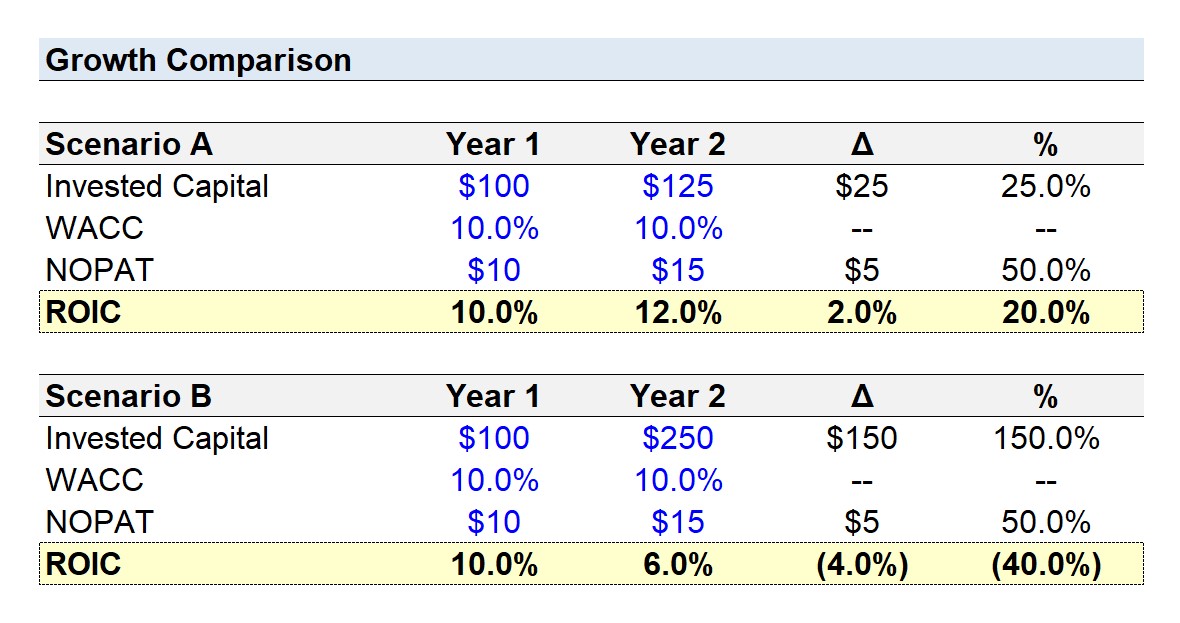
Contrary to a common misunderstanding, growth is not always a positive signal for a company.
The question that must be asked is, "At what cost was the growth obtained?"
Often, companies will make significant investments to expand, but if the ROIC is lower than the cost of capital (WACC), the Capex destroys value, not creating shareholder value.
Scenario A ➝ In Scenario A, the change in invested capital was $25m more, for an increase of $5m in NOPAT.
Scenario B ➝ In contrast, in Scenario B, the NOPAT increased by $5m too, but $150m was spent. Therefore, focusing on growth in NOPAT by itself would be misleading in the latter case.
How to Balance ROIC with Growth and Value Creation
Generally speaking, the higher the return on invested capital (ROIC), the more likely the company is to achieve sustainable long-term value creation.
50% ROIC ➝ A 50% ROIC means that a company provided with $1.00 in funding can reinvest those proceeds to turn the investment into $1.50.
25% ROIC ➝ In comparison, a 25% ROIC means that the company turned the $1.00 into $1.25 instead, so it should be straightforward to understand that a higher ROIC ratio is preferable.
Companies with higher return on invested capital (ROIC) are more likely to continue employing capital thoughtfully to achieve returns in line with the past (or similar) – albeit, identifying such opportunities early on is easier said than done.
Growth can often be the most enticing factor to investors—whether investing in the public equities or private markets— but a consistent return on invested capital (ROIC) is a more sustainable pathway to long-term value creation.
On that note, value investors in particular prioritize investing in the equity of companies led by a management team that can efficiently allocate capital toward projects that create long-term, sustainable value.
ROIC Calculator
We’ll now move on to a modeling exercise, which you can access by filling out the form below.
Excel Template | File Download Form
You’re logged in! Form submission not required. Access your file below.
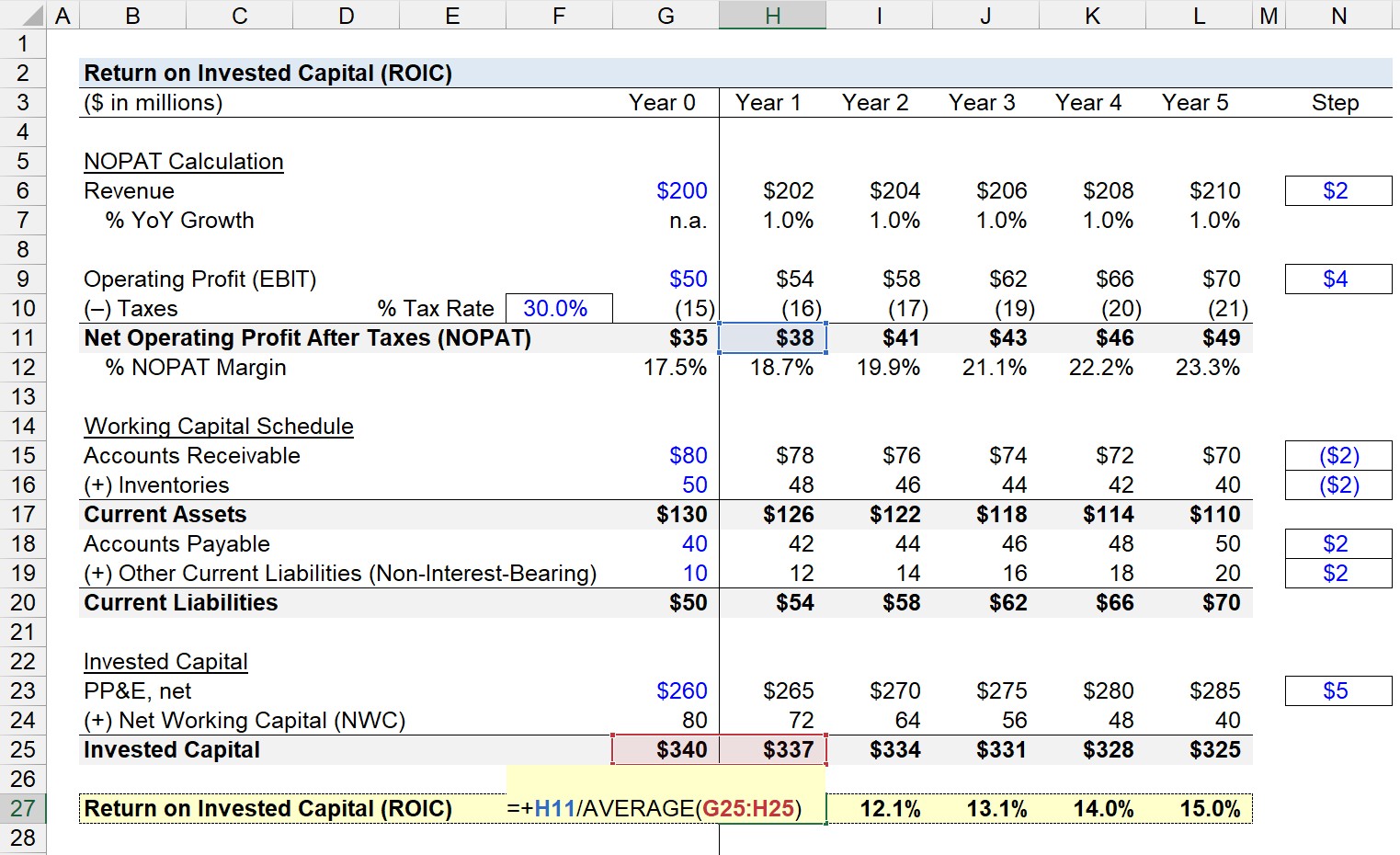
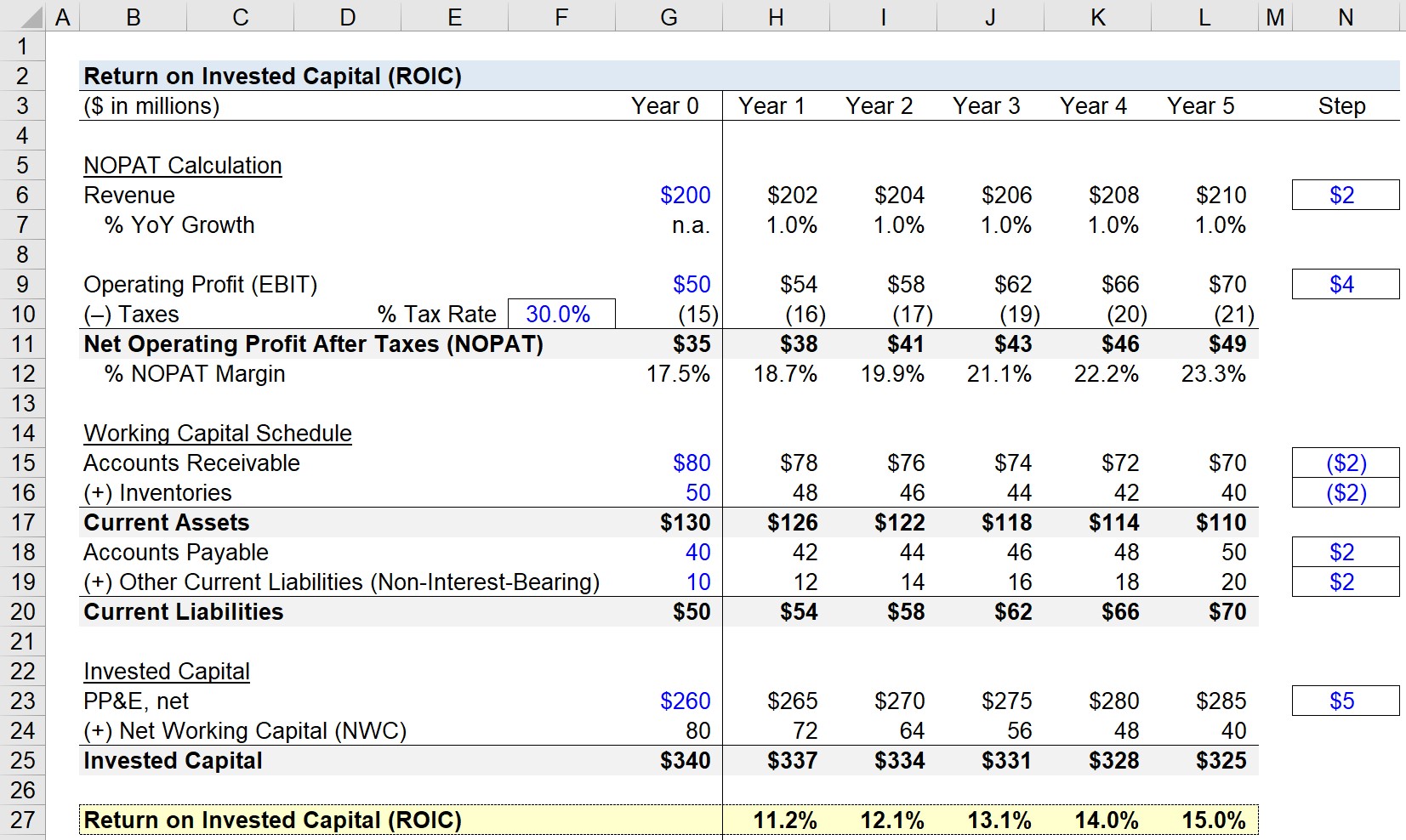
Suppose we're tasked with calculating the return on invested capital (ROIC) of a company with the following financial profile as of Year 0.
Year 0 Revenue = $200 million
Year 0 Operating Income (EBIT) = $50 million
Tax Rate = 30%
From Year 0 to Year 5, revenue is projected to grow $2m per year, while EBIT grows $4m per year under the same time horizon. To reflect this, we'll use step functions as seen on the right side of the model.
The NOPAT margin – NOPAT as a percentage of revenue – expanded from 17.5% in Year 0 to 23.3% in Year 5.
Based on these assumptions, note that the growth of NOPAT is outpacing revenue, which will increase the likelihood of ROIC increasing – unless the invested capital offsets the margin expansion.
2. Invested Capital Calculation Example
Next, we'll calculate the invested capital, which represents the net operating assets used to generate cash flow.
For the working capital schedule and fixed assets forecast, the following assumptions will be used:
Accounts Receivable (A/R) = $80 million
Inventories = $50 million
Accounts Payable (A/P) = $40 million
Other Current Liabilities = $10 million
PP&E = $260 million
The company's net working capital (NWC) can be calculated by subtracting the current liabilities (excluding debt and interest-bearing securities) from the current assets (excluding cash & cash equivalents).
All operating current assets are projected to decline by $2m each year, while operating current liabilities are forecast to grow by $2m each year.
The PP&E balance is forecast to grow by $5m each year.
3. ROIC Calculation Example
Once the entire forecast is complete, we can calculate the ROIC in each period by dividing NOPAT by the average between the current and prior period invested capital balance.
Starting from Year 1 to Year 5, we can see an increase from 11.2% to 15.0%, which is caused by increased profit margins and the increase in operating current liabilities.
ROIC – Year 1 = $38 million ÷ ($340 million + $337 million) = 11.2%
Since the invested capital is declining while the revenue and NOPAT are growing at a higher pace, the ROIC is rising because more value is being derived from the invested capital.
The takeaway here is that the more revenue generated per dollar of invested capital and the higher the profit margins, the higher the return on invested capital (ROIC) will be — all else being equal.
In the final step, we multiply the NOPAT margin by the average invested capital balance of the current and prior year to get the same ROICs, which confirms our calculations were done correctly.
Frequently Asked Questions
Are loans to subsidiaries, employees, or other financial assets included in invested capital?
No, financial assets like loans to subsidiaries, employees, or other financial receivables are generally excluded from invested capital, since the income generated by these assets isn't part of a company's core operating profit (EBIT) that NOPAT is built from. Invested capital is meant to capture only the capital deployed toward the operations that actually drive the business's operating returns, so anything generating income outside of that operating scope gets left out of the calculation.
Are deferred tax assets and liabilities included in invested capital?
Yes, deferred tax assets and liabilities are typically included in invested capital, since they arise from a company's core operations and affect the capital tied up in running the business. The general rule for what belongs in invested capital isn't about the specific accounting label of an item, but whether it was invested in or incurred as part of core operations and contributes to NOPAT and unlevered free cash flow.
Do operating lease right-of-use assets count as part of invested capital?
Yes, the right-of-use asset recognized for an operating lease is treated as a fixed asset and included in invested capital. Since accounting standards now require most operating leases to be capitalized on the balance sheet, the associated right-of-use asset represents real capital tied up in running the business, just like owned property or equipment would.
Why is goodwill included in invested capital if it doesn't generate any direct operating return?
Goodwill is included because, even though it's technically just an accounting plug representing the premium paid over the fair value of acquired assets, it still reflects a real capital allocation decision made by management. Paying a premium in an acquisition is a genuine use of capital that a company's leadership chose to make, so excluding it from invested capital would understate how much capital was actually deployed to generate the company's returns.
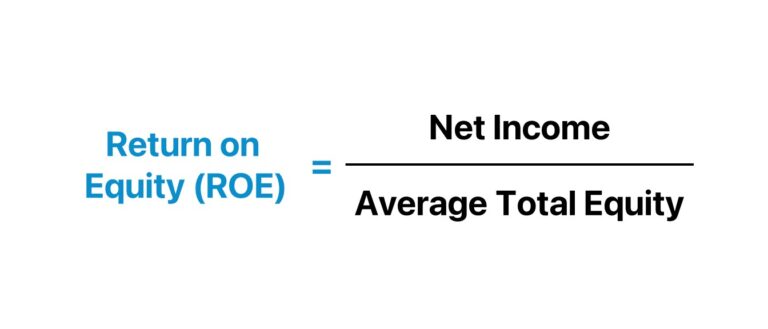
What's the difference between ROIC and ROE?
ROIC measures returns generated on the total capital provided by both debt and equity holders, using NOPAT, an unlevered profit measure unaffected by capital structure, in the numerator. ROE measures returns only from the perspective of equity holders, using net income, which is affected by interest expense and therefore by how much debt a company carries. A company can boost its ROE simply by taking on more debt, even if its underlying operating efficiency, as measured by ROIC, stays flat or declines.
Can a company have a negative ROIC, and what does that mean?
Yes, a negative ROIC occurs when a company's NOPAT is negative, meaning its core operations are losing money even before accounting for financing costs. This is common among early-stage companies, businesses going through a significant operational turnaround, or companies in a cyclical downturn, and it signals that the capital currently invested in the business isn't generating a positive operating return, at least in that period.
Is ROIC a useful metric for evaluating banks and other financial institutions?
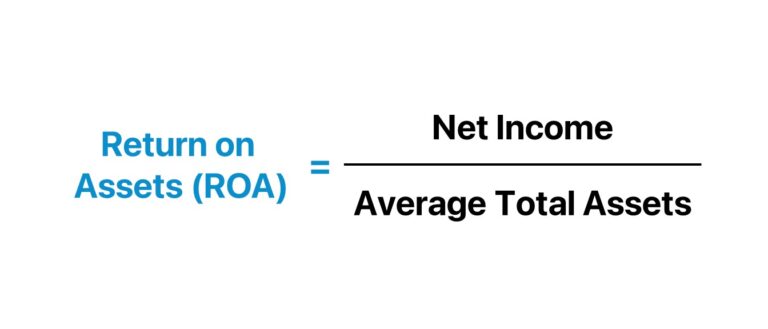
ROIC is generally not well-suited for banks and financial institutions, since the entire framework relies on separating operating activities from financing activities, and for a bank, lending and borrowing money is the core operating business itself rather than a financing decision layered on top of operations. Metrics like return on equity or return on assets are typically more appropriate for evaluating financial institutions, since they're built around how banks actually generate and deploy capital.
How does ROIC differ from ROIIC (Return on Incremental Invested Capital)?
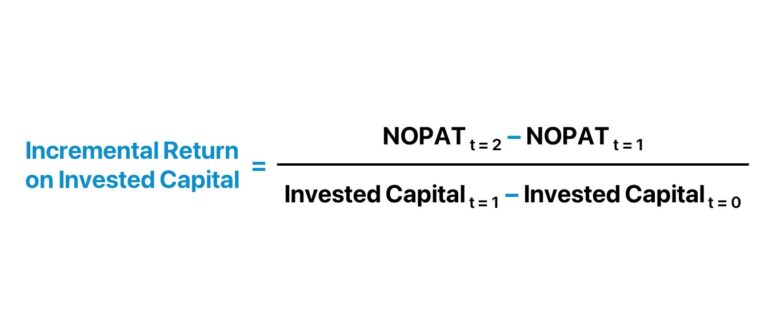
ROIC measures the return generated on a company's total invested capital base as it currently stands, while ROIIC measures the return generated specifically on the additional capital a company invests during a given period. ROIIC is particularly useful for evaluating whether a company's new investments and growth spending are creating value at the same rate as its existing capital base, since a company can maintain a strong overall ROIC while its most recent incremental investments are actually earning a much lower, or even negative, return.
Why might a young, high-growth company show a low or negative ROIC despite strong future prospects?
Young, high-growth companies often invest heavily upfront in infrastructure, customer acquisition, and product development well before that spending translates into proportional operating profit, which drags down NOPAT relative to the capital already deployed. This doesn't necessarily mean the company is a poor investment; it may simply reflect that the return on that invested capital hasn't materialized yet, which is why investors evaluating early-stage companies often look at the trajectory of ROIC over time rather than a single low or negative snapshot.
How consistent does a company's ROIC need to be to indicate a real competitive moat rather than a temporary advantage?
A genuine competitive moat is typically reflected by a company sustaining an ROIC meaningfully above its cost of capital across multiple years and, ideally, across different points in the broader economic cycle, rather than in just one or two strong years. A single year of high ROIC can result from a temporary favorable pricing environment or a one-time cost advantage, while a durable moat shows up as consistently elevated returns even as competitors attempt to enter the market and compress those returns over time.
Yes, the right of use asset of an operating lease counts as a fixed asset.
BB
Yao Shan
August 23, 2022 9:46 pm
Hi Brad,
Are the goodwill and deferred tax asset / liability counted as operating assets / operating liability? Are they inclusive in invested capital?
I believe operating asset and invested capital (NWC and fixed asset) are two distinct concepts, operating asset is a more broader concept, there are assets that are counted as operating asset but are not invested capital, isn’t it?
Thanks.
Brad Barlow
August 24, 2022 11:24 pm
Hi, Yao,
Yes, Goodwill and DTA/DTL are included in invested capital, and what we mean by ‘operating’ would include anything that goes into invested capital.
BB
Yao Shan
August 24, 2022 11:30 pm
Thanks Brad. Is there any assets that are “operating” but not counted as invested capital? Thanks.
Brad Barlow
August 24, 2022 11:40 pm
Hi, Yao,
No. If the company invested in those assets or incurred those liabilities as part of its core operations, and if they contribute to NOPAT and unlevered FCF, they are part of invested capital. Don’t get hung up on terminology, it is all about whether they are part of core operations.
BB
Yao Shan
August 24, 2022 11:50 pm
I see, have got a much clearer picture of what it is. Thanks Brad.
Brad Barlow
August 29, 2022 8:59 pm
You’re welcome, Yao!
rachit
February 9, 2023 8:38 am
Does financial asset like loan to subsidiary or associate and loan to employee will be termed as invested capital ?
Plus why goodwill come under invested capital for roic calculation when it does not create any return, is it not just an accounting adjustment?
Brad Barlow
February 10, 2023 1:00 pm
Hi, Rachit,
Financial assets are typically not part of invested capital for ROIC, because the income from those assets is typically not part of core operations (EBIT). As for Goodwill, while it is merely an accounting adjustment, it does represent the cost of real investment in operations via M&A activity.





Do operating leases count as fixed assets?
Hi, Phryne,
Yes, the right of use asset of an operating lease counts as a fixed asset.
BB
Hi Brad,
Are the goodwill and deferred tax asset / liability counted as operating assets / operating liability? Are they inclusive in invested capital?
I believe operating asset and invested capital (NWC and fixed asset) are two distinct concepts, operating asset is a more broader concept, there are assets that are counted as operating asset but are not invested capital, isn’t it?
Thanks.
Hi, Yao,
Yes, Goodwill and DTA/DTL are included in invested capital, and what we mean by ‘operating’ would include anything that goes into invested capital.
BB
Thanks Brad. Is there any assets that are “operating” but not counted as invested capital? Thanks.
Hi, Yao,
No. If the company invested in those assets or incurred those liabilities as part of its core operations, and if they contribute to NOPAT and unlevered FCF, they are part of invested capital. Don’t get hung up on terminology, it is all about whether they are part of core operations.
BB
I see, have got a much clearer picture of what it is. Thanks Brad.
You’re welcome, Yao!
Does financial asset like loan to subsidiary or associate and loan to employee will be termed as invested capital ?
Plus why goodwill come under invested capital for roic calculation when it does not create any return, is it not just an accounting adjustment?
Hi, Rachit,
Financial assets are typically not part of invested capital for ROIC, because the income from those assets is typically not part of core operations (EBIT). As for Goodwill, while it is merely an accounting adjustment, it does represent the cost of real investment in operations via M&A activity.
BB