Positive Value Creation → If the return on invested capital (ROIC) exceeds the weighted average cost of capital (WACC), the economic profit will be positive.
Negative Value Creation → If the return on invested capital (ROIC) is less than the weighted average cost of capital (WACC), the economic profit will be negative.
If the ROIC is less than the cost of capital, there is no value creation, irrespective of the growth profile of the underlying company.
Therefore, maximizing economic profit, rather than ROIC by itself, contributes to real shareholder value creation over the long run.
Companies with an ROIC consistently above their cost of capital are implied to allocate capital efficiently into profitable projects, contributing to the creation of an economic moat that protects long-term profits and market share.
The process of calculating the economic profit comprises two steps:
Calculate the Percent Difference between ROIC and WACC
Multiply the "Excess" Spread by Invested Capital
Economic Profit Formula
The economic value can be calculated using two methods.
Economic Profit = (ROIC – WACC) × Average Invested Capital
Economic Profit = NOPAT – (Average Invested Capital × WACC)
Where:
Return on Invested Capital (ROIC) = NOPAT ÷ Average Invested Capital
Cost of Capital (WACC) = [Cost of Debt x (Debt ÷ Total Capital)] + [Cost of Equity × (Equity ÷ Total Capital)]
Invested Capital = Fixed Assets + Net Working Capital (NWC) + Acquired Intangibles + Goodwill
Since the cost of capital (WACC) and NOPAT are each unlevered metrics – i.e. capital structure neutral – the economic value is the “excess” above the required rate of return attributable to the company’s capital providers, inclusive of equity shareholders and debt lenders.
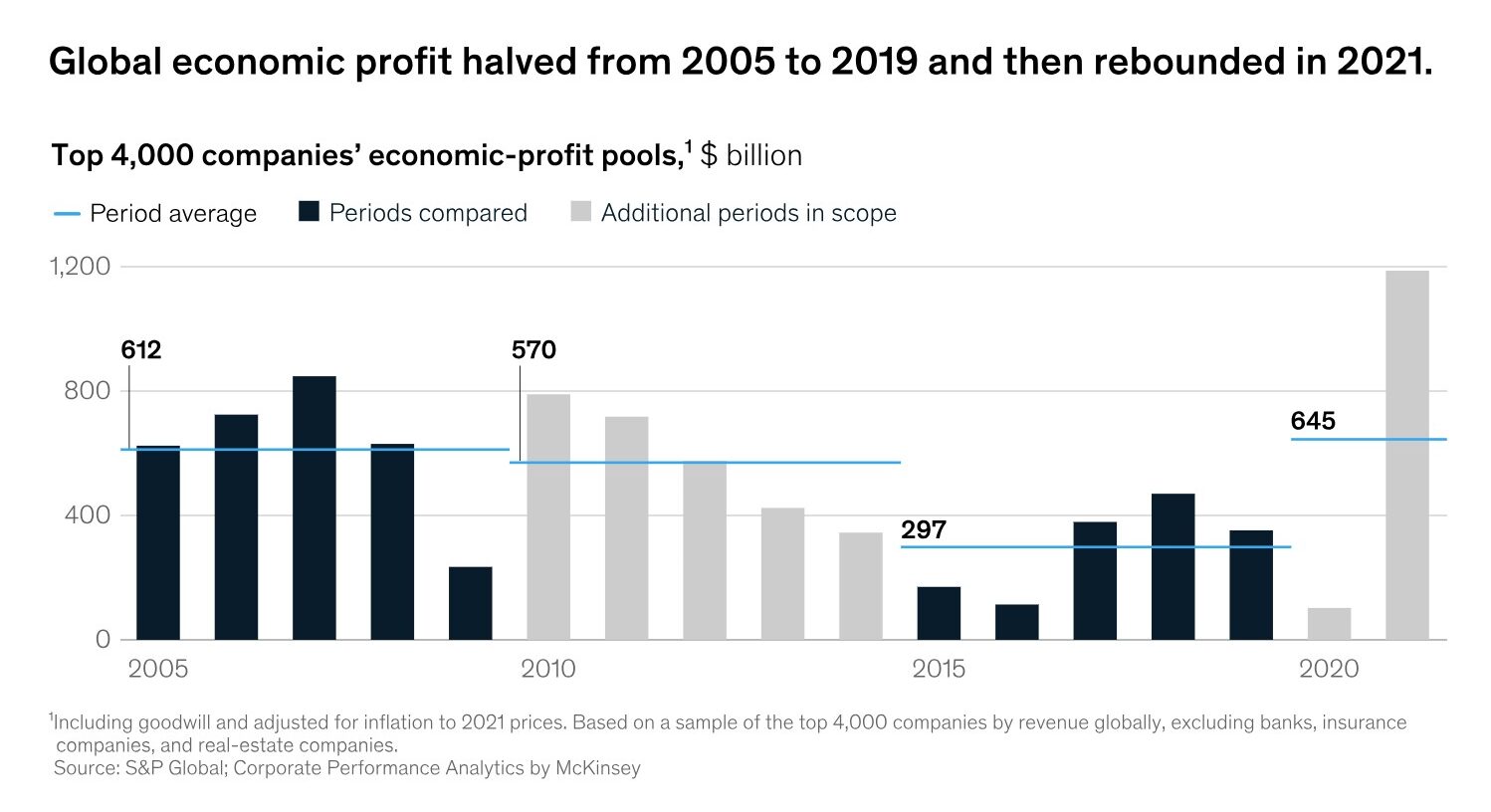
McKinsey & Company – Shrinking Global Economic-Profit Pools
"The wider the spread between a company’s ROIC and its cost of capital, the more economic profit its capital will create."
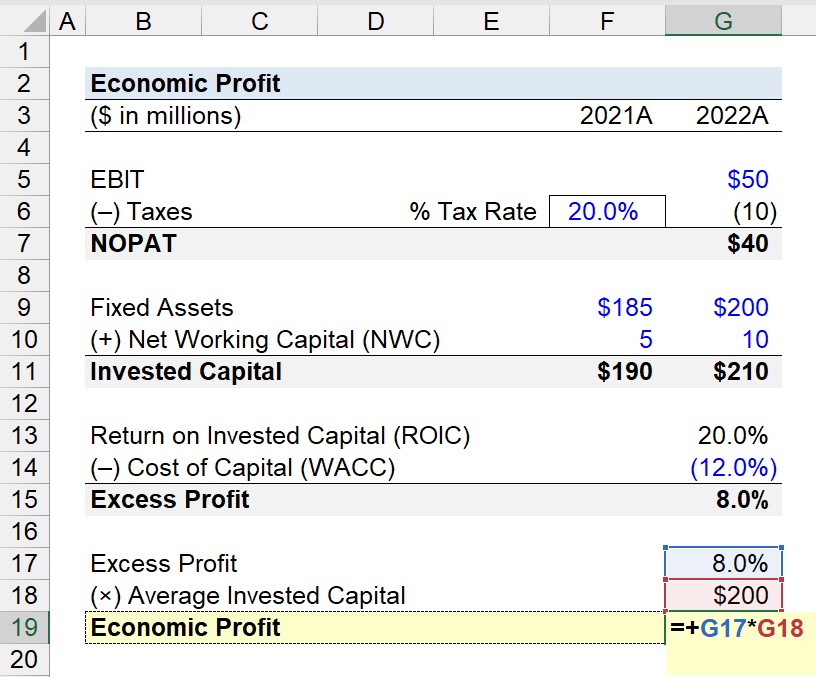
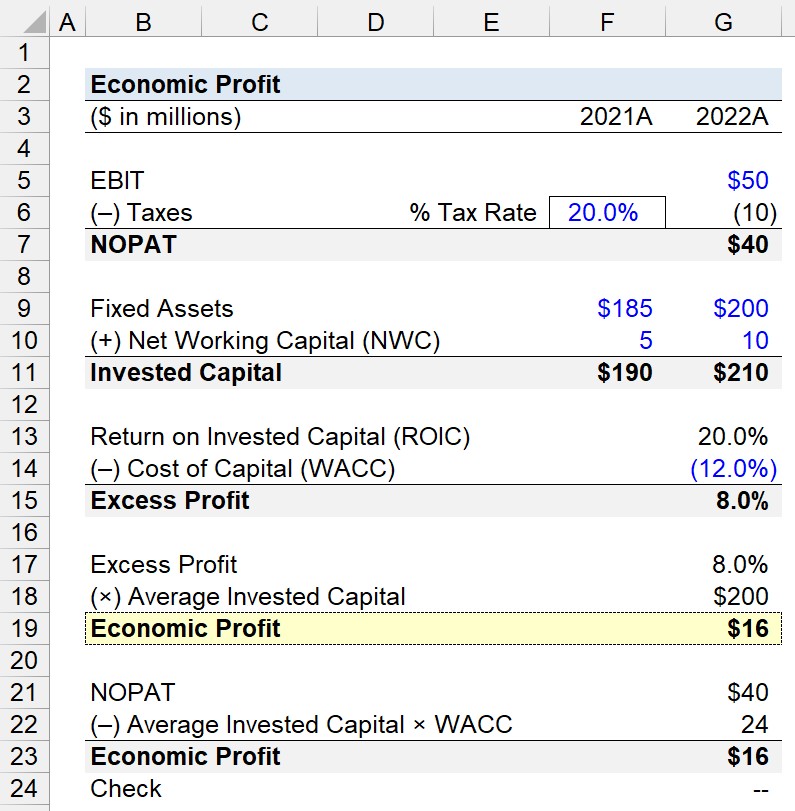
The invested capital for each year equals the sum of the two line items, which is $190 million and $210 million, respectively.
Invested Capital, 2021A = $185 million + $5 million = $190 million
Invested Capital, 2022A = $200 million + $10 million = $210 million
Average Invested Capital = ($190 million + $210 million) ÷ 2 = $200 million
Since NOPAT was $40 million in 2022, we'll divide by the average invested capital ($200 million) to determine the return on invested capital (ROIC) as 20.0%.
Return on Invested Capital (ROIC) = $40 million ÷ $200 million = 20.0%
For the cost of capital (WACC) input, we'll assume the company's WACC is 12.0%, which we'll deduct from its ROIC, resulting in an excess profit of 8.0%.
Excess Profit = 20.0% + (12.0%) = 8.0%
The excess profit, expressed in percentage form, is multiplied by the average invested capital to obtain $16 million for the economic profit.
Economic Profit = 8.0% × $200 million = $16 million
In conclusion, our final step is to confirm the accuracy of our work by subtracting the product of the company's average invested capital and WACC from its NOPAT to arrive at $16 million, which matches our prior calculation.
Economic Profit = $40 million – ($200 million × 12.0%) = $16 million
Continue Reading Below
Step-by-Step Online Course
Everything You Need To Master Financial Modeling
Enroll in The Premium Package: Learn Financial Statement Modeling, DCF, M&A, LBO and Comps. The same training program used at top investment banks.







No comments yet.