What is Capex to Cash Flow Ratio?
The Capex to Cash Flow Ratio is the percentage of a company’s operating cash flow (OCF) allocated towards the purchase of long-term fixed assets, i.e. capital expenditures.

The Capex to Cash Flow Ratio is the percentage of a company’s operating cash flow (OCF) allocated towards the purchase of long-term fixed assets, i.e. capital expenditures.
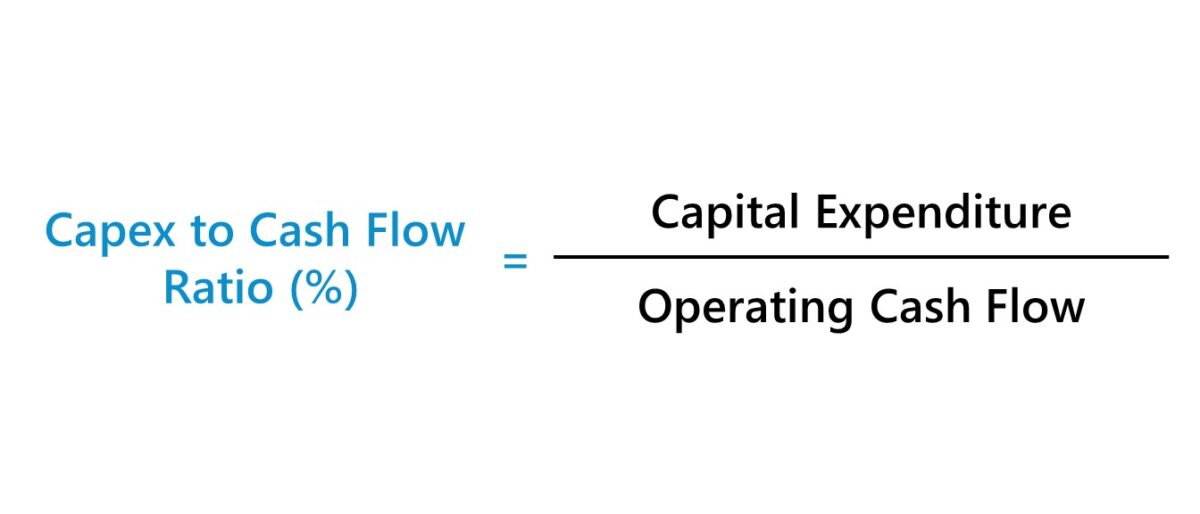
The capex to cash flow ratio is a method to measure the efficiency at which a company utilizes its operating cash flow (OCF) towards the purchase of fixed assets (PP&E).
The calculation of the capex to cash flow ratio involves comparing a company's capital expenditures to its operating cash flow (OCF).
The allocation of the remaining cash flow from operations (CFO) is up to management discretion. For instance, the cash can be issued to common shareholders in the form of dividends or used for stock buybacks, capital expenditures, business acquisitions, and more.
All else being equal, a company that spends less on capital expenditures per dollar of operating cash flow, yet generates the same (or more) revenue than its industry peers is more efficient at utilizing its fixed asset base.
The steps to calculate the capex to cash flow ratio (%) consist of a three-step process:
The formula to calculate the capex to cash flow ratio is as follows.
Where:
We’ll now move on to a modeling exercise, which you can access by filling out the form below.


Suppose you’re tasked with calculating the capex to cash flow ratio of a company given the following operating assumptions for fiscal year 2022.
Fixed Asset (PP&E) Assumptions
Operating Assumptions
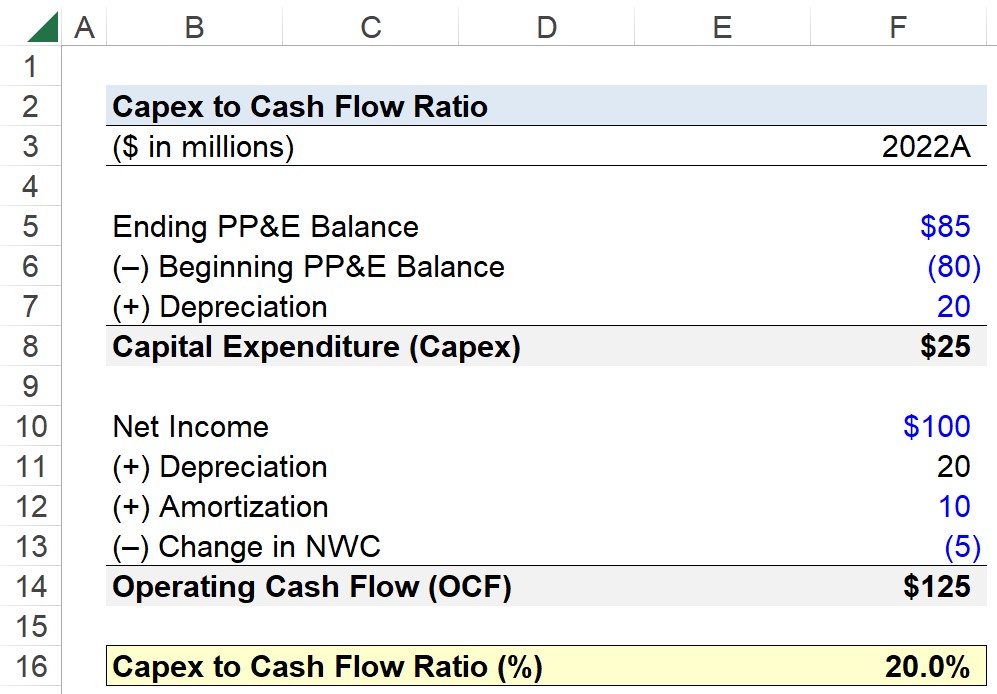
First, we’ll determine our company’s capital expenditures (Capex) by deducting the beginning PP&E balance from the ending PP&E balance—with the end-of-period balance entered as a negative number—before adding back the non-cash depreciation expense.
Next, we’ll calculate the company’s operating cash flow (OCF) in the same period by taking its net income and reconciling it for non-cash items (e.g. D&A) and the change in net working capital (NWC).
Lastly, we'll enter the operating cash flow (OCF) and capital expenditures (Capex) into the formula from earlier to arrive at a capex to cash flow ratio of 20.0%, which is the percentage of the company's operating cash flow allocated towards its capex spending.
The implied proportion of operating cash spent on capex (%) is a standardized metric and can thereby be compared to the company's historical capex spending and that of its industry peers to gauge its relative capex efficiency.

Enroll in The Premium Package: Learn Financial Statement Modeling, DCF, M&A, LBO and Comps. The same training program used at top investment banks.


No comments yet.