Debtor Days Ratio is the number of days on average that a company needs to collect cash payments from its customers.
A company’s debtor days is essentially a measure of how quickly the company can retrieve cash payments from its customers that paid using credit.
How to Calculate Debtor Days
The debtor days ratio, often called days of sales outstanding (DSO), pertains to credit sales, which refers to when customers make a promise to pay for a purchase in cash on a future date.
Companies that sell products or services to customers can be paid in either cash or on credit. For a credit purchase, the company has provided the product or service to the customer, but no cash payment has been received to date.
Until the customer fulfills the payment obligation in cash, the amount owed will be recorded as accounts receivable on the balance sheet.
The accounts receivable of a company is recognized as an asset on the balance sheet, and captures the outstanding credit purchases that have not yet been met.
On the balance sheet, the accounts receivable is recorded in the current assets section because the collection of the cash is expected to be in the near term (within 12 months).
Companies with low debtor days are viewed as more operationally efficient, while companies with high debtor days are perceived as inefficient and might need to implement changes to their business models.
Low Debtor Days → Quick Collection of Cash Payment from Credit Purchases
High Debtor Days → Slow, Inefficient Collection of Cash Payment from Credit Purchases
Calculating debtor days involves dividing a company’s receivables amount and dividing it by its credit sales for the corresponding period, followed by multiplying the resulting figure by 365 days.
Debtor Days Formula
The formula for calculating the debtor days metric is as follows.
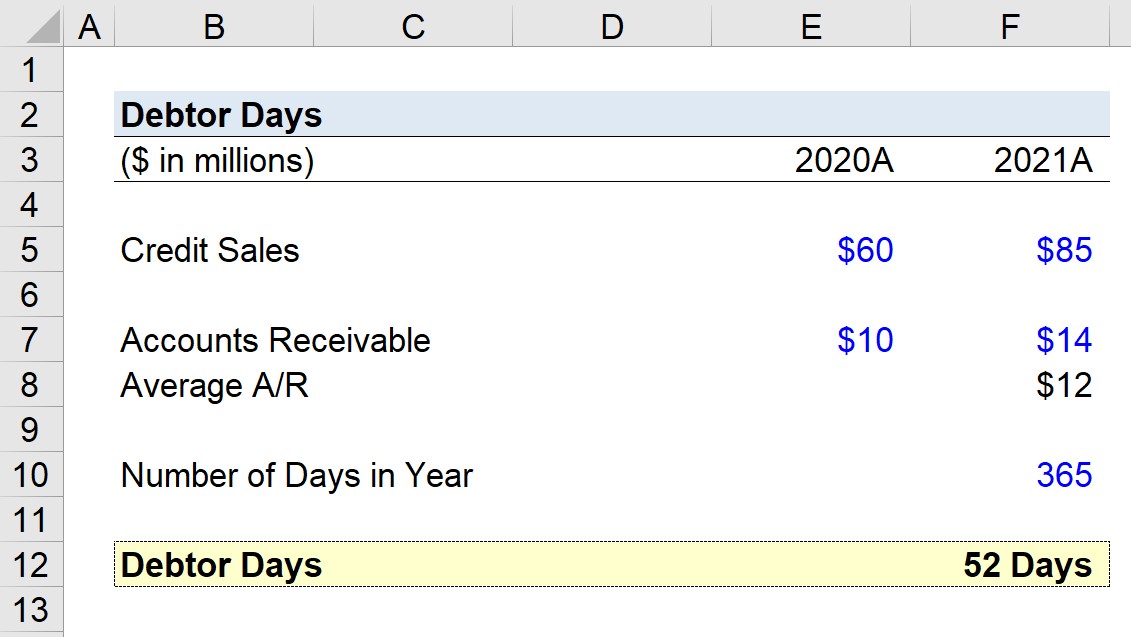
Debtor Days = (Average Accounts Receivables ÷ Credit Sales) × 365 Days
Using a company’s credit sales results in a more accurate metric than using the total sales amount, however, the credit sales data may not always be readily available (in which case using total sales would be the only option).
The rationale for using the average accounts receivable, i.e. the average between the beginning and ending period balances, is to better "match" the accounts receivable period to the sales period. In particular, sales data comes from the income statement, which tracks performance across two periods.
In contrast, A/R is from the balance sheet, which is a snapshot of the assets, liabilities, and equity at a specific point in time.
To match the timing covered in the numerator and denominator, we use the average, but using the ending balance is also acceptable in most cases.
Debtor Days Calculator
We’ll now move to a modeling exercise, which you can access by filling out the form below.
You’re logged in! Form submission not required. Access your file below.







No comments yet.