What is the Average Payment Period?
The Average Payment Period represents the approximate number of days it takes a company to fulfill its unmet payment obligations to its suppliers or vendors.

The Average Payment Period represents the approximate number of days it takes a company to fulfill its unmet payment obligations to its suppliers or vendors.
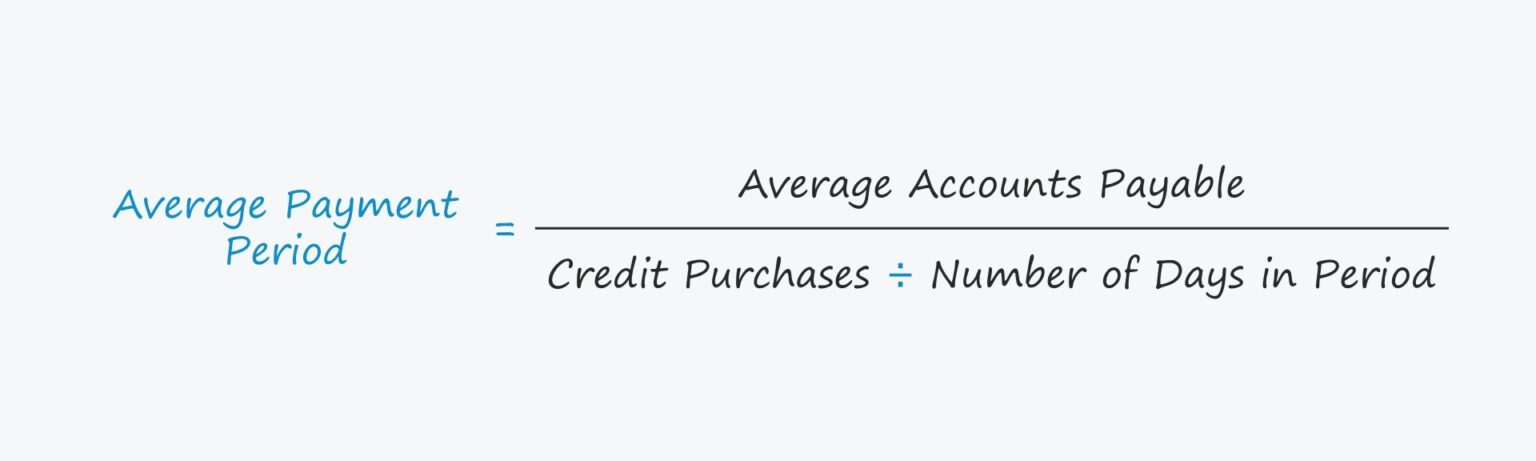
The average payment period counts the number of days it takes a company, on average, to pay off its outstanding supplier or vendor invoices.
For accounts payable to be recognized on the balance sheet, the product or service was delivered to the company as part of the agreement with the supplier.
However, the company has yet to pay the related invoice, so the cash remains under the possession of the company until issued.
Until the company pays the supplier – in the form of cash ("cash outflow") – the outstanding balance is recognized in the accounts payable (A/P) line item on its balance sheet.
While the supplier or vendor delivered the purchased good or service, the company placed the order using credit as the form of payment (and the related invoice has not yet been processed in cash).
Calculating the average payment period can be broken into a three-step process:
The formula for calculating the average payment period is as follows.
Where:
The equation to compute the average accounts payable of a company is as follows.
So, why is the "average" accounts payable balance used?
The reason for using the average balance, rather than the ending balance, is to ensure consistency in the timing of the ratio.
In other words, the credit purchases are measured across the fiscal period, so the average accounts payable balance is usually used.
However, the ending A/P balance is often acceptable in practice, as the insights derived will rarely be that different under either approach, barring unusual circumstances.
In general, the more a supplier relies on a customer, the more negotiating leverage the buyer has in terms of payment periods.
The time between the initial purchase date and the date of actual cash payment (and receipt by the supplier) is oftentimes used as a proxy for a buyer’s bargaining power, i.e. the capability of a company to exert pressure when negotiating terms with its suppliers to receive favorable terms, such as price reductions and extensions of payment due dates.
Companies with more buying power and negotiating leverage typically have the following characteristics:
We’ll now move to a modeling exercise, which you can access by filling out the form below.

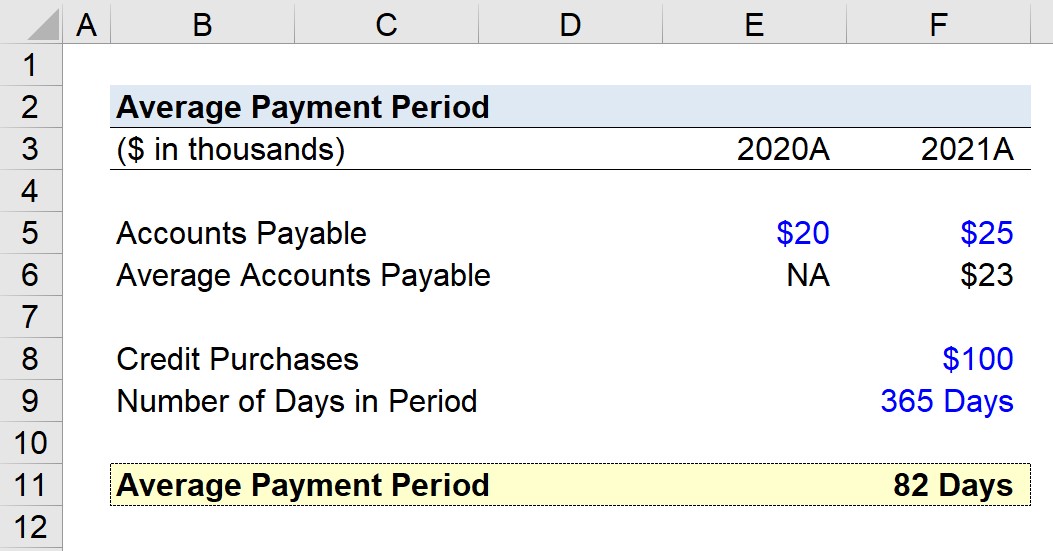
Suppose we’re tasked with calculating the average payment period of a company with an ending accounts payable balance of $20k and $25k in 2020 and 2021, respectively.
Given those two values, the average accounts payable is roughly $23k.
Furthermore, we'll assume our company made $100k in credit purchases in fiscal year 2021.
Since all of our figures so far are on an annual basis, the correct number of days in the accounting period to use in our calculation is 365 days.
In closing, the average payment period for our hypothetical company is approximately 82 days, which we calculated using the formula below.

Enroll in The Premium Package: Learn Financial Statement Modeling, DCF, M&A, LBO and Comps. The same training program used at top investment banks.


No comments yet.