What is Operating Expense Ratio?
The Operating Expense Ratio (OER) measures the proportion of a real estate investment property’s gross income allocated toward operating expenses.

The Operating Expense Ratio (OER) measures the proportion of a real estate investment property’s gross income allocated toward operating expenses.
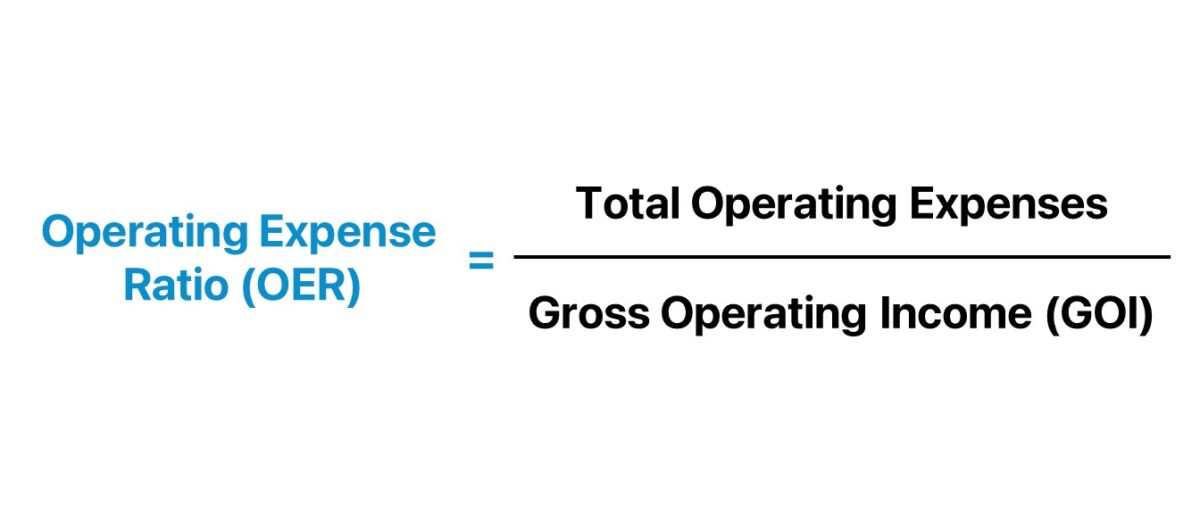
The operating expense ratio (OER) is determined by dividing a real estate property’s operating expenses by its gross operating income (GOI).
The operating expense ratio (OER) can be calculated using the following four-step process.


The operating expense ratio (OER) formula is as follows.
Since the OER formula compares an investment property’s operating expenses to its gross operating income (GOI), the ratio shows the percentage of a property’s gross operating income that can “cover” its operating expense burden.
Level up your real estate investing career. Enrollment is open for the upcoming Wharton Certificate Program cohort.
Conceptually, the operating expense ratio (OER) illustrates the percentage of a property’s gross income to pay off operating expenses.
Therefore, a lower operating expense ratio (OER) is preferred because it implies that a greater percentage of the property’s gross income remains as profit after deducting operating expenses.
Since the operating expense ratio (OER) focuses on the property's operational efficiency, neither financing costs such as mortgage payments and interest nor capital expenditures (Capex) are included in the calculation.
One caveat to a low OER is that the ratio can be reduced by limited reinvestment activity, even for required maintenance Capex, which could potentially cause other issues.
The operating expense ratio (OER) and the capitalization rate, or “cap rate,” are two real estate metrics that serve distinct purposes and offer different perspectives on a potential property investment.
Therefore, the use case of OER is to grasp the cost efficiency of a property’s operations, while the cap rate estimates a property investment's potential return.
We’ll now move to a modeling exercise, which you can access by filling out the form below.

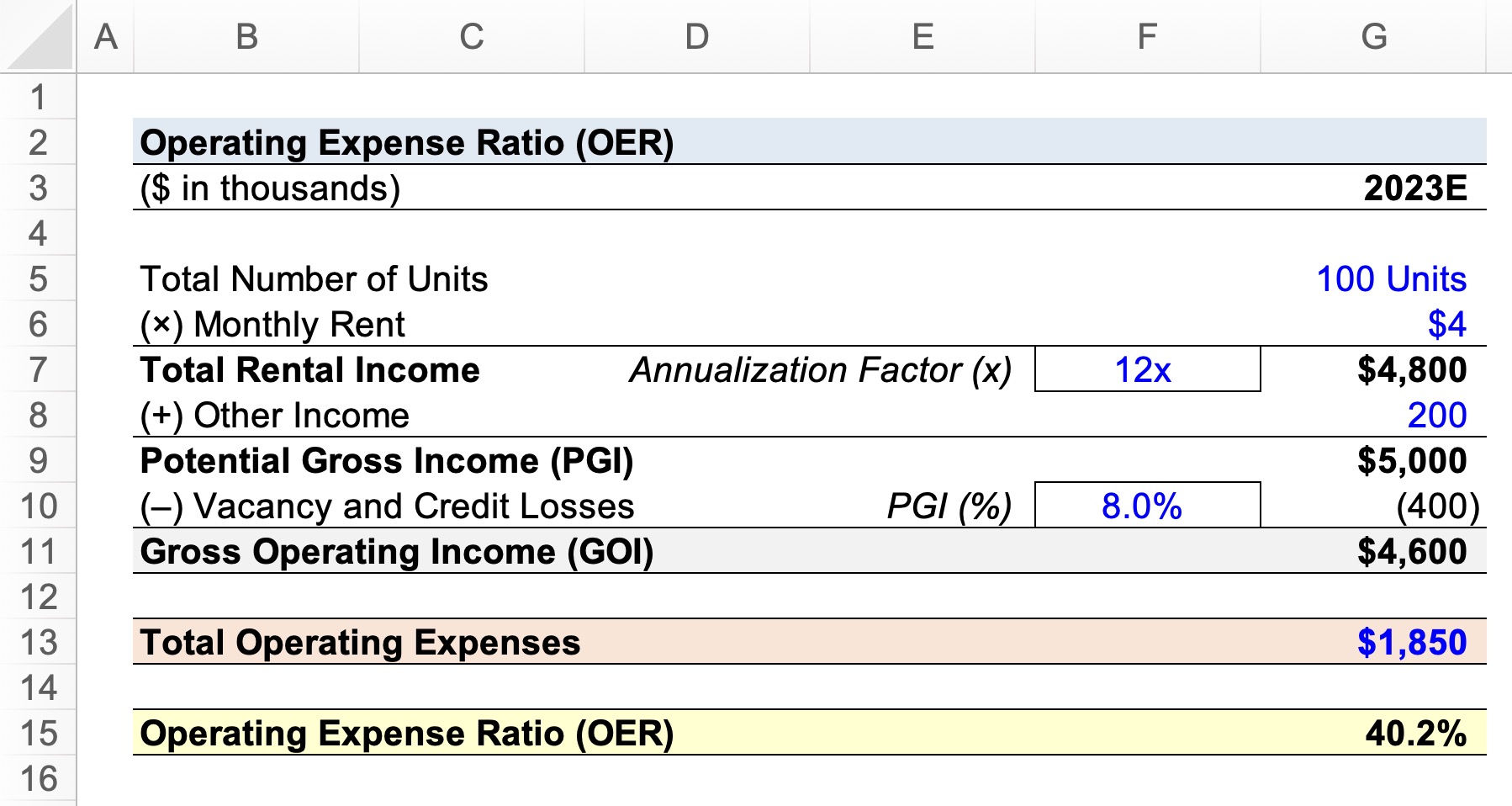
Suppose a real estate investment firm acquired a residential building with 100 units and a market-rate rent of $4k per month.
The product of the total number of units and the monthly rent is $400k, which is the building's total monthly rental income.
Since we're calculating the operating expense ratio (OER) on an annual basis, we'll convert the monthly rental income into an annualized figure by multiplying by 12, i.e. each lease is a twelve-month arrangement.
Furthermore, we'll assume the other income earned on the side by the property amounts to $200k, which we'll add to our total income.
The potential gross income (PGI) comes to $5 million upon computing the sum.
However, the potential gross income (PGI) metric assumes no vacancy losses or credit losses (i.e. collection issues), which is an inevitable part of property management, regardless of the methods used to mitigate risk.
For the vacancy and credit losses, we will attach an 8.0% assumption (of PGI) to estimate the projected losses.
The gross operating income (GOI) is $4.6 million, which we determined by adjusting the potential gross income (PGI) by the vacancy and credit losses.
Our model is now missing only one assumption—the total operating expenses—which we'll assume to be $1.85 million.
In conclusion, we'll divide the residential building's total operating expenses by gross operating income (GOI) to arrive at a 40.2% operating expense ratio.


No comments yet.