What is Funds Available for Distribution?
Funds Available for Distribution (FAD) estimates the capacity of a REIT to generate sufficient cash to distribute dividends to its shareholders, or unit holders.

Funds Available for Distribution (FAD) estimates the capacity of a REIT to generate sufficient cash to distribute dividends to its shareholders, or unit holders.
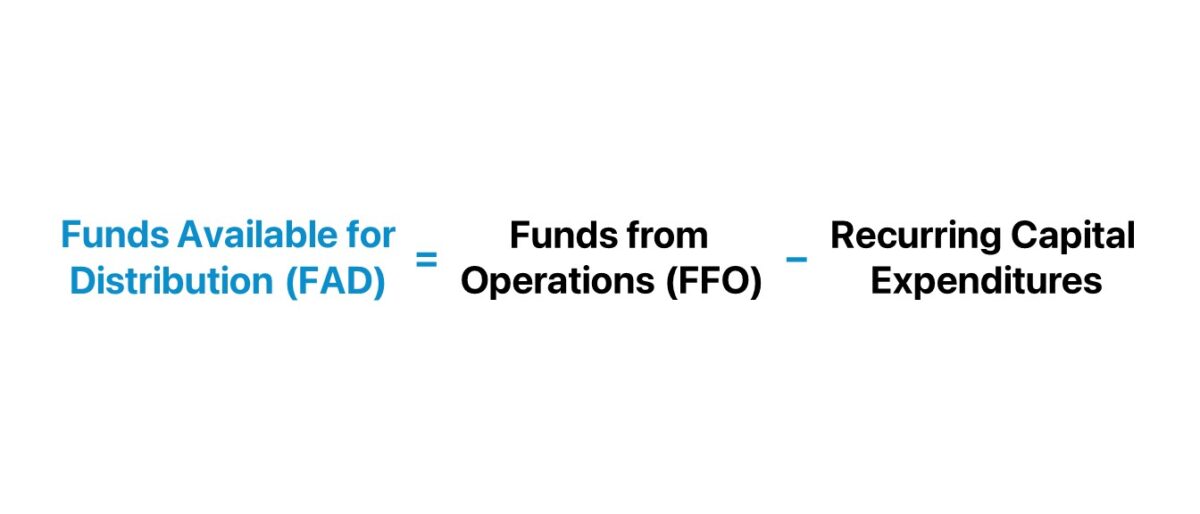
Funds available for distribution (FAD), also referred to as “cash available for distribution” (or “CAD”), quantifies the cash-on-hand of a real estate investment trust (REIT) that can be distributed to shareholders as dividends.
In practice, the funds available for distribution (FAD) metric is tracked in the REIT industry to understand the amount of cash belonging to the fund that is available to be paid out as dividends to compensate shareholders.
REITs own a portfolio of income-producing real estate assets, such as commercial buildings, offices, residential properties, hotels, self-storage facilities, and communities. Per SEC guidance, part of qualifying as a REIT is that the company must distribute a minimum of 90% of its annual taxable income to shareholders in the form of dividends.
Compared to the funds from operations (FFO) metric, the funds available for distribution is perceived as a more conservative measure because the routine, recurring capital expenditures (Capex) incurred by the REIT are factored in.
The calculation of a REIT’s funds available for distribution (FAD) is a three-step process.
However, it is worth noting that there is no standardized method to compute the FAD metric.
The lack of standardization in the FAD metric is one reason that the metric receives less attention than other more standardized real estate metrics, such as funds from operations (FFO), especially when it comes to comparisons between different REITs.


While there may be no standardized formula to calculate the funds available for distribution (FAD) metric, the core components of the formula are the same across most variations, for the most part.
The formula to calculate the funds from operations, the starting point of the funds available for distribution calculation, is as follows.
Two other common adjustments to the FAD calculation are straight-line rent and non-recurring item adjustments.
Level up your real estate investing career. Enrollment is open for the upcoming Wharton Certificate Program cohort.
We’ll now move on to a modeling exercise, which you can access by filling out the form below.

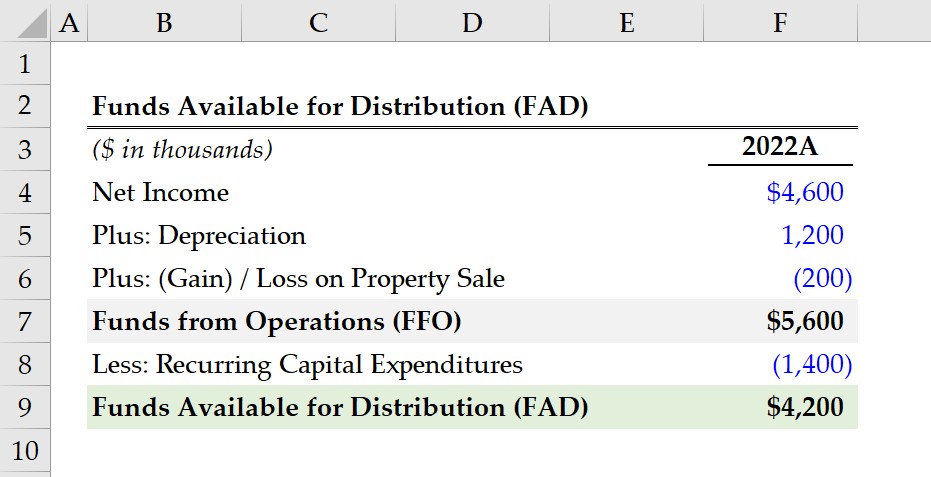
Suppose you’re tasked with calculating the funds available for distribution (FAD) for a REIT that reported the following financials for the fiscal year ending 2022.
Fiscal Year 2022 – Selected Financial Data
Upon adding depreciation to net income and subtracting the gain on the sale of the property (i.e. “cash outflow”), the funds from operations (FFO) amounts to $5.6 million.
For our assumption regarding recurring capital expenditures, we’ll assume the REIT's routine spending on maintenance Capex was $1.4 million in 2022.
In conclusion, we arrive at a funds available for distribution (FAD) of $4.2 million after subtracting our hypothetical REIT’s recurring capital expenditures (Capex) from its funds from operations (FFO).


No comments yet.