A Real Estate Investment Trust (REIT) is a company that owns a portfolio of properties across a range of sectors such as offices, retail, apartments, hospitals, and hotels.
REITs actively invest in the properties themselves, generating income primarily through the collection of rent from tenants.
How Does a REIT Work?
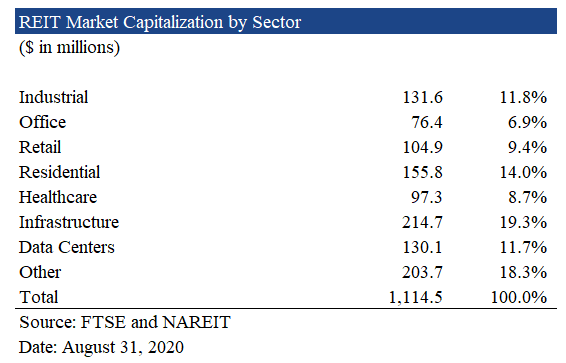
REITs can invest in all property types, although most specialize in specific property types. There are around 160 US public REITs with a combined market cap of $1 trillion (Globally, there are 300 REITs with a market cap of $3 trillion).
Most REITs are publicly traded, which enables investors to gain access to a diversified collection of income-producing real estate similar to investing in mutual funds. Unlike regular companies that can hold on to their profits, REITs must distribute at least 90% of their profits every year back to shareholders in the form of dividends.
As a result of the dividend requirement, the dividend yield on REIT stocks is above 4% - significantly higher than the 1.6% dividend yield for the S&P 500 overall.
In addition to facilitating diversification and high dividend yield, the other major benefit of REITs over other forms of real estate investment is the tax advantages.
Real Estate Interview Guide | File Download Form
You’re logged in! Form submission not required. Access your file below.
REITs are a tax-efficient, diversified alternative to direct real estate ownership and investment.
Rather than having to buy and maintain actual physical real estate properties, investors can simply own REIT shares, which are backed by physical assets managed by the REIT.
Feature
REITs
Real Estate
Liquidity (Easy to buy and sell)
Advantage
Low capital intensity (Doesn't require a lot of capital to invest upfront)
Advantage
Diversification (Easy to invest in multiple property types across geographies)
Advantage
Control (Influence on management and strategy)
Advantage
What are the Historical Returns on REITs?
Contrasting REIT vs Real Estate returns is a little more complicated.
REITs have generated 10% in annualized returns over the long run (including the last 10 years).
Meanwhile, real estate assets have grown at 2-3% annually, seemingly giving an advantage to REITs. However, this is not an apples-to-apples comparison.
A huge accelerator of returns is leverage: The average debt / total value for Equity REITs is 37.0% as of 2020 (Source: NAREIT).
Meanwhile, direct real estate investment can range widely, but at the high end, investors can secure debt upwards of 80% of the total property value, which all else equal amplifies returns (and risk) significantly.
Continue Reading Below
The Wharton Online and Wall Street Prep Real Estate Investing & Analysis Certificate Program
Level up your real estate investing career. Enrollment is open for the upcoming Wharton Certificate Program cohort.
Below is a list of the top 20 largest public REITs in the world, by market cap:
Ticker
Name
Market Capitalization ($mm)
AMT
American Tower Corp.
$10,7318
PLD
Prologis, Inc.
$73,278
CCI
Crown Castle International Corp.
$69,955
SPG
Simon Property Group, Inc.
$42,863
DLR
Digital Realty Trust, Inc.
$38,576
PSA
Public Storage
$38,346
WELL
Welltower, Inc.
$22,830
AVB
AvalonBay Communities, Inc.
$20,999
O
Realty Income Corp.
$20,919
WY
Weyerhaeuser Co.
$20,686
EQR
Equity Residential
$20,331
ARE
Alexandria Real Estate Equities, Inc.
$20,071
HCP
Healthpeak Properties, Inc.
$17,708
VTR
Ventas, Inc.
$15,554
EXR
Extra Space Storage, Inc.
$14,546
SUI
Sun Communities, Inc.
$14,341
DRE
Duke Realty Corp.
$13,703
ESS
Essex Property Trust, Inc.
$13,529
MAA
Mid-America Apartment Communities, Inc.
$13,172
BXP
Boston Properties, Inc.
$12,528
What are the Tax Advantages of REITs?
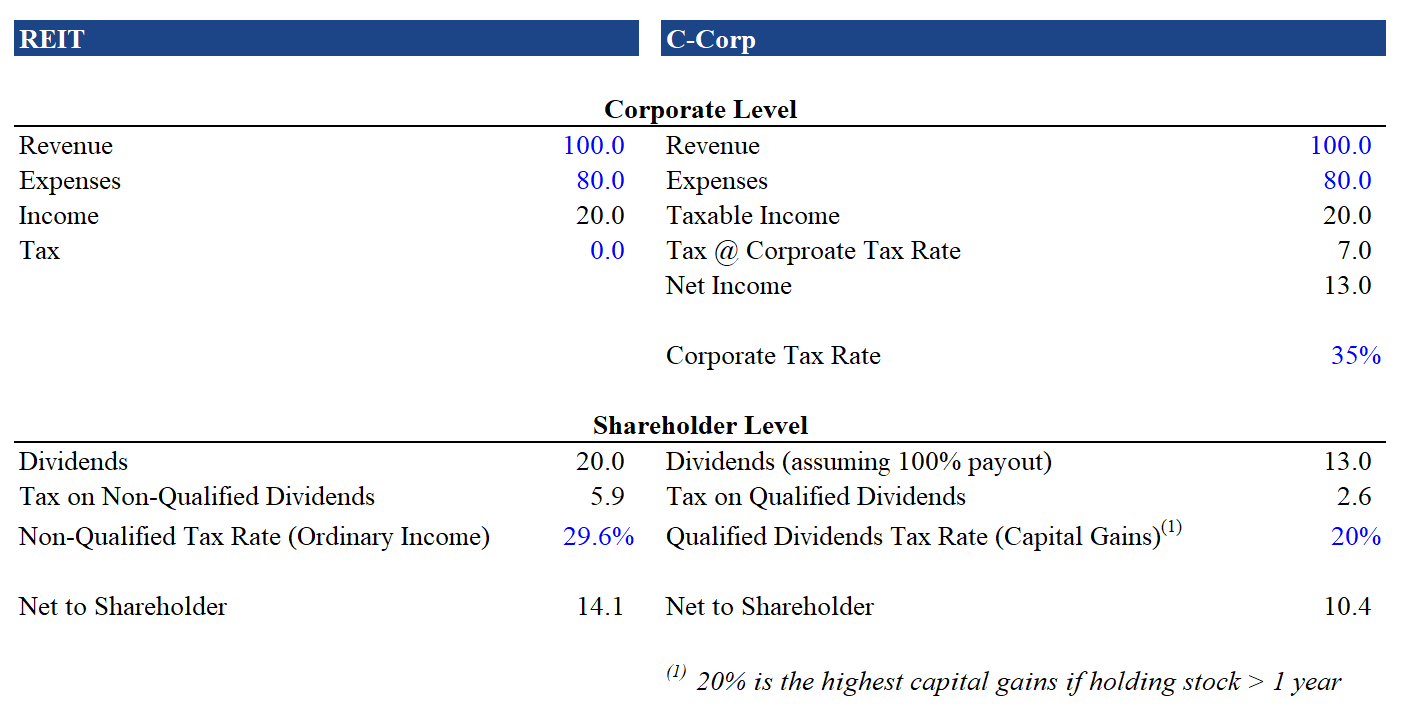
Entities qualifying for REIT status under the tax code receive preferential tax treatment: The income generated by REITs is not taxed on the corporate level and is instead taxed only on the individual shareholder level.
Specifically, REIT profits pass through – untaxed –to shareholders via dividends.
This is a tax advantage over C-corporations, which are taxed twice - first, on the corporate level, and then a second time on the individual level via a tax on dividends.
In order to qualify for this tax status, REITs must comply with certain requirements, the biggest one being that REITs are required to distribute nearly all profits (at least 90%) as dividends
What are REIT Dividends?
REIT dividends are cash distributions to REIT shareholders. REITs distribute almost all of their profits as dividends.
REIT dividends are typically “non-qualified” dividends, meaning they are taxed at ordinary income tax rates (up to 29.6%1), as opposed to the lower capital gains (up to 20%) on the shareholder level.
That doesn't sound so great but remember that this is the only tax the investor pays because REITs entirely avoid a corporate-level tax.
In contrast, in a C-corp, there is a corporate-level tax (up to 21%), followed by a second tax on any dividends distributed to shareholders (albeit at the lower capital gains rate of 20% because C-corp dividends are typically “qualified dividends”).
REIT vs. C-Corp: What is the Difference?
This simple illustration shows the basic difference between the single pass-through taxation of a REIT and the double taxation of a C-corp.
Note, however, the following model is a simplification of a rather complex topic.
REIT tax rules can get quite complicated, especially if tax breaks for depreciation are brought into the picture, which can further increase the tax advantages of REITs.
Excel Template
You’re logged in! Form submission not required. Access your file below.
Gain from the sale of real property/shares of other REITs
Certain qualified investment income
At least 95% of gross income must come from
All of the above, plus:
Dividends, interest, and gain on sale from non-real estate investments
Assets
At least 75% of assets must be
Real estate, mortgages, equity in other REITs, cash, and government securities
Subsidiaries
A REIT’s taxable subsidiaries (companies providing services to tenants in REIT buildings) must be < 25% of the REIT’s assets
Their income does not count toward the 75% income test
Shareholders
Shares must be owned by at least 100 shareholders
Must have transferrable shares
No more than 50% of shares outstanding can be owned by 5 or fewer people (“5/50 test”)
Although not a legal requirement, virtually all REITs limit individual ownership to 9.9%
Entity
Must be a domestic corporation for federal tax purposes
Cannot be a financial institution or insurance company
Must have a calendar year tax year
What are the Different Types of REITs?
Equity vs. Mortgage REITs
Most REITs directly own the real estate and are called equity REITs. However, a few REITs simply own mortgages (Mortgage REITs) and collect income (interest income) from the mortgages.
REIT Type
Description
Equity
90% of total
Equity REITs acquire, develop, and then operate its own properties, unlike other real estate companies which tend to resell once developed
Mortgage10% of total
Purchase debt (real estate loans and mortgage-backed securities)
Internal vs. External Management
REITs can be internally or externally managed
REIT Type
Description
Internal management
Management are employees of the REIT
Majority of public REITs are internally managed
External management
Similar to private equity, external management receives flat and incentive fees for managing the real estate portfolio
Flat fee based on assets under management
Incentive fee based on returns from the sale of assets
Typically incentive fee carries a high water mark (i.e. only kicks in if NAV exceeds the highest historical NAV)
Private and mortgage REITs tend to be externally managed
How to Analyze REITs?
When valuing REITs, investors look at both traditional profit metrics such as EBITDA, as well as real estate and REIT-specific metrics, including:
Net operating income, or "NOI", is the most important profit measure in real estate.
NOI strives to isolate to core operating profits of real estate assets, so as to avoid muddying the waters with non-operating items such as corporate overhead and major non-cash items like depreciation.
In a sense, NOI is similar to EBITDA, but with even more add-backs to really focus on pure operating income generated by the properties.
Net Operating Income (NOI) = Rental and Ancillary Income – Direct Real Estate Expenses
Thus, NOI captures profitability before any depreciation, interest, taxes, corporate-level SG&A expenses, capital expenditures, or financing payments
While NOI is a useful profit measure for analyzing real estate down to the property level, FFO is a real estate-specific metric for cash generated from operations.
FFO is an attempt to reconcile accounting (GAAP) net income to a consistent measure of profit specifically tailored for analysis of REITs. In fact, most REITs provide FFO reconciliations in their filings.
Funds From Operations = Net Income to Common + Depreciation – Gains on Sale + Non-Controlling (NCI) Interest Expense, net of NCI Cash Dividends
While often misunderstood, FFO is NOT actually designed to be a measure of cash flow because the formula excludes working capital, capital expenditures (Capex), and other cash flow adjustments
The cap rate, along with NOI are arguably the most important metrics in real estate. Unlike NOI or FFO, however so far, the cap rate is not actually a measure of profit, but rather a yield measure.
It measures the real estate property's operating profit as a % of the property's value. If you're familiar with EV/ EBITDA multiples, the closest thing to a cap rate is an inverse EBITDA multiple.
Cap rates are the primary shorthand by which different real estate properties are compared by investors. For example a property with a 10% cap rate provides a better yield than a comparable property with a 7% cap rate.
Cap Rate = Net Operating Income (NOI) ÷ Market Value of Property
Capitalization Rate Calculation Example
A property with an asking price of $1m and NOI of $125k will have a $125k / $1 m = 12.5% cap rate
As we've noted, cap rates are simply the inverse of a traditional valuation multiples like EV/EBITDA.
What Factors Influence the Cap Rate?
Just as with traditional multiples, there are many variables that can distort the comparison of properties using this metric, including:
Timing of NOI (LTM or forward)
Growth rates
Returns on capital
Cost of capital of properties (or REITs) being compared
However, in real estate, it is much easier to find comparable properties (with therefore similar growth, returns, and cost of capital profiles), which mutes the problems described above.
A REIT model will first forecast the financial statements and then apply the valuation methodologies discussed above to arrive at an investment thesis.
The key challenges in modeling REITs include modeling individual (same-store properties, acquisitions, developments, and dispositions) using the appropriate drivers and occupancy rate assumptions: Obviously mature properties with stable occupancy rates will have a different forecast profile than properties under development.
A second challenge is working with a real company's financial statements. This requires digging into a REIT's financial statements and ensuring consistent and logical modeling of REIT-specific metrics and ratios like funds from operations (FFO) and adjusted funds from operations (AFFO / CAD).
What are the REIT Valuation Methods?
So, how can the value of a REIT be determined?
In practice, analysts primarily value REITs using the following four approaches:
The biggest difference between REITs and these other real estate companies is that REITs are publicly traded and report earnings quarterly.
From a strategy perspective, REITs tend to have a much lower risk tolerance than private real estate investment firms, which results in REITs’ portfolios consisting of primarily core assets (meaning more stable, lower cap rates), an aversion to redevelopment and development, and much less acquisition and disposition activity. Asset management roles are featured prevalently at most REITs.
1 The top marginal tax rate on ordinary income is 37% but REITs get a 20% deduction, dropping the rate down to 29.6%







No comments yet.