REIT Valuation Methods
REIT Valuation is commonly performed by analysts using the following 4 approaches:
- Net asset value (“NAV”)
- Discounted cash flow (“DCF”)
- Dividend discount model (“DDM”)
- Multiples and cap rates

REIT Valuation is commonly performed by analysts using the following 4 approaches:

Companies operating in industries like technology, retail, consumer, industrials, and healthcare are valued using cash flow or income-based approaches, like the discounted cash flow analysis or Comparable Company Analysis.
By contrast, the Net Asset Value ("NAV") and dividend discount model ("DDM") are the most common REIT valuation approaches.
So, what's different about REITs?
With these other types of companies, the values of the assets that sit on their balance sheets do not have efficient markets from which to draw valuations.
If you were to try to value Apple by looking at its balance sheet, you would be grossly understating Apple's true value because the value of Apple's assets (as recorded on the balance sheet) are recorded at historical cost and thus do not reflect its true value.
But REITs are different. The assets sitting in a REIT are relatively liquid, and there are many comparable real estate assets constantly being bought and sold. That means that the real estate market can provide much insight into the fair market value of assets comprising a REIT’s portfolio.
In addition, REITs have to pay out nearly all of their profits as dividends, making the dividend discount model another preferable valuation methodology.


| REIT Type | Description |
|---|---|
| Net asset value (“NAV”) |
|
| Discounted cash flow (“DCF”) |
|
| Dividend discount model (“DDM”) |
|
| Multiples and cap rates | The 3 most common metrics used to compare the relative valuations of REITs are:
|
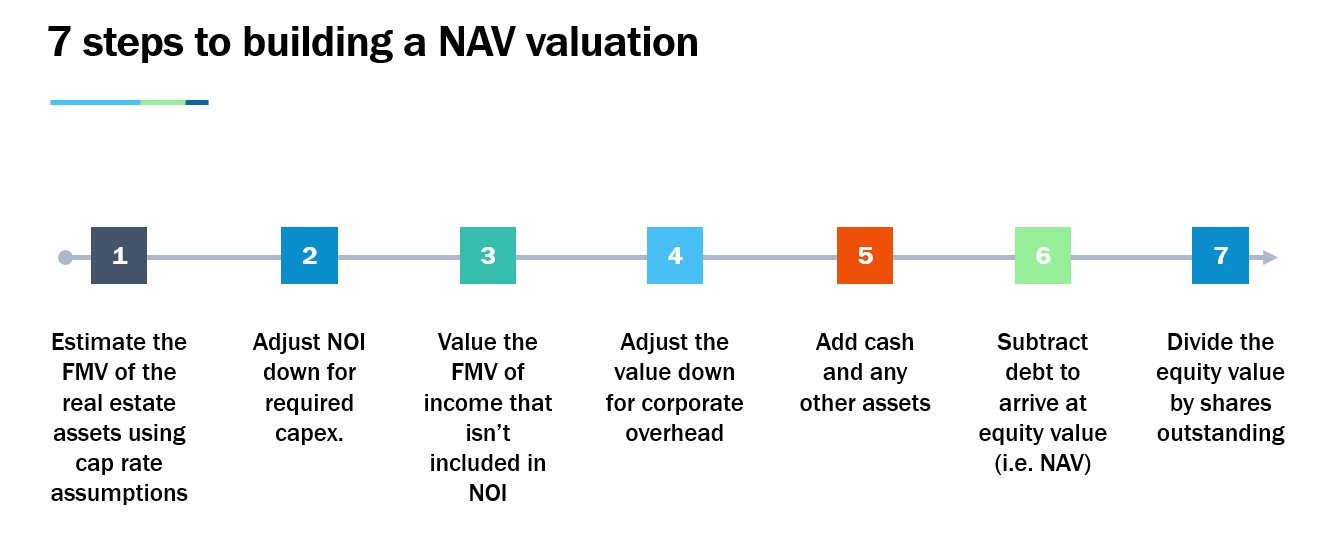
The NAV valuation is the most common REIT valuation approach. Below is the 7-step process for valuing a REIT using the NAV approach.
Level up your real estate investing career. Enrollment is open for the upcoming Wharton Certificate Program cohort.
This is the most important assumption in the NAV. After all, a REIT is a collection of real estate assets - adding them up should give investors a good first step in understanding the overall REIT value.
Process:
REITs must make regular capital investments in their existing properties, which is not captured in NOI, and the result is that Capex is sometimes left out entirely or grossly underestimated in the NAV.
However, ignoring the recurring cost of capex will overstate the valuation, so a proper NAV valuation must reduce the NOI down to the expectation for required annual capital expenditures.
Income streams not included in NOI, like management fees, affiliates and JV Income, also create value and should be included in the NAV valuation.
Typically, this is done by applying a cap rate (which can be different from the rate used to value the NOI-generating real estate) to the income not already included in the NOI.
Now that you've counted the value of all the assets, make sure to adjust the valuation down by corporate overhead - this is an expense that does not hit NOI and needs to be reflected in the NAV to not overstate the valuation. The common approach is to simply divide the forecast for next year's corporate overhead by the cap rate.
If the REIT has any cash or other assets not already counted, add them usually at their book values, perhaps adjusted by a premium (or more rarely a discount) as deemed appropriate to reflect market values.
Debt, preferred stock and any other non-operating financial claims against the REIT must be subtracted to arrive at equity value. What's more, these obligations need to be reflected at fair market value. However, practitioners often simply use book value for liabilities because of the presumed small difference between book and fair value.
At this point, the NAV will arrive at the equity value for the REIT. The final step is to simply convert this to an equity value per share.
This is the final step to arrive at the NAV per share. For a public REIT, the NAV-derived equity value is compared against the public market capitalization of the REIT. After accounting for potentially justifiable discounts or premiums to NAV, conclusions about whether the REIT’s share price is overvalued or undervalued can then be made.
Want to learn how to perform a REIT valuation the way you would as a real estate investor?
Our REIT Modeling program uses a real case study to go through the REIT Modeling process step-by-step, exactly the way it's done by professional REIT investors and investment bankers.


We should use the Financial Debt or all the liabilities?
Alberto:
Under the NAV approach, you should deduct out all liabilities.
Best,
Jeff
Agree with Jeff