What is FCF Margin?
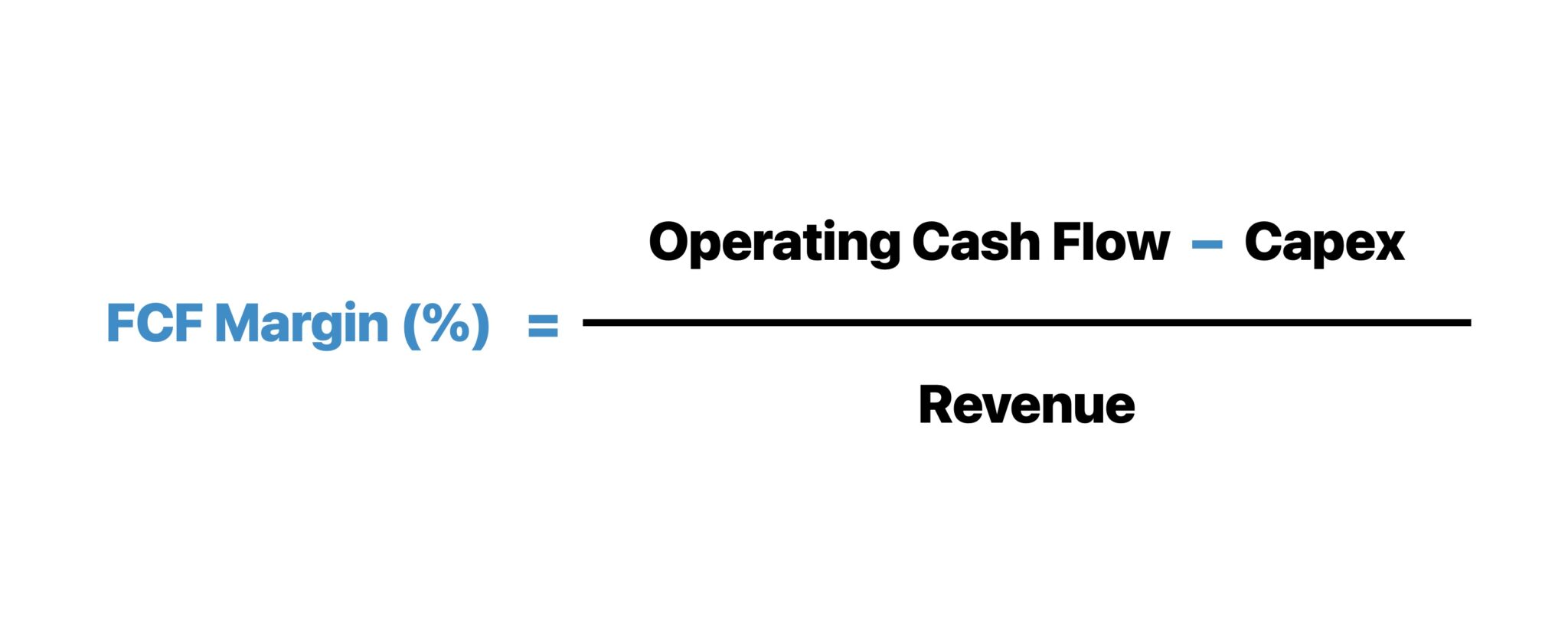
The FCF Margin is a company’s operating cash flow minus its capital expenditures (Capex) in a specified period, expressed as a percentage of revenue.

The FCF Margin is a company’s operating cash flow minus its capital expenditures (Capex) in a specified period, expressed as a percentage of revenue.
The free cash flow margin—or "FCF margin”—is a profitability ratio that compares a company's free cash flow to its revenue to understand the proportion of revenue that becomes free cash flow (FCF).
Therefore, the FCF margin measures the efficiency at which a company can convert its revenue into free cash flow.
The simplest variation of the FCF margin is calculated by taking a company's cash flow from operations and deducting capital expenditures (Capex) since it is a recurring, core expense.
The starting point of the operating cash flow (OCF) calculation is net income from the accrual-based income statement.
From there, net income is adjusted for non-cash expenses (e.g. depreciation and amortization) and changes in net working capital (NWC).
There are several types of free cash flow metrics, such as free cash flow to firm (FCFF) and free cash flow to equity (FCFE), which are intended to measure a company's discretionary cash flow.
The difference between the two FCF metrics, however, comes down to the investor group(s) represented.
Each variation of free cash flow discussed thus far can be divided by revenue to reflect the proportion of a company's revenue remaining for the investor group in the form of discretionary cash.
The free cash flow margin answers, “For each dollar of revenue generated, what percent gets converted into free cash flow (FCF)?”
Companies with an abundance of discretionary free cash flow tend to operate more efficiently with higher profit margins, while possessing more cash to reinvest in their operations (i.e. funding working capital and capital expenditures).
Furthermore, the FCF margin can also be useful for understanding a company's capital intensity.
The capital intensity of a company refers to its reliance on capital expenditures (Capex) to drive revenue, including the percentage contribution from growth versus maintenance Capex.
The FCF margin formula subtracts the capital expenditure (Capex) of a company from its operating cash flow (OCF), and then divides that figure by revenue.
The free cash flow metric we use here is the simplest variation, wherein a company's capital expenditures are subtracted from its operating cash flow (OCF).
We’ll now move on to a modeling exercise, which you can access by filling out the form below.


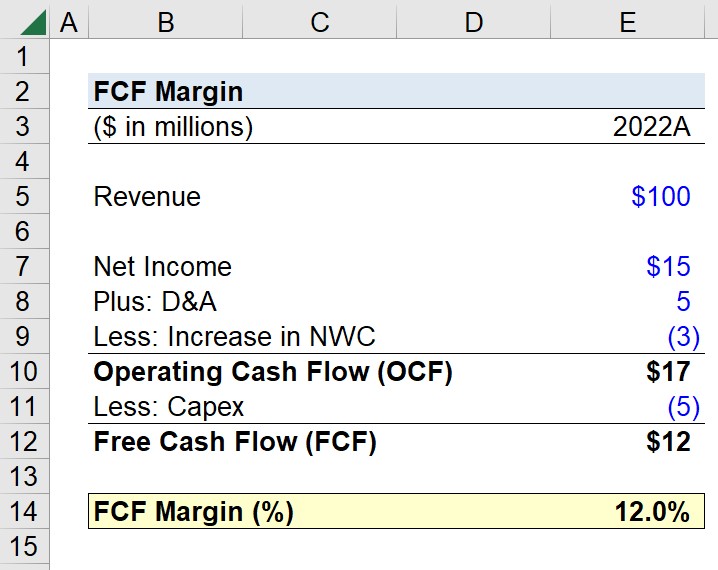
Suppose you're tasked with calculating the FCF margin of a company that generated $100 million in fiscal year 2022.
Over the same period, the company's net income was $15 million, D&A and Capex were both $5 million, and the change in net working capital (NWC) was an increase of $3 million.
To calculate the operating cash flow (OCF), we'll add back the non-cash depreciation expense to net income and subtract the increase in NWC to arrive at an OCF of $17 million.
The next step is to deduct our Capex assumption from our operating cash flow (OCF), which results in our company's free cash flow (FCF).
In 2022, our company's free cash flow (FCF) was $12 million, which we'll divide by the net revenue generated in the corresponding period ($100 million) to arrive at a FCF margin of 12%.

Enroll in The Premium Package: Learn Financial Statement Modeling, DCF, M&A, LBO and Comps. The same training program used at top investment banks.


No comments yet.