What is Adjusted EBITDA Margin?
The Adjusted EBITDA Margin measures the core operating profitability of a company on a normalized basis, i.e. inclusive of only items related to core business activities.

The Adjusted EBITDA Margin measures the core operating profitability of a company on a normalized basis, i.e. inclusive of only items related to core business activities.
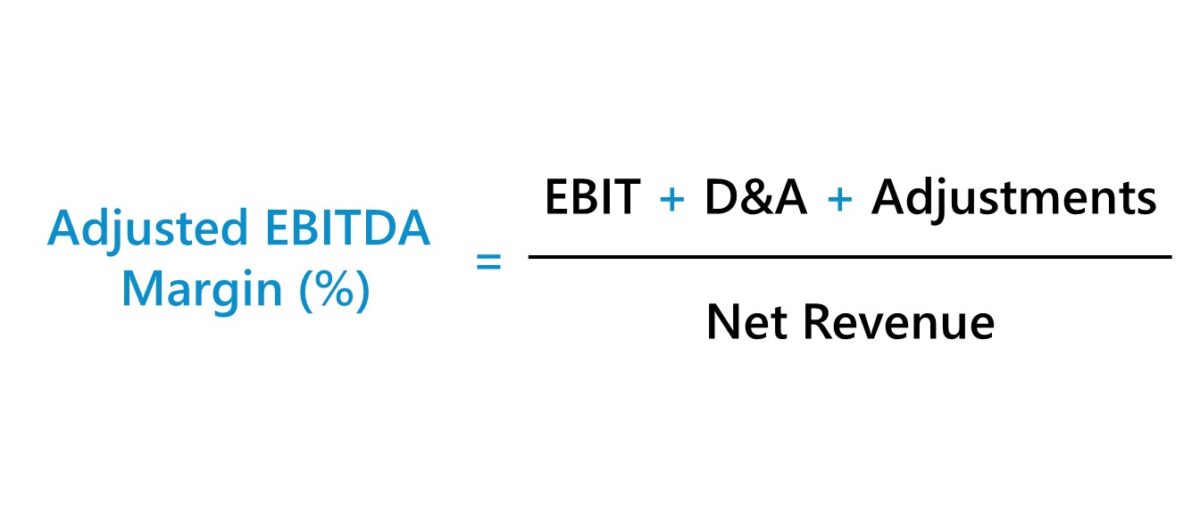
The adjusted EBITDA margin is the ratio between a company’s adjusted EBITDA and net revenue, expressed as a percentage.
At the most basic level, the traditional calculation of EBITDA comprises adding depreciation and amortization to EBIT, otherwise known as “operating income”. D&A is an add-back to the cash flow statement, as well as for free cash flow calculations (e.g. FCFF, FCFE), since no actual movement of cash occurred.
The movement from EBITDA to adjusted EBITDA is where most discrepancies and differences in opinion arise.
EBITDA is a non-GAAP metric, so the adjusted EBITDA metric expands the room for management discretion (and the risk of inflated earnings) even further.
The formula to calculate the adjusted EBITDA margin is equal to adjusted EBITDA divided by revenue.
Where:
There is no standardized approach to calculating the adjusted EBITDA metric, which is the source of much criticism, as mentioned earlier.
In general, the most commonly accepted add-backs with relatively minimal push-back are the following:
The adjusted EBITDA metric is most prevalent in M&A, although public companies have increasingly started to present their own non-GAAP metrics, such as in press releases and earnings reports.
EBITDA reflects the core operating performance of a company and is not affected by non-core items like interest expense, gains or losses on asset sales, and impairments, among others.
Because EBITDA is independent of the capital structure (i.e. discretionary financing decisions) and hones in on the core operations of the company, the metric is widely used by equity analysts and investors, both on the retail and institutional side.
In theory, the adjustments offer more transparency to the investor (or acquirer) and portray the true financial state of the company. The problem that emerges, however, is determining which items qualify as an adjustment and which criteria to apply.
Thus, references to an acquisition target’s historical profitability are most often alluding to the adjusted EBITDA margin or adjusted operating margin metrics.
Once past the letter of intent (LOI) stage, a significant portion of the diligence conducted by the acquirer (or team of M&A advisors) is to verify each of the adjustments made to EBITDA and to ensure no material item was missed, followed by further negotiations with the seller and the sell-side advisor.
We’ll now move on to a modeling exercise, which you can access by filling out the form below.


Suppose you’re tasked with calculating the adjusted EBITDA of Twitter in Q-2 of 2022, before the social media company underwent a privatization.
The financial data that we’ll use in our exercise are as follows.
| Selected Financial Data ($ in 000s) | Q2-2022 |
|---|---|
| Revenue | $1,176,660 |
| Net Income / (Loss) | ($270,007) |
| Stock-Based Compensation | 282,190 |
| Depreciation and Amortization (D&A) | 173,288 |
| Interest and Other Expense / (Income) | (7,869) |
| Income Taxes | (65,897) |
While not recommended on the job, we’ll be taking Twitter’s internal adjustments at face value, for the sake of time.
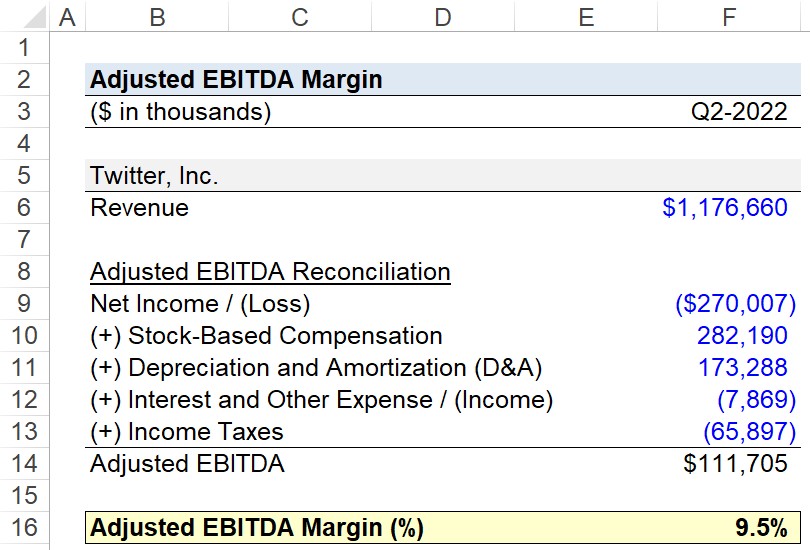
Starting from net income, we’ll make a total of four adjustments.
Once the four adjustments are made, we’re left with an adjusted EBITDA of $111.7 million, which is equivalent to the reported amount in Twitter’s Q2-22 filing.
In the final part of our exercise, we’ll calculate Twitter’s adjusted EBITDA margin in Q2-2022.
Since we have the two required inputs—adjusted EBITDA and revenue—we can enter them into our formula from earlier to arrive at an adjusted EBITDA margin of 9.5%.

Enroll in The Premium Package: Learn Financial Statement Modeling, DCF, M&A, LBO and Comps. The same training program used at top investment banks.


No comments yet.