What is SOTP?
Sum of the Parts Analysis (SOTP), or “break-up analysis”, estimates the value of each business segment within a company separately, which are then added together to arrive at the company’s implied total enterprise value.

Sum of the Parts Analysis (SOTP), or “break-up analysis”, estimates the value of each business segment within a company separately, which are then added together to arrive at the company’s implied total enterprise value.
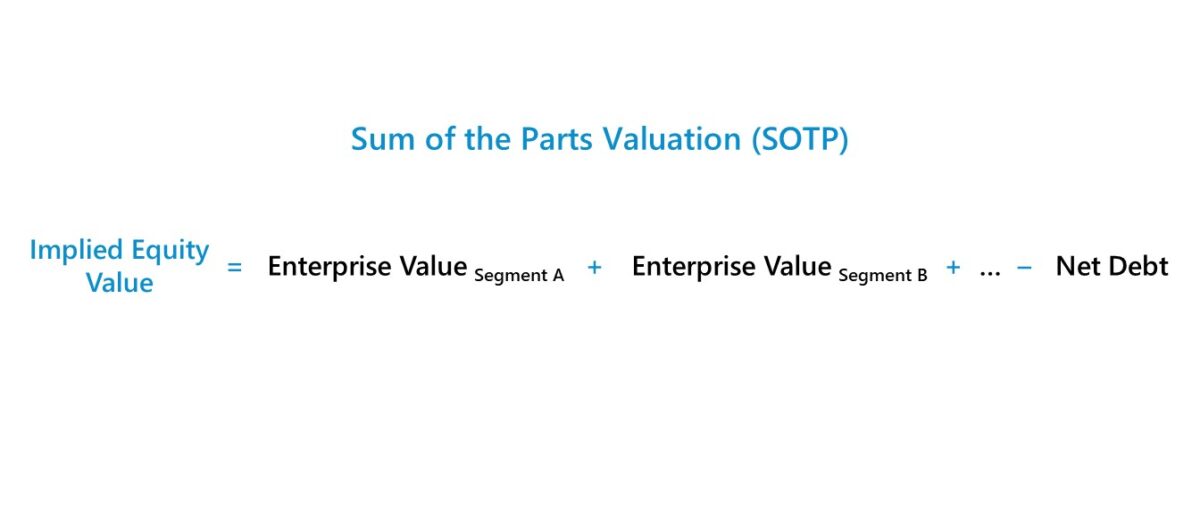
The sum-of-the-parts valuation (SOTP) is most appropriate for valuing companies with multiple divisions that are each distinct from one another from a risk/return standpoint, creating the need to “break up” the company into separate components for the valuation to be more accurate.
For companies suitable for a SOTP valuation, under the discounted cash flow approach (DCF), each of their segments would adhere to a different discount rate, which means the expected returns (and coinciding risks) of each individual segment would differ.
If attempting to value the company through multiples analysis – either via comparable company analysis (trading comps) or precedent transactions (transaction comps) – it’ll be quite challenging to determine a single appropriate trading or transaction multiple, considering just how widespread the implied ranges will be across the different business segments.
The SOTP valuation methodology can be broken into four steps:
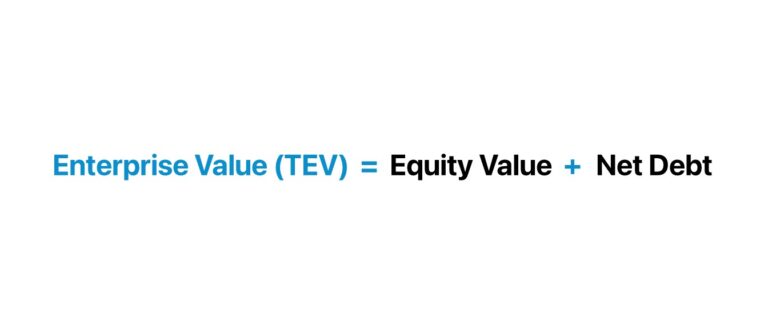
From the total enterprise value (TEV), or "total firm value", the company's total net debt (gross debt less cash and equivalents) yields the implied equity value, i.e. the residual value attributable to only common shareholders.
By dividing the implied equity value by the total number of shares outstanding, we arrive at the SOTP-derived share price, which can then be compared to the current pricing in the open markets to determine if the shares are undervalued, overvalued, or fairly valued.
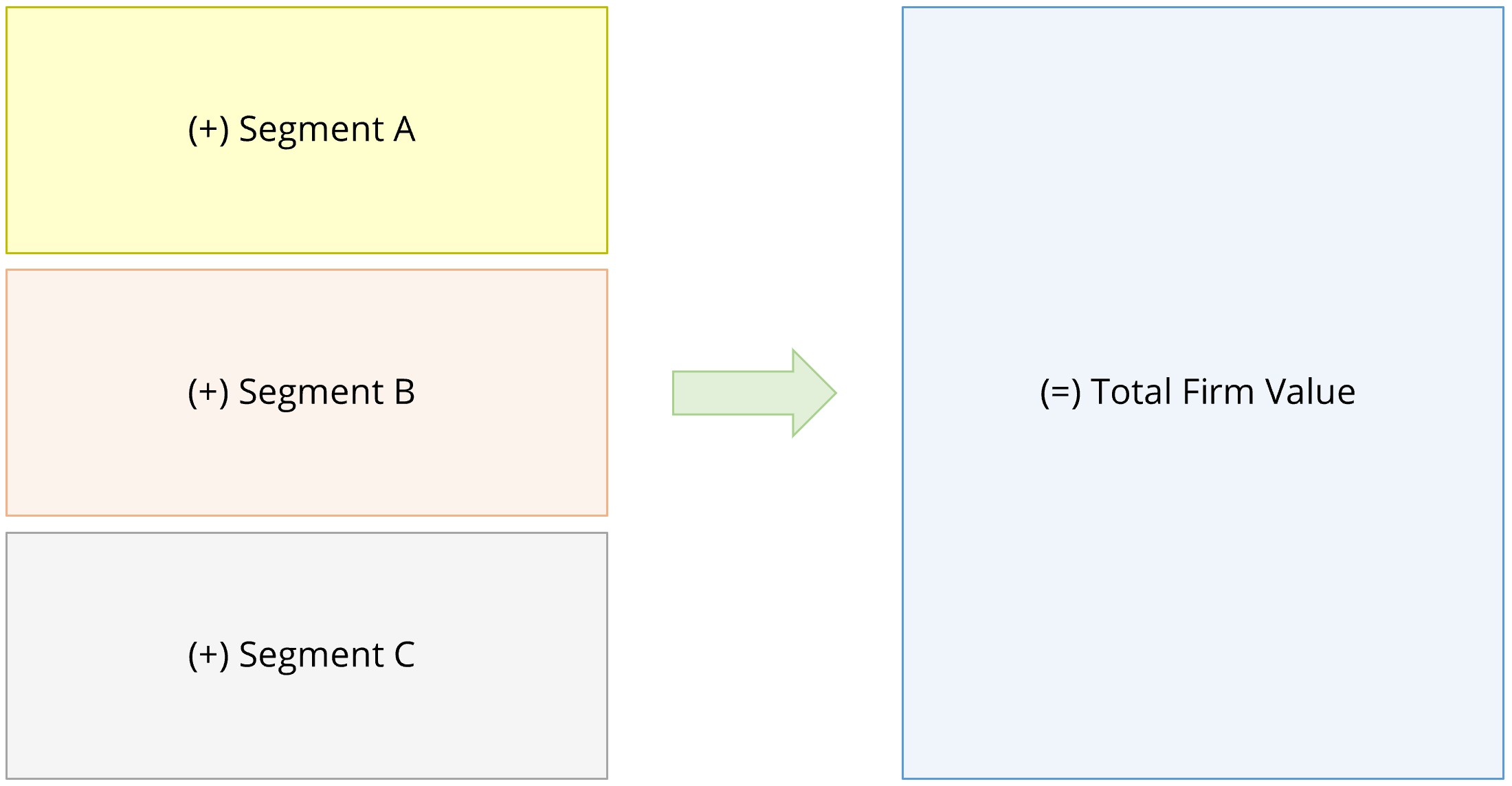
As implied by the name, SOTP entails valuing each underlying piece of a company separately and then adding them together, rather than valuing the entire company in aggregate using traditional means.
The objective of SOTP is to value each part of the company separately and then add all the calculated values together. Then, upon deducting net debt from the enterprise value, the implied equity value can be derived.

Once the sum of each segment's firm values (TEV) has been determined, the remaining step is to subtract net debt and any non-operating assets or liabilities unrelated to shareholders in order to calculate equity value, as mentioned in the prior section.
One sector in which SOTP analysis is relied upon is the biotech sector, particularly for clinical-stage, pre-revenue companies.
Performing a valuation on a biotech company requires a wide range of assumptions per therapeutic asset – such as the estimated market size, revenue potential ("peak opportunity") and uptake curve post-product launch – as well as the probability of success (POS) rate.
The product-level assumptions are intended to address the uncertainties surrounding a product's path to commercialization, namely the clinical FDA trials as part of the regulatory approval process.
Earlier-stage therapeutic assets, compared to those in the later stages of obtaining regulatory approval (or even commercialization), have a far lower probability of success and are therefore inherently riskier. Hence, a robust biotech SOTP model must account for such contingencies.
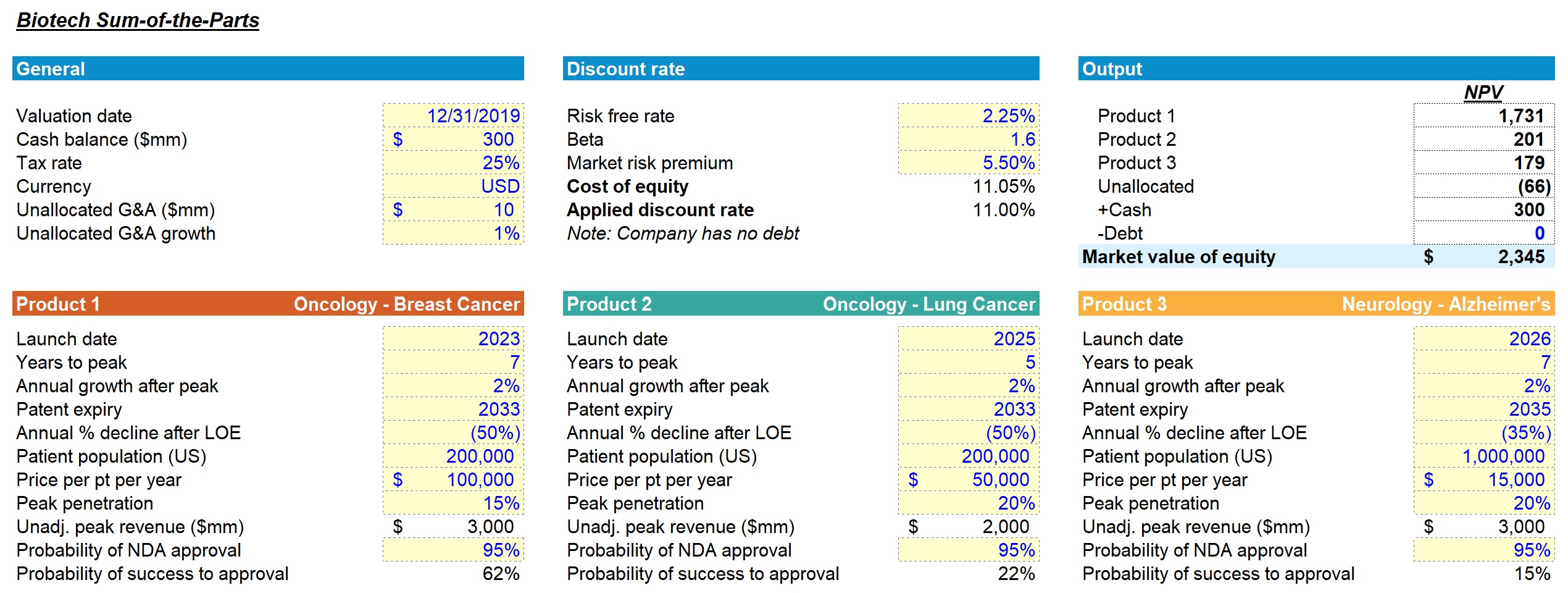
Biotech Sum-of-the-Parts Dashboard (Source: Biotech SOTP Valuation Course)
SOTP valuations are often used when the target has several operating divisions in unrelated industries, each with different risk profiles. For instance, a conglomerate like Berkshire Hathaway, which states the following business divisions in its annual report.
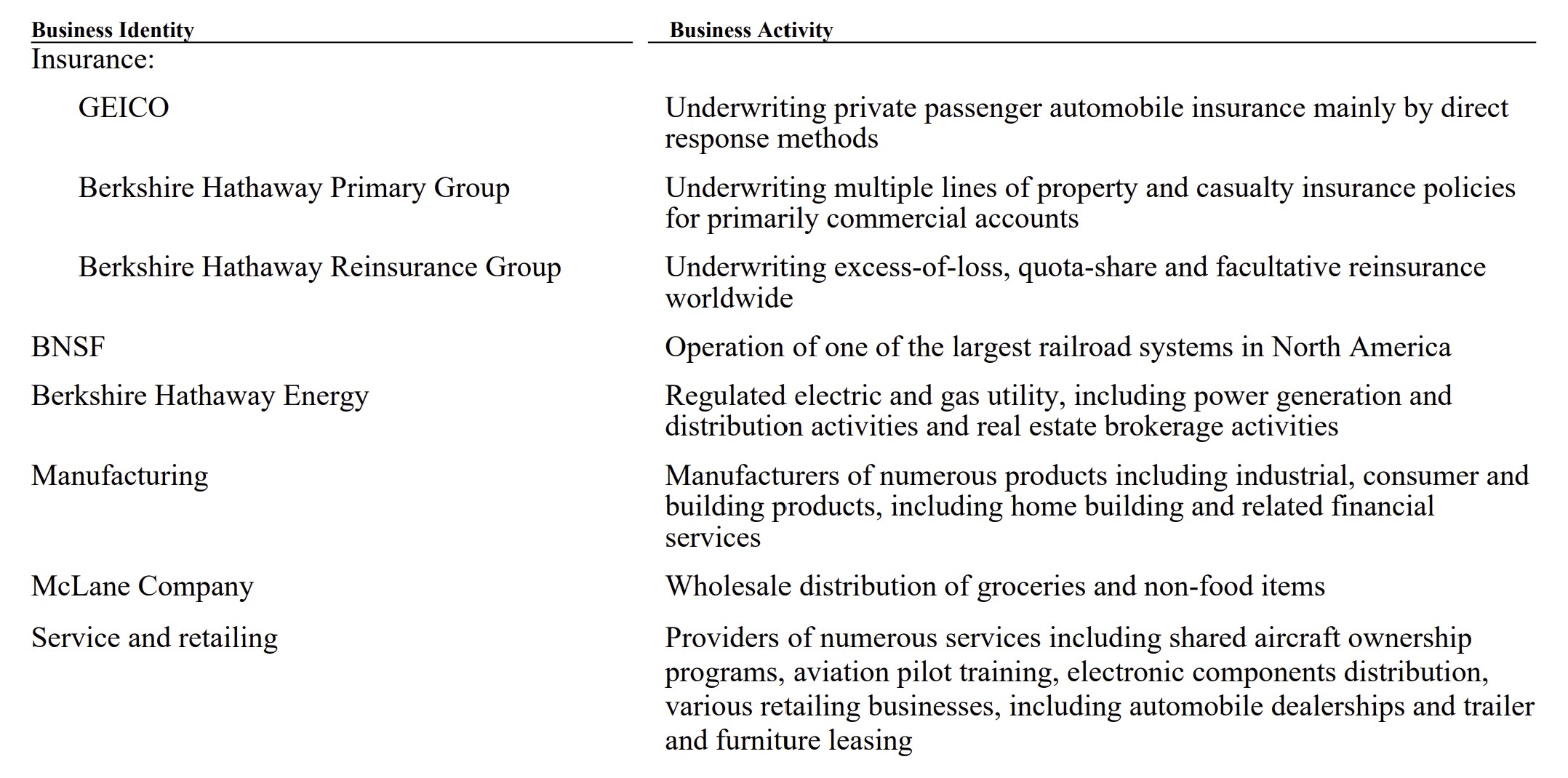
Conglomerate Business Segments Example (Source: Berkshire 2020 Annual Report)
We’ll now move to a modeling exercise, which you can access by filling out the form below.

Our SOTP modeling tutorial will start with some background details regarding the hypothetical company.
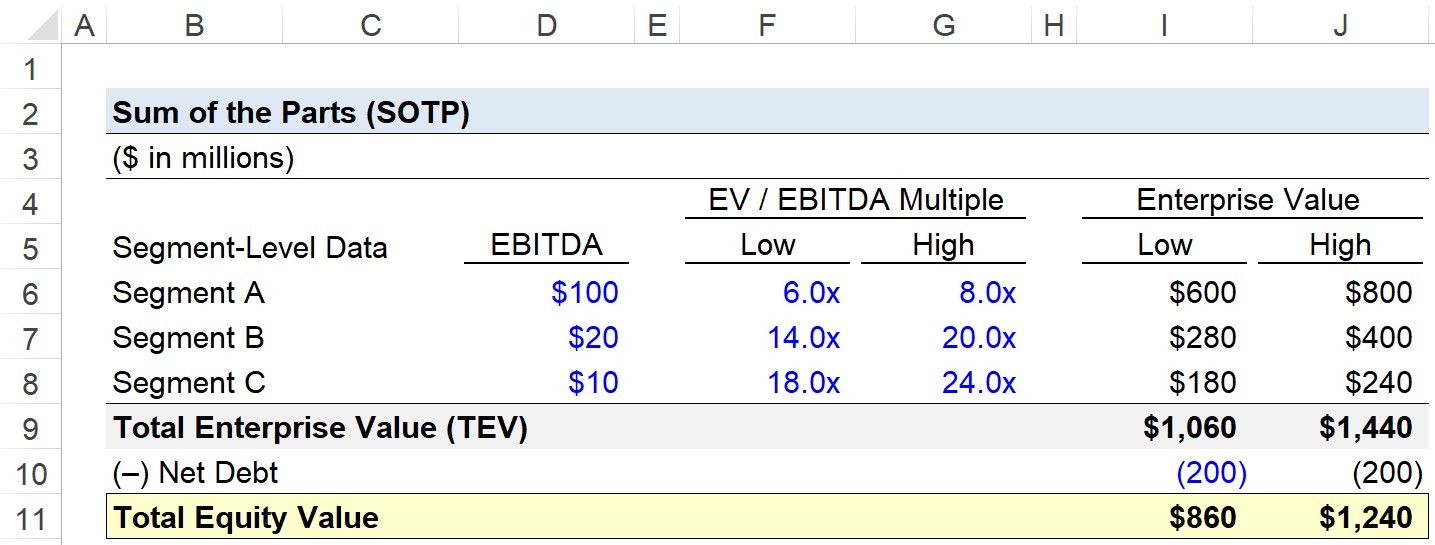
The company consists of three segments – Segment A, B, and C – which are each valued at different multiples and operate in different industries.
Here, the comps-derived valuation is estimated using the "Low" and "High" end of the EV/EBITDA multiple ranges pulled from each segment's peer group.
Segment A: Financial Assumptions
Segment B: Financial Assumptions
Segment C: Financial Assumptions
Clearly, Segment A contributes the most EBITDA to the company, but the total firm valuation multiple appears to be weighed down by its comparatively lower EV/EBITDA multiple.
The next step is to calculate the enterprise value of each segment – both at the lower and upper end of the valuation range.
By multiplying the EV/EBITDA multiple by the corresponding EBITDA metric for each segment, we can determine the segment enterprise values.
Upon completing each division's valuation, the values are added up to arrive at the total enterprise value (TEV).
Once the firm values have all been calculated, the final step in our modeling exercise is to subtract net debt, which we assume to be $200m.
On the lower end of the valuation range, the implied equity value of our company is $860m, whereas, on the higher end of the range, the implied equity value is $1.24bn.

Enroll in The Premium Package: Learn Financial Statement Modeling, DCF, M&A, LBO and Comps. The same training program used at top investment banks.


No comments yet.