What are Open Market Operations?
Open Market Operations refer to a central bank selling or purchasing securities in the open market in an effort to influence the money supply.

Open Market Operations refer to a central bank selling or purchasing securities in the open market in an effort to influence the money supply.
The Federal Reserve is the central bank of the United States, and it makes decisions regarding monetary policy in its effort to keep inflation low and economic growth high.
One of the tools available to the Fed is its ability to conduct open market operations.
When the Federal Reserve decides to enact monetary policy action, the Federal Open Market Committee can instruct the Fed’s Domestic Trading Desk to either purchase or sell securities on the open market.
If the Fed chooses to purchase securities on the open market, it is purchasing the securities from depository institutions in exchange for liquidity (i.e. cash).
Moreover, when banks have more liquidity, they have more cash to lend to the public, which leads to increased spending throughout the economy.
The Federal Open Market Committee (FOMC) makes decisions regarding the target range for the federal funds rate when it meets every six weeks.
The federal funds rate is defined as the rate at which banks lend to one another in order to meet their reserve requirements.
Moreover, the committee's decisions are forwarded as directions to the Fed’s Domestic Trading Desk (DTC), which enacts them through the trading of securities.
When the DTC successfully trades securities, it is effectively manipulating the supply of money in the economy.
The end goal of the DTC is to manipulate the supply of money enough for the federal funds rate to reach the FOMC’s agreed-upon target.
Thereby, if the Fed is purchasing securities, it is trying to lower the effective federal funds rate (and the reverse is the case if the Fed is selling securities).
Open market operations affect the federal funds rate through the basic dynamics of supply and demand.
Learn how institutional investors identify high-potential undervalued stocks. Enrollment is open for the upcoming cohort.
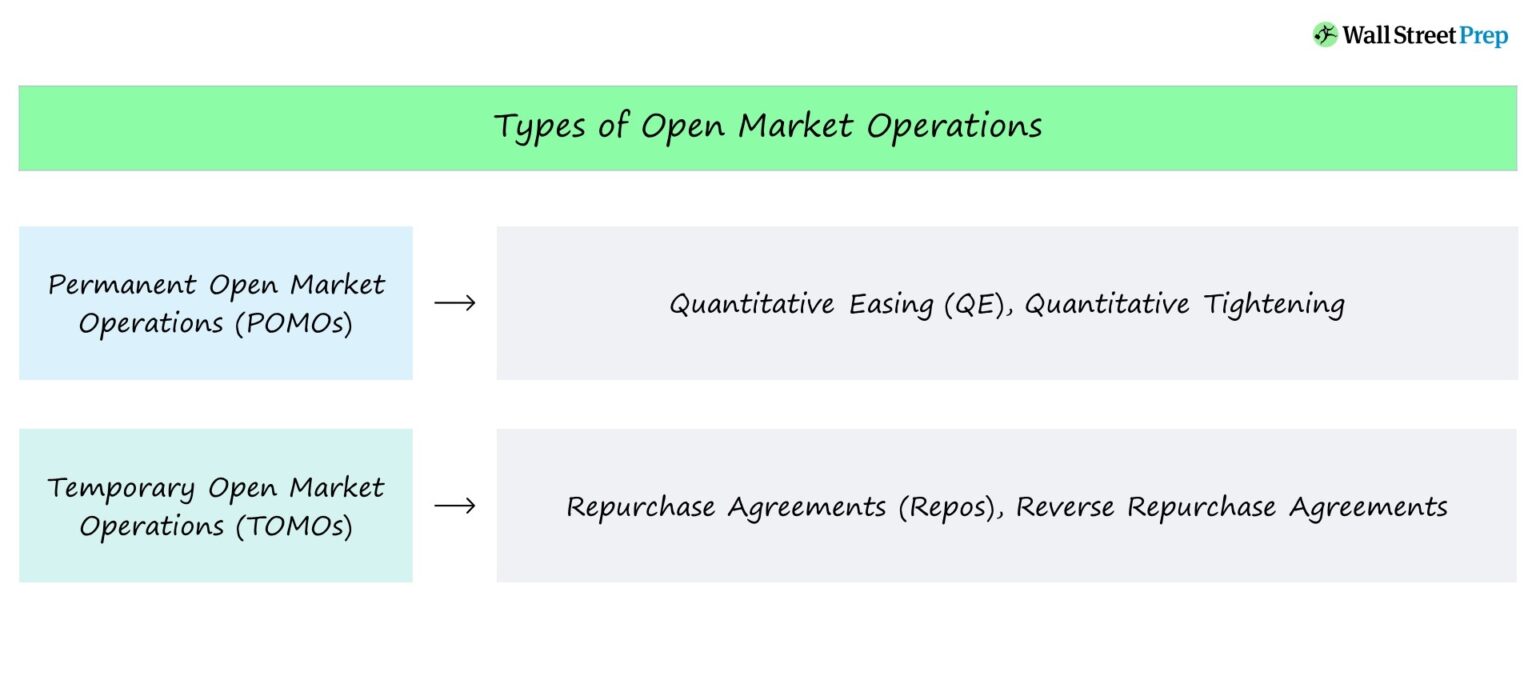
Open market operations come in two varieties:
1) Permanent Open Market Operations (POMOs) – The central bank consistently uses open market operations to influence monetary policy. This occurs when a central bank sells or purchases securities outright in order to permanently influence the supply of money.
2) Temporary Open Market Operations (TOMOs) – The central bank temporarily addresses reserve needs by influencing the supply of money on a short-term basis.
One notable example of open market operations occurred directly following the economic contraction brought about by the COVID-19 pandemic.
After a strong correction in the equities markets and the lingering effects of shutdown policies on the U.S. economy, the Fed took action by conducting open market operations.
The Fed enacted a quantitative easing plan, in which it initially announced $700 billion in asset purchases.
Three months later, the Fed began monthly purchases of $80 billion in Treasury securities and $40 billion in mortgage-backed securities, a policy that lasted until March 2022.
The Fed grew the supply of bank reserves by purchasing assets from the open market, thus increasing the overall money supply throughout the economy and maintaining a dovish monetary policy while the market recovered, reflecting a positive outlook on the future performance of the economy while it remained at lower levels due to the onslaught of the pandemic.
Despite the recovery we’ve seen, however, prolonged open market operations come with other consequences.
While the Fed continued to stimulate the economy, inflation has begun to skyrocket, with the Consumer Price Index (CPI) rising 7.9% YoY in February, the largest increase since 1982.
As a result, the Fed increased its target federal funds rate by 25 basis points after the FOMC’s March 16th meeting, and most expect that it will do the same after its next six meetings.
The prospect of a rising rate environment will have a significant effect on stock market valuations, as rising rates mean companies are not only forced to borrow at higher rates but also that their future cash flows are being discounted more, meaning the present value of these companies’ cash flows is now lower, resulting in lower perceived share prices.


Great lecture.