Why is Deflation Bad?
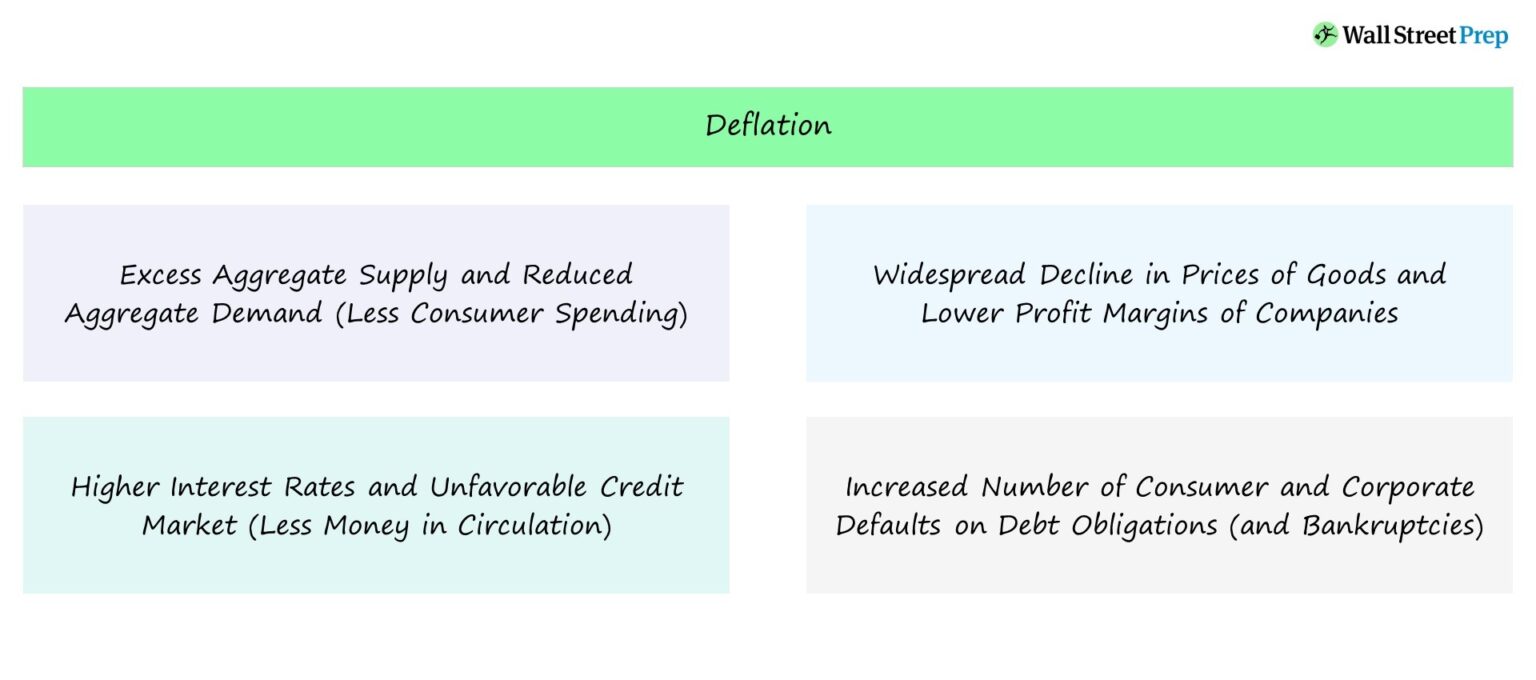
In theory, the negative effects of deflation are closely tied to an expansion in the real value of an economy’s debt, which includes the borrowings by consumers, corporations, and governments.
If a highly levered credit environment is coupled with deflation, the number of defaults, bankruptcies, and limited liquidity can result in a recession, especially if the financial health of the country’s banks is unstable.
Since companies cannot increase prices in a deflationary period — i.e. demand is already low — their method of survival is typically via operational restructurings, such as cost-cutting, reducing employee wages, and shutting down non-essential functions.
Companies in cost-cutting mode also frequently try to extend their days payables (i.e. the number of days between receiving the goods and the date of cash payment), as well as negotiate terms that are less favorable to suppliers.
These short-term measures might temporarily reduce the burden faced by companies, yet these actions contribute to an even more significant downward spiral in the economy.
Deflation vs. Inflation: What is the Difference?
Contrary to deflation, inflation describes periods in which the price of goods rise, resulting in a widespread reduction in purchasing power across consumers.
While consumers can purchase more for the same amount of money and the value of the country’s currency rises over time under deflation, the opposite occurs in inflationary periods, when fewer goods can be purchased using the same amount of money, and the currency becomes devalued.
Inflation and deflation in an economy are each caused by an imbalance in the supply and demand within the country.
- Inflation → Aggregate Supply < Aggregate Demand
- Deflation → Aggregate Supply > Aggregate Demand
Inflation can be caused by decades of low interest rates, as currently seen in the U.S. economy in 2022, which was worsened by the pandemic (and the unprecedented monetary policies where capital flooded the markets at very low-interest rates).
On the other hand, deflation can result from rising interest rates. For instance, the central bank could implement a tighter monetary policy where interest rates are increased.
Rising interest rates in an economy cause lower levels of borrowing from consumers and companies, along with reduced overall spending.
Deflation is commonly perceived as a sign of a looming recession, which can cause a noticeable economic slowdown.
From the perspective of certain economists, deflation is actually worse than inflation, since the ability for the central bank to step in is more limited.
Given the fewer tools on hand and how interest rates can only be reduced to zero (with negative interest rates remaining highly controversial), a so-called "liquidity trap" can occur, as observed with Japan’s economy.
Deflation Real-Life Example: Japan in 2022
In 2022, inflation has been soaring globally as countries around the world scramble to contain the negative effects that stem from high rates of inflation. However, Japan is interesting, not among those companies.
After decades of fighting deflation, with very low interest rates set by the central government – in fact, interest rates were negative for approximately six years – economic theory would suggest higher spending given the low cost of borrowing.
Yet, there has been a disparity between reality and academic theory, as Japan’s spending remains on the lower end while its population continues to age.
Japan has historically struggled with deflation for decades and is now facing low economic growth, coupled with low inflation. The recovery from the period of deflation in the 2000s has been disappointing, to say the least.
Currently, Japan's low rate of inflation hovering around 3% might be near the target of certain countries. But in actuality, there are far more variables at play and lessons to be learned from the past policies implemented by Japan.
The government price controls (e.g. gas, electricity and utility regulations), the aging population with less spending, and the long-term ramifications of the negative interest rate period are all factors contributing to Japan's long-term struggle to overcome its current economic weaknesses.



No comments yet.