What is InsurTech?
InsurTech describes the emergence of innovative technologies built to improve the cost-efficiency and effectiveness of the traditional insurance sector.

InsurTech describes the emergence of innovative technologies built to improve the cost-efficiency and effectiveness of the traditional insurance sector.

The term “InsurTech" refers to data analytics and artificial intelligence (AI) tools designed to improve the efficiency of the traditional insurance business model.
InsurTech startups are data-driven with new offerings that provide coverage to a more digitally-savvy customer base.
Their offerings reduce costs for insurance providers, which enables them to offer lower prices for consumers, creating a positive-sum cycle resulting in improved customer satisfaction and retention rates.
Nowadays, adopting enhanced digital capabilities has become necessary for all industries, with InsurTech being no exception – however, the insurance industry has also been known for its reluctance to change.
Simply put, InsurTech promotes the transition towards providers offering simpler interfaces and greater digital capabilities to consumers, coupled with more transparency.
The widespread emphasis on connectivity has, in fact, been a tailwind for InsurTech, especially for startups specializing in artificial intelligence (AI) and automated chatbots.
InsurTech has the potential to enable certain insurance providers to become more efficient in underwriting, claims processing, and risk management (e.g. fraud detection).
For instance, by using advanced data analytics, insurance companies can obtain more practical insights into customer needs, offer more targeted products/services to customize marketing and process incoming claims more efficiently with less risk of human errors.
The convenience aspect and ease of access are major factors driving growth in the InsurTech market from consumers' perspectives.
AI and data analytics can substantially reduce the reliance on repetitive processes performed manually and tailor plan offerings based on each customer's specific needs — i.e. streamline the process from initial inquiry until enrollment.
Consumers being able to file claims and check the status of a claim in real-time from a mobile device is one distinct development in the industry.
In 2021, InsurTech topped $15.4 billion in total investor funding with an estimated 566 deals, according to TechCrunch, marking it a record-breaking milestone year for the sector.
The influx of capital being allocated to InsurTech is indicative of the broad scope of disruption that venture capital (VC) firms anticipate in the industry.
The potential benefits could stem from claims processing, customer relationship management (CRM), and AI chatbots, among the numerous areas startups are attempting to disrupt.
In particular, the COVID pandemic led to a greater proportion of capital being placed into InsurTech startups to accelerate the transition towards a virtual customer interface and claims processing (i.e. remote engagement with customers).
The shift towards digital distribution has exhibited the most disruption in the industry value chain.
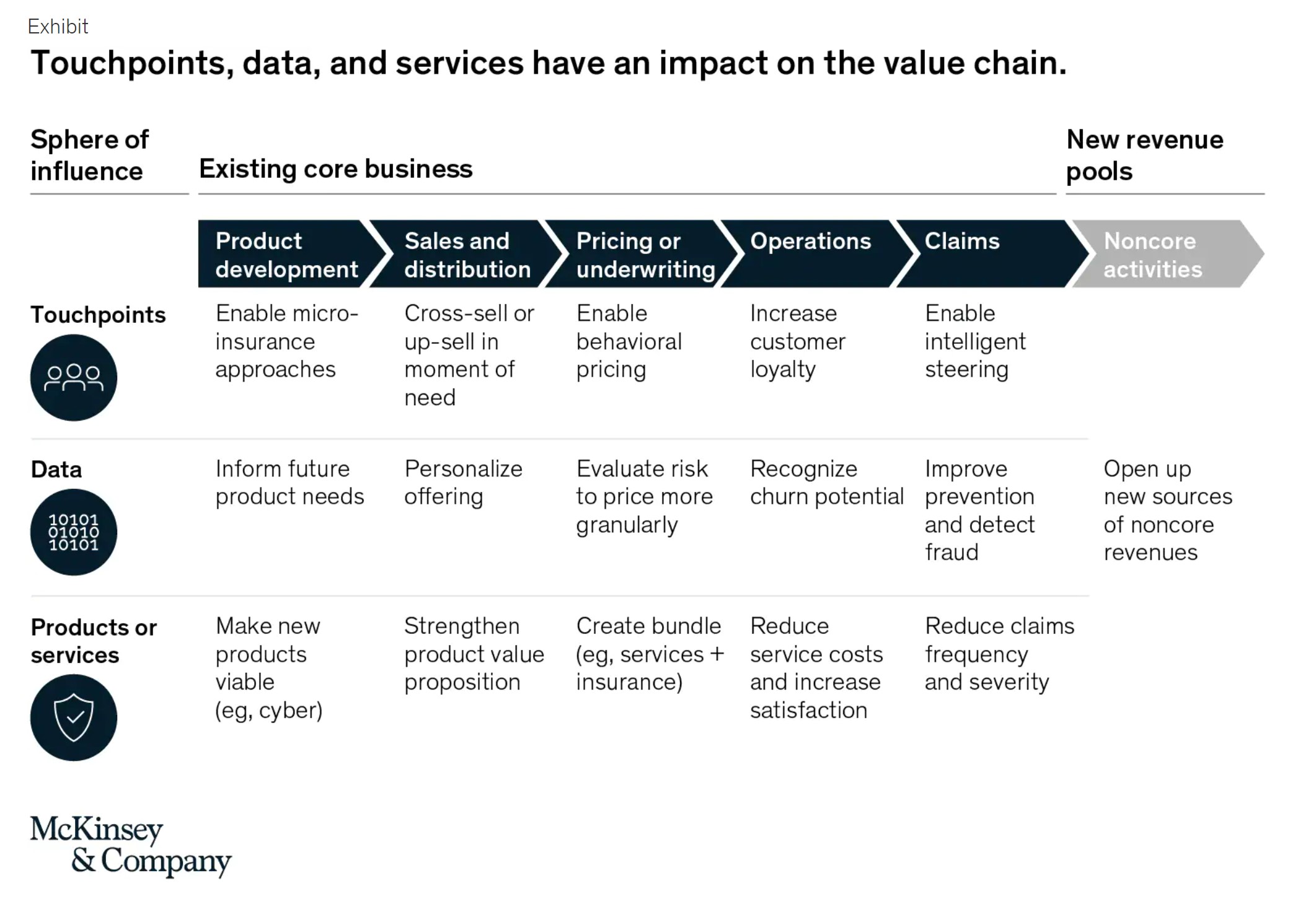
Insurance Value-Chain (Source: McKinsey)
Learn how institutional investors identify high-potential undervalued stocks. Enrollment is open for the upcoming cohort.
Customer-centricity has become a central point of InsurTech, and nowadays, consumers are well-versed in technology and expect insurance products to be on par with their other products, such as digital banking.
Since simplicity and transparency have become the norm, recent advancements have targeted these traditionally weak areas in the insurance industry.
Historically, premiums for insurance were set based on a limited number of data points, such as the type of policy sought, age of the policyholder, and criminal history records.
Using just a couple of pieces of information, an actuary or statistician attempts to determine the probability of an individual filing a certain claim.
But developments in machine learning and IoT devices have made gathering comprehensive data sets possible and more easily— so insurance companies can utilize the better, more robust data to personalize premiums.
By delivering personalized insurance policies, establishing customer cohorts based on shared data points, and increased customer engagement, there are more opportunities for upselling, cross-selling, and improving customer retention rates.
For insurance underwriting and policy structuring, utilizing smart sensors and data analytics can help predict accidents, floods, burglary attempts, or hazards like fire breakouts — which can be used to price premiums for customers more appropriately based on the probability of occurrence.
From the example above, policy pricing can be personalized by leveraging predictive models and analyzing a user's specific behavioral patterns.
Claims processing and management is another segment with significant interest from startups, as the current method of handling receives constant criticism for the lack of transparency and slow communication.
Digital claims processing applications can fix these complaints, aided by AI-powered software applications that can automate certain portions of the process.
These applications often take the form of an online form and chatbot that offer support in real-time as policyholders submit a claim.
With a very minimal delay after filing, typically under a minute, the claim processing algorithms can sort through the claim and process it, all while scanning for signs of potentially fraudulent behavior.
As an illustrative example, an auto insurance policyholder could get into a car accident.
Using InsurTech applications, the user could provide the details through an application on their smartphone, upload images of the accident in question, and directly file the claim at once.
Still, despite the wide array of benefits and value-add products, there appears to be a disconnect between the growth in funding and the pace of adoption from incumbents.
In general, the legacy insurance industry has been dismissive of capitalizing on and leveraging new technologies.
Even though the insurance industry seems like a sector ripe for disruption, adoption has been rather disappointing as legacy insurance incumbents continue to be criticized for their reluctance to adopt new digital products/services.
But with regards to the value proposition, InsurTech has the potential to enable certain insurance providers to become more efficient in underwriting, processing claims with automated technology, and managing risk (e.g. fraud detection).
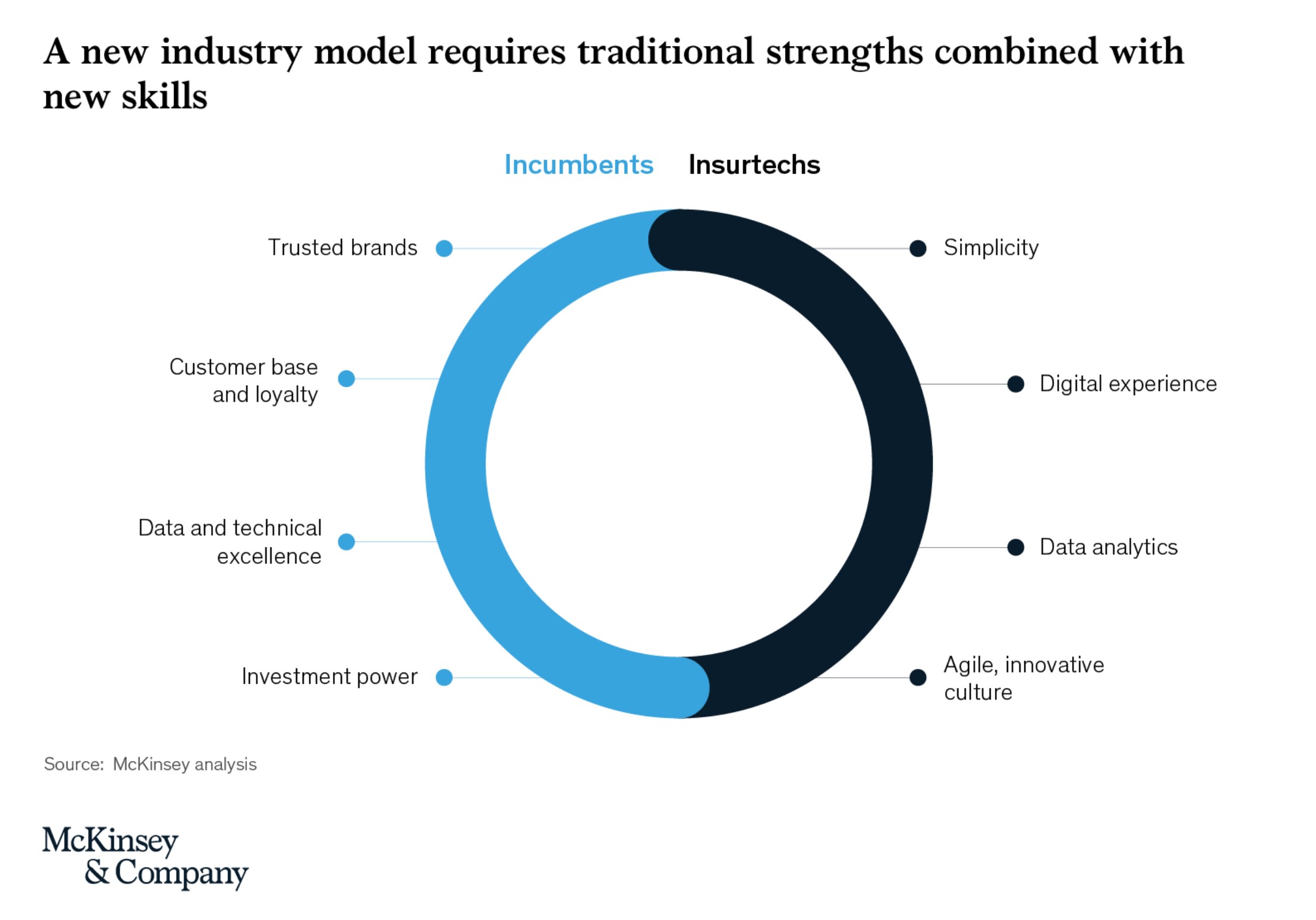
InsurTech vs Incumbents (Source: McKinsey)
The regulatory landscape has been (and to this date, continues to be) the major hurdle for insurance companies to embrace change.
On top of the compliance spending, insurance regulations often disincentivize upgrading to new technologies, i.e. regulations are in place to protect consumers from predatory pricing models that effectively make upgrading difficult.
For example, auto insurance is a heavily regulated industry in which providers must spend a significant amount on maintenance to ensure compliance with frequently changing standards.
Aside from the unfavorable regulatory structure, the reluctance of incumbents to integrate newer offerings is another headwind, much like in the healthcare industry.
Why? The insurance industry – again, with many parallels to healthcare – has gained a reputation for being risk-averse and cautious when it comes to spending, which is likely due to the low margins in the industry.
InsurTech startups are essentially starting from nothing and building bottoms-up using up-to-date technology, whereas existing incumbents must completely overhaul an outdated system developed internally for decades.
Incumbent’s Dilemma is Our Opportunity
"It is difficult for incumbents, with massive legacy businesses to protect, to wholeheartedly adopt new technologies that call for a 30% rate decrease for two-thirds of their customers
That may explain why 96% of incumbent policies use no telematics data, while the 4% that do, tend to turn it off after two weeks, and to underweight its signals.
Innovators, legacy-free and built from scratch in the 21st century, are uniquely positioned to lead the industry’s graduation from pricing based on proxies, to pricing based on continuous data streams."
- Lemonade Shareholder Presentation (Source: Q3-2021 IR Deck)
Since going public via IPO or a SPAC merger, many leading InsurTech companies have seen their share prices plummet since the start of 2020.
With that said, the sharply declining valuations of public InsurTech companies have led many to predict M&A activity will soon pick up, given the plunge in share prices.
| Company | IPO/SPAC Pricing | Current Share Price |
|---|---|---|
| Oscar Health (NYSE: OSCR) | $39.00 | $6.65 |
| Root (NASDAQ: ROOT) | $27.00 | $1.69 |
| Lemonade (NYSE: LMND) | $29.00 | $29.07 |
| Metromile (NASDAQ: MILE) | $10.00 | $1.49 |
| Hippo (NYSE: HIPO) | $10.00 | $1.92 |
Latest Closing Date: 2/14/2022
In the coming years, the following patterns seem likely to emerge:
Notably, Lemonade (NYSE: LMND) offers insurance to renters and homeowners by using artificial intelligence (AI) and chatbots.
Lemonade views itself as a disruptor leading the modern insurance business model because of two key factors:
After a promising IPO in 2020, Lemonade’s shares soared approximately 139% on the first day of trading, closing at $69.41 per share.
Lemonade's shares later went on to peak at an all-time high of around $188 per share.
Despite trading multiples times its IPO issuance price, Lemonade’s shares have since declined to their IPO level at $29.07 in early 2022.
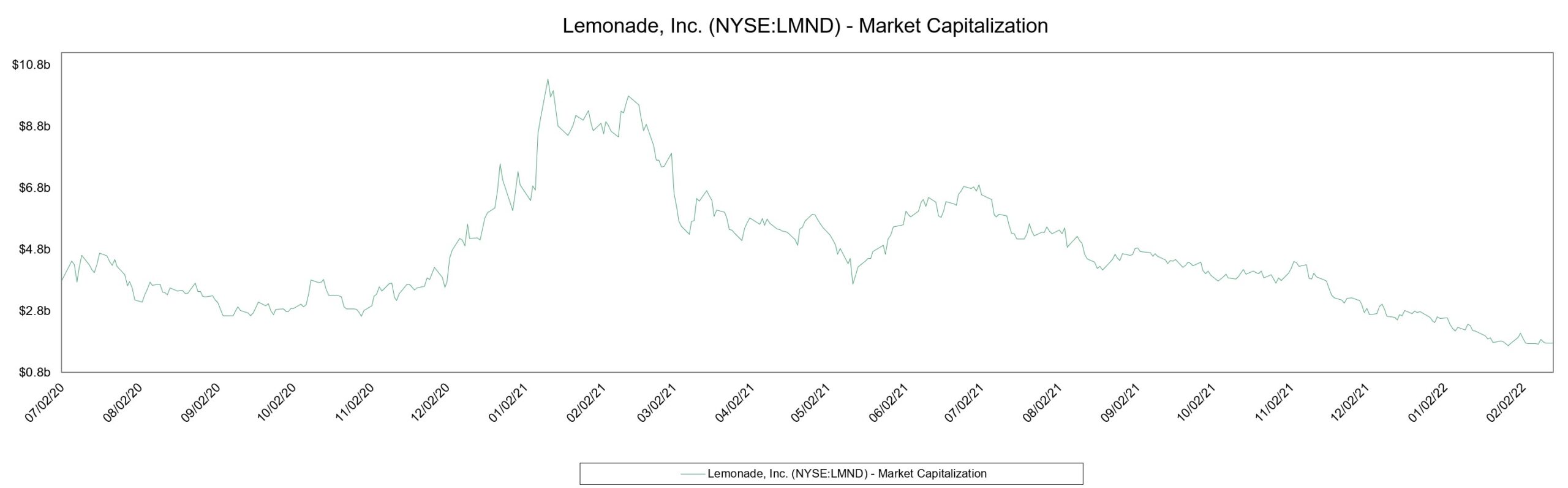
Lemonade Historical Market Capitalization (Source: CapIQ)
In November of 2021, Metromile, a pay-per-mile car insurance company, announced Lemonade would acquire it in an all-stock transaction, which is expected to close in Q2-2022.
Lemonade and Metromile are down by more than 80% and 90% from their all-time highs, respectively.
The acquisition of Metromile signals a steep write-down in the valuation, as the implied fully diluted equity value is approximately $500 million, or $200 million net of cash on the balance sheet.
Therefore, certain InsurTech companies startups might opt to sell their companies to a strategic rather than attempt to go public – or wait for the volatility to pass and share prices to recover to prior levels.


No comments yet.