What is a Markup?
The Markup Price is the difference between a product’s average selling price (ASP) and the corresponding unit cost, i.e. the cost of production on a per-unit basis.

The Markup Price is the difference between a product’s average selling price (ASP) and the corresponding unit cost, i.e. the cost of production on a per-unit basis.
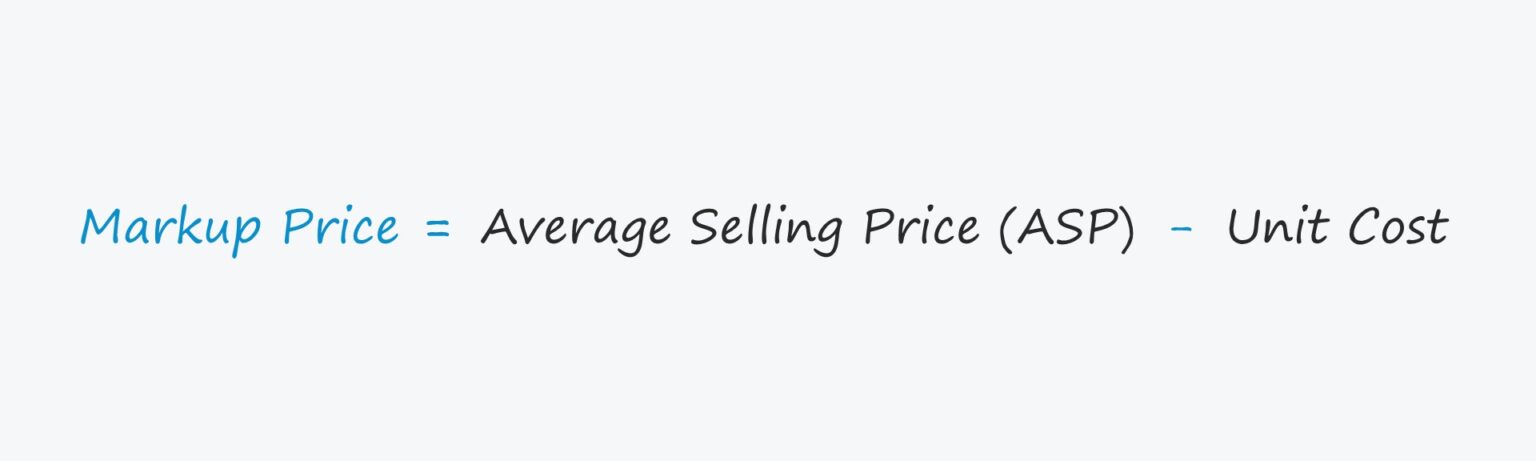
The markup price represents the average selling price (ASP) in excess of the cost of production per unit.
Calculating the markup price is a rather straightforward process, as it simply involves:
The formula for calculating the markup price is as follows.
In order to make the markup price metric more practical, the markup can be divided by the average unit cost to arrive at the markup percentage.
The markup percentage is the excess ASP per unit (i.e. the markup price) divided by the unit cost.
Since all companies seek to improve their operating efficiency and profit margins over time, management must set prices accordingly to ensure they are on track to become more profitable.
Learn how institutional investors identify high-potential undervalued stocks. Enrollment is open for the upcoming cohort.
The markup and gross profit margin of a particular company are closely tied concepts.
The higher the markup, the higher the gross margin of the company – all else being equal.
While a company’s margins divide a specific profit metric by revenue, a markup reflects how much more the selling price is than the cost of production.
For instance, the gross profit margin divides a company’s gross profit by revenue, which equals revenue less the cost of goods sold (COGS).
The gross margin portrays the percentage of revenue remaining after COGS are deducted.
The relationship between the mark-up and gross margin is that the mark-up percentage can be back-solved by dividing the gross margin by COGS.
If COGS was entered as a negative figure in Excel, make sure to place a negative sign in front of the formula.
We’ll now move to a modeling exercise, which you can access by filling out the form below.


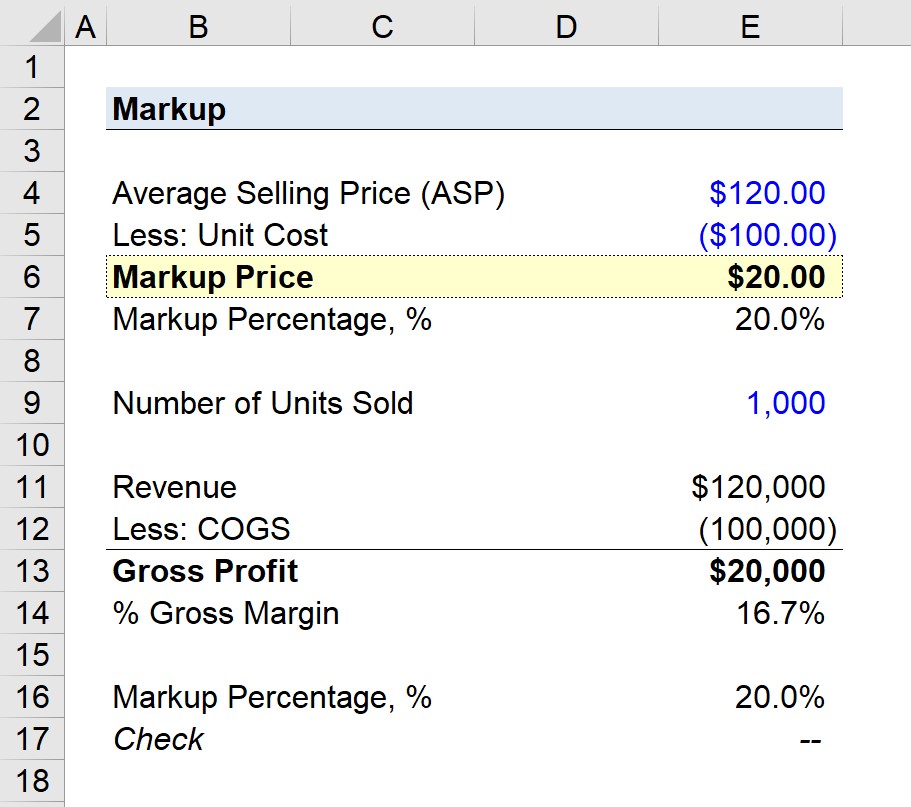
Suppose a company’s products are sold at an average selling price of $120, while the associated unit cost is $100.
By subtracting the unit cost from the average selling price (ASP), we arrive at a markup price of $20, i.e. the excess ASP over the unit cost of production.
By dividing the $20 markup by the $100 unit cost, the implied markup percentage is 20%.
Next, we’ll assume that our hypothetical company sold 1,000 units of its product in a specified period.
The revenue for the period is $120k while COGS is $100k, which we calculated by multiplying the ASP by the number of units sold, and the unit cost by the number of units sold, respectively.
The gross profit is $20k, and we’ll divide that amount by the $120k in revenue to calculate the gross margin as 16.7%.
In closing, the $20k in gross profit can be divided by the $100k in COGS to confirm the markup percentage is 20%.


No comments yet.