What is Debt Capital Markets?
The Debt Capital Markets (DCM) product group advises corporations and government entities, such as sovereigns and supranationals, on raising capital via investment-grade debt securities.

The Debt Capital Markets (DCM) product group advises corporations and government entities, such as sovereigns and supranationals, on raising capital via investment-grade debt securities.

The debt capital markets (DCM) is a product group within the investment banking division that offers capital raising services in the form of corporate bonds and government bonds on behalf of their clients.
Usually, the clients served by the debt capital markets group (DCM) are investment-grade corporations with high credit ratings and governmental entities.
The term “product group” in investment banking refers to deal teams that specialize in a particular type of transaction.
On that note, the debt capital markets (DCM) product group specializes in assisting their clients with raising capital in the form of investment-grade debt securities, such as bonds and loans.
While there are exceptions, most DCM groups are frequently industry agnostic. The DCM group's capital raising services can therefore be offered to a wide range of clients, irrespective of the sector.
The issuance of debt is one method for corporate and government entities to raise capital to fund their ongoing operations and strategies to achieve growth and expansion.
So, what sort of analytical work does an investment banker in the debt capital markets (DCM) group perform on the job?
The analysis performed by the debt capital markets (DCM) investment banking product group while structuring issuances are based around the following parameters:
The transactions the debt capital markets (DCM) group advises on are predominantly related to the origination, structuring, and marketing of investment-grade debt issuances.
The core focus of the DCM product group is the issuance of investment-grade bonds syndicated and sold to institutional investors.
The debt capital markets (DCM) group also works on debt refinancing transactions, where the issuer is advised on the replacement of an existing debt obligation with a new issuance.
The structure of a debt instrument – i.e. the terms attached to the security – is specific to the type of financial product offered and the credit profile of the issuer, among other factors.
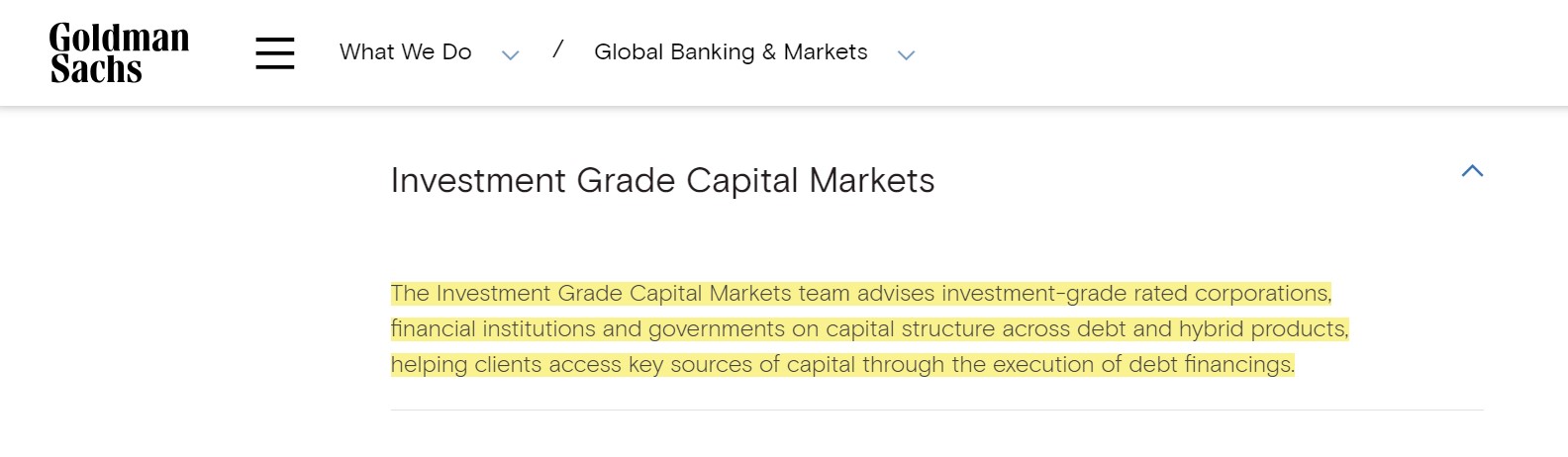
Investment Grade Capital Markets (Source: Goldman Sachs)
The most common types of debt issuances that the debt capital markets (DCM) product group works on include the following:
Generally speaking, capital can be raised in the form of either equity or debt, which the DCM and ECM investment banking product groups facilitate.
The types of transactions worked on by the equity capital markets (ECM) groups include IPOs and secondary offerings, as well as divestitures (e.g. spin-offs), private placements, private investment in public equity (PIPE) transactions, and special purpose acquisition vehicles (SPACs).
The ECM group tends to receive more publicity and press coverage for that reason, and thus arguably carries more prestige (and better exit opportunities) compared to the DCM product group.
The debt capital markets (DCM) product group is closely tied to the Leveraged Finance (LevFin) group.
In fact, the LevFin product group is classified under DCM at most investment banks.
In practice, however, the LevFin groups tend to be recognized as separate groups.
The distinction between the DCM and LevFin product group comes down to the credit rating of the debt issuers and the circumstances of the use of debt proceeds.
Usually, DCM clients raise capital for more general purposes, while LevFin clients actively participate in obtaining riskier forms of financing for complex, high-stakes transactions, such as acquisitions (e.g. leveraged buyouts, or “LBOs”) and leveraged recaps.
Both the DCM and LevFin group advise on the issuance of debt securities, which unlike equity, represent contractual borrowings that come with periodic interest payment obligations as part of the financing arrangement, along with the return of the original principal at maturity.
Should these obligations not be met, the issuer has defaulted on the debt and is at risk of financial distress.
Given those circumstances, restructuring becomes necessary, and the borrower might need to file for bankruptcy protection in-court if the issues cannot be settled with creditors out-of-court.
The most common catalyst for corporate restructuring and bankruptcies is an unsustainable capital structure – where the debt burden exceeds the capacity that the borrower can handle – which reflects the risks associated with an over-reliance on debt.
Therefore, while credit analysis and risk diligence are critical parts of the DCM and LevFin groups, the circumstances of LevFin transactions make the role more strenuous and demanding from a technical standpoint.
Enroll in The Premium Package: Learn Financial Statement Modeling, DCF, M&A, LBO and Comps. The same training program used at top investment banks.


No comments yet.