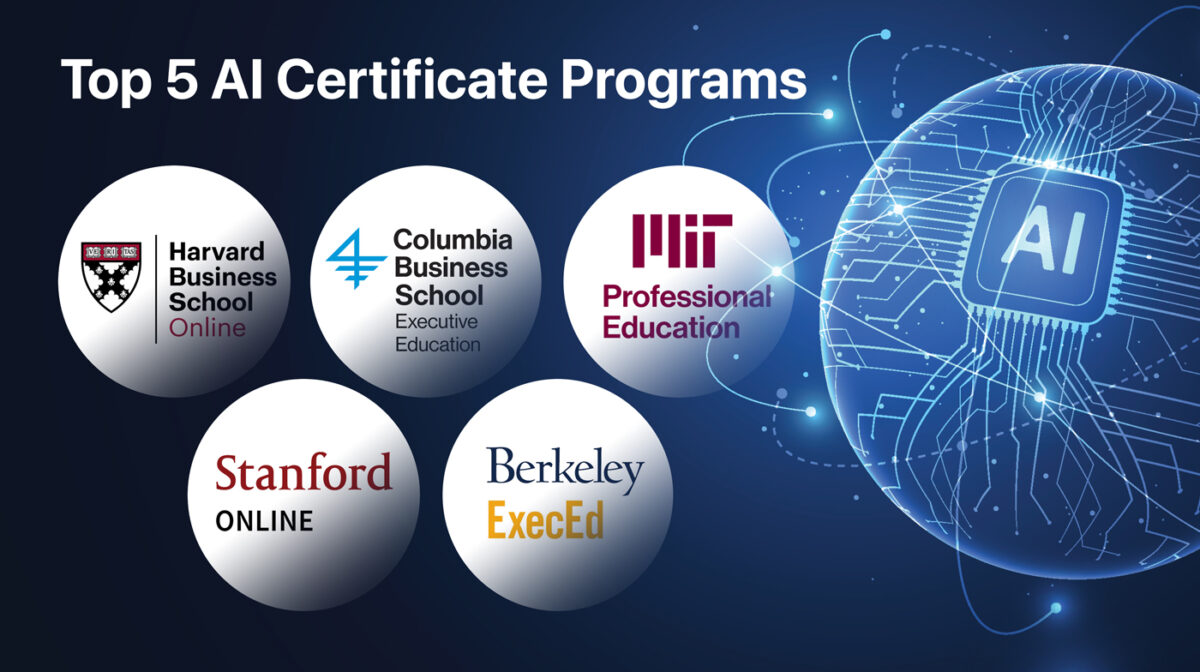
Top 5 AI for Business & Finance Certificate Programs
AI is already entrenched in the workflows of modern finance.
From investment banking to private equity to corporate finance, teams are automating, forecasting, and analyzing with speed and scale once thought impossible.
Generate Key Takeaways
Here are just a few recent examples:
Morgan Stanley is deploying AI-powered chatbots to assist wealth managers.1
Private equity firms are using AI to accelerate due diligence and target screening.2
Visa leverages AI to detect fraud in real time across billions of transactions.3
Goldman Sachs uses machine learning to optimize IPO pricing and bookbuilding.4
These aren’t outliers—they’re signals of a broader shift. Thousands of finance professionals are already seeing their roles reshaped by AI.
As this transformation accelerates, the demand for an AI skillset is no longer just for engineers.
Employers are urgently looking for business professionals who understand how AI works, and how to use it to drive results.
If you're looking to upskill, not every AI course will get you there. Many are too generic, theoretical, or too technical.
Here we break down the more recognized and practical AI programs tailored for finance and business professionals, so you can find the one that matches your role, goals, and learning style.
Comparison: Which AI Program Is the Best for Finance?
Program
Duration
Price
CEUs
Live Networking
Best For
Overall Value for Career
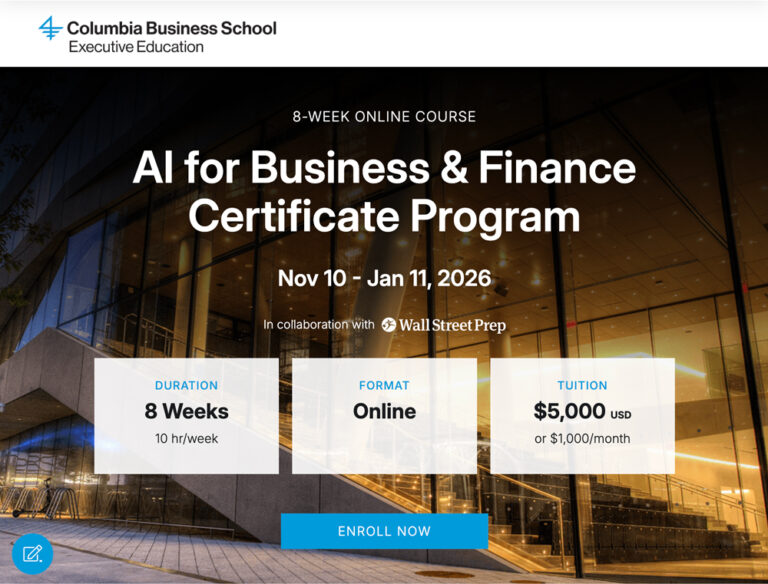
AI for Business & Finance
Columbia Business School Executive Education + Wall Street Prep
8 Weeks
$5,000
65
✅ Lifetime access to community and recruiting events
Overview: Co-created with Wall Street Prep, the #1 financial training services provider, this program is purpose-built for applying AI in finance. Unlike generic AI business courses, it integrates real financial workflows, teaching professionals how to apply AI tools like Python and SQL in areas such as forecasting, investment analysis, and automation.
Who it’s for: FP&A leaders, private equity professionals, portfolio managers, financial analysts, equity researchers, risk management professionals, corporate finance teams, and business analysts
What it solves: Equips finance professionals to use AI for forecasting, investment analysis, risk modeling, and operational automation. The course bridges technical tools with finance workflows, enabling more informed, data-driven decisions.
Industry relevance and recognition: Wall Street Prep is the financial training provider of choice for the world’s top investment banks, private equity firms, and Fortune 1000 companies.
Co-developed with Columbia Business School Executive Education, this certificate brings real-world credibility and industry alignment to professionals looking to apply AI in finance. Graduates earn recognition from two trusted institutions—backed by decades of expertise in finance and executive education.
Learning experience:
Step-by-step video lessons designed to fit a full-time schedule
Insights from top finance leaders at BlackRock, Morgan Stanley, Capital Group, and more on how AI is being implemented across investment strategy, risk modeling, and banking operations
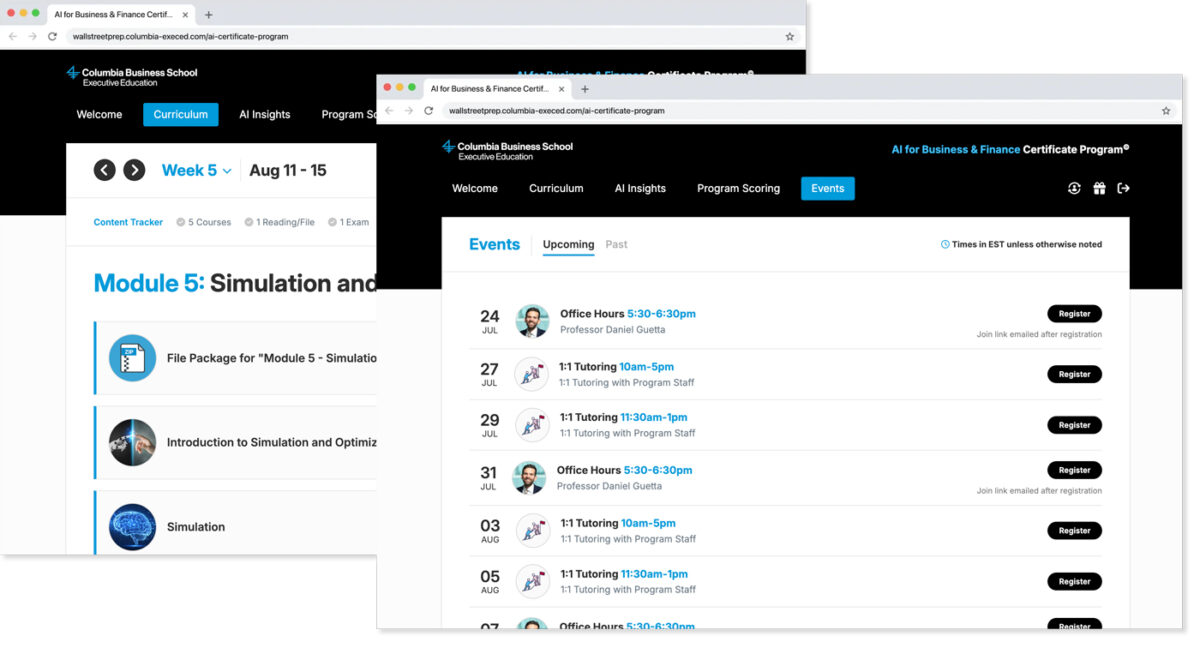
Personalized support through live 1:1 coaching and office hours
Ongoing in-person networking events hosted in major cities after the program ends
Access to invitation-only LinkedIn group and Slack channels
Invitation to a closing ceremony at Columbia’s NYC campus
Continued access to updated materials and new content for 2 years after completion
Certificate from Columbia Business School Executive Education
Columbia Business School Exec Ed + Wall Street Prep's AI for Business & Finance Certificate Program offers ample opportunity for participants to connect with staff and each other in live sessions.
Curriculum:
10/10 for finance alignment: The curriculum is built around real-world applications of AI across FP&A, investment analysis, risk modeling, and more.
Continuously updated content: As AI evolves, so does the program. You'll get access to updated course materials for two years after your cohort ends.
Built for what’s happening now: Case studies and exercises are regularly refreshed to reflect the latest tools, use cases, and trends in AI for finance.
Hands-on and job-ready: Lessons are grounded in practical skills like Python, predictive analytics, and OpenAI tools, not just theory.
Taught by experts shaping the field: Learn from Columbia Business School faculty and Wall Street Prep instructors who train top finance teams globally.
Technical level: Low-code — just enough coding (Python, SQL) to be dangerous without overwhelming non-technical learners
“We kept hearing the same thing from business schools and finance teams: ‘We need to help our people get up to speed on AI—fast,” says Wall Street Prep CEO Matan Feldman. “That’s really what sparked this program. It’s built to meet that need with skills that actually translate into the work finance professionals do every day.”
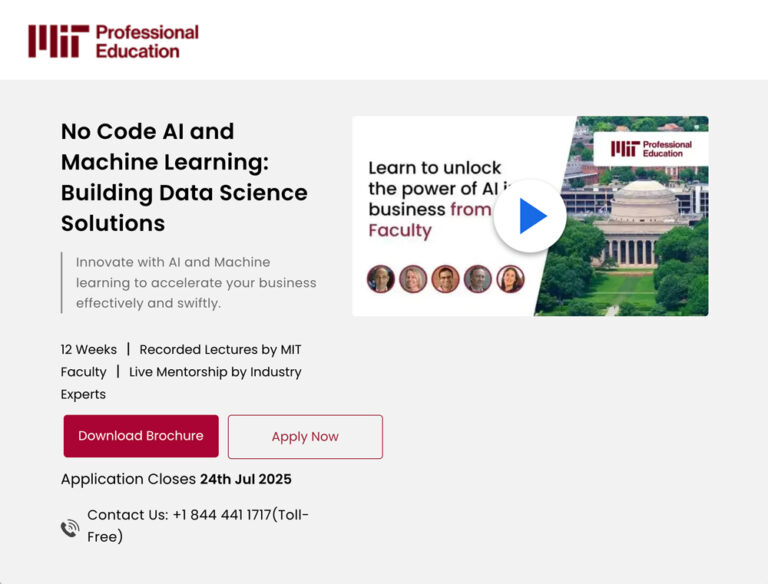
Overview: Good for professionals who need to understand how AI works without writing code. Strong fit for mid-career managers and senior leaders overseeing AI integration.
Who it’s for: Product managers, Project managers, Consultants, Entrepreneurs
What it solves: Provides a foundational understanding of AI and ML concepts, with a focus on how to evaluate, deploy, and manage AI initiatives in a business setting
Industry relevance and recognition: The No-Code AI and Machine Learning program is backed by MIT Professional Education, a globally recognized institution in engineering and innovation.
While the program is not tailored to finance, it offers broad industry relevance for professionals seeking to understand AI strategy and implementation across sectors like healthcare, manufacturing, and operations.
For finance professionals, it may serve as a helpful primer on AI concepts—but lacks the domain-specific depth found in finance-focused programs.
Learning Experience:
Weekly asynchronous video lectures delivered by MIT faculty, focusing on AI strategy, applications, and concepts
Case studies from industries like healthcare, manufacturing, and retail—but limited focus on finance-specific use cases
Emphasis on strategic understanding over hands-on coding or technical buildout
Includes video lectures, interactive exercises, and discussion forums
Curriculum:
Introductory AI concepts covered: Learners explore machine learning fundamentals including classification, regression, and language models.
Understand broad business applications: Learn how to assess AI use cases and consider their strategic implications across different functions.
Examples from multiple industries: Course content includes real-world scenarios, though not tailored specifically to finance roles.
Emphasis on responsible AI: Covers key ethical considerations and best practices for deploying AI in a variety of business settings.
Technical level: No-code — emphasizes strategy, decision-making, and oversight rather than hands-on development
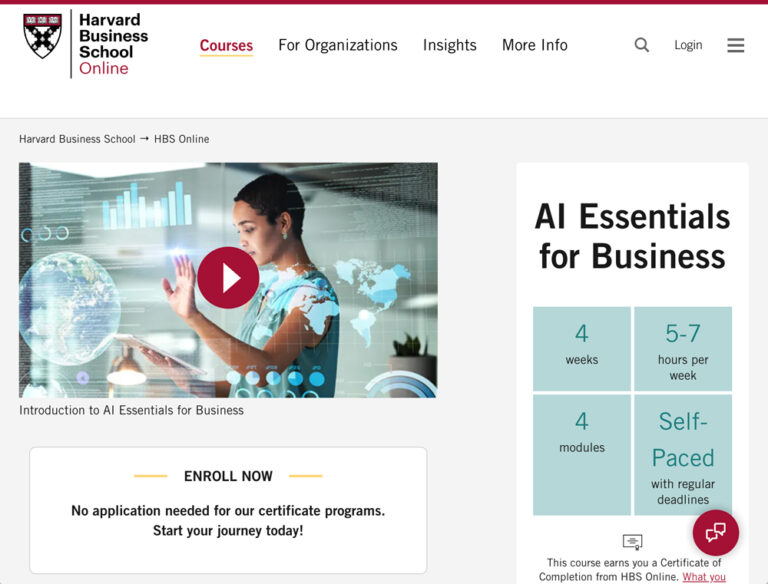
Overview: Backed by HBS, this course lends strong employer credibility. Finance is mentioned as one of several functional areas, but it’s not the focus. The curriculum is broader—suitable for roles in marketing, operations, and HR as well.
Who it’s for: Business leaders and managers, Marketing, Product management, Operations, HR
What it solves: Helps professionals identify high-impact AI use cases across functions, manage AI projects, and communicate effectively with technical teams
Industry relevance and recognition: Offered through Harvard Business School Online, this program carries strong name recognition and credibility with employers across industries. It’s designed for business leaders, managers, and decision-makers looking to understand AI at a strategic level.
However, it is not tailored to finance—the course emphasizes broad cross-functional applications in areas like marketing, operations, and product management.
Finance professionals may find the content relevant for understanding organizational AI strategy, but less actionable for technical or workflow-specific applications in finance.
Learning Experience:
Self-paced format with weekly deadlines on the HBS Online platform
Bite-sized videos from HBS faculty and guest business leaders
Interactive graphs, cold-call simulations, and frequent activity changes (every 3–5 minutes) to sustain attention
Global peer networking via the HBS Online Community’s networking group
Case-based learning with examples from Amazon, Microsoft, Moderna, Mozilla, and Novartis
Course access ends 60 days after your final deadline, compared to Columbia’s program, which offers ongoing updates and full material access for 2 years
Curriculum:
Covers AI fundamentals and strategy: Introduces core topics such as generative AI, data infrastructure, and frameworks for value creation.
Broad industry focus: Examples span a range of sectors; limited emphasis on finance-specific functions or decision-making contexts.
Explores organizational readiness: Includes topics like digital ethics, privacy, and preparing teams for AI adoption.
Geared toward general leadership roles: Best suited for business leaders seeking conceptual awareness rather than hands-on technical depth.
Lacks finance-specific tools and cases: Does not include instruction in Python, or applied AI use in areas like FP&A, investment analysis, or risk modeling—unlike Columbia’s program.
Technical level: No-code — focused on business implications, organizational change, and strategic decision-making
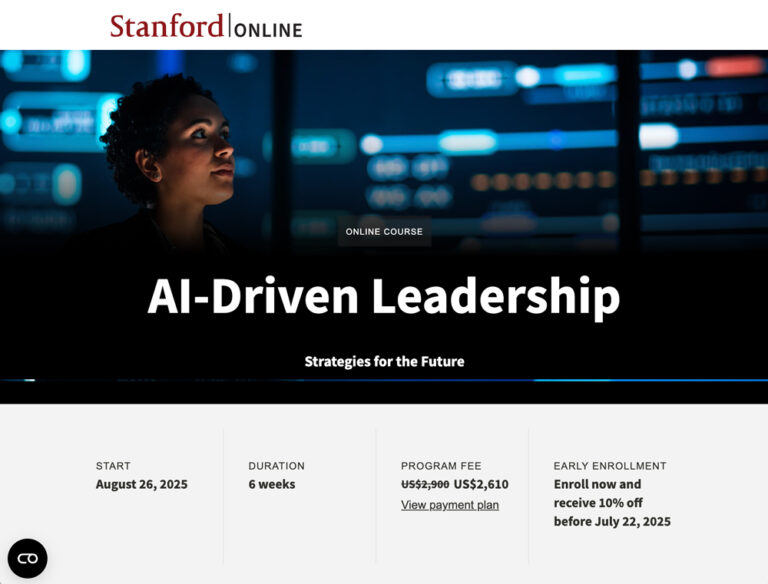
#4: AI-Driven Leadership: Strategies for the Future — Stanford Online
Overview: Designed for senior leaders driving enterprise-level AI adoption. Less focused on finance-specific applications, but valuable for CFOs and finance executives leading digital transformation.
Who it’s for: Executives in finance, strategy, or transformation roles
What it solves: Prepares leaders to navigate the business and ethical implications of AI, lead AI-focused teams, and integrate AI strategy across departments
Industry relevance and recognition: Stanford’s course is geared toward senior leaders navigating organizational change in the age of AI. It focuses on leadership strategy, data culture, and digital implementation across industries.
While it’s not finance-specific, the program reflects growing demand for leaders who can manage AI integration, anticipate risks, and foster innovation in complex environments.
Learning Experience:
6-week online course with flexible learning pace
Instructor-led content from Stanford faculty
Peer collaboration through study groups and networking forums
Final capstone project to design an AI implementation plan
Access to course materials for up to 6 months post-completion
Curriculum:
Designed for organizational leadership: Focuses on managing AI-driven change, not developing technical finance capabilities.
Covers foundational leadership topics: Includes data readiness, workflow design, and AI governance strategies.
Use cases are broad, not finance-specific: Highlights generative AI and predictive analytics, but lacks depth in FP&A, risk modeling, or investment workflows.
Best for senior leaders: Aimed at executives guiding AI adoption—less suited for those seeking practical finance applications or tools like Python.
Technical level: No-code — focused on leadership, strategy, and cross-functional alignment
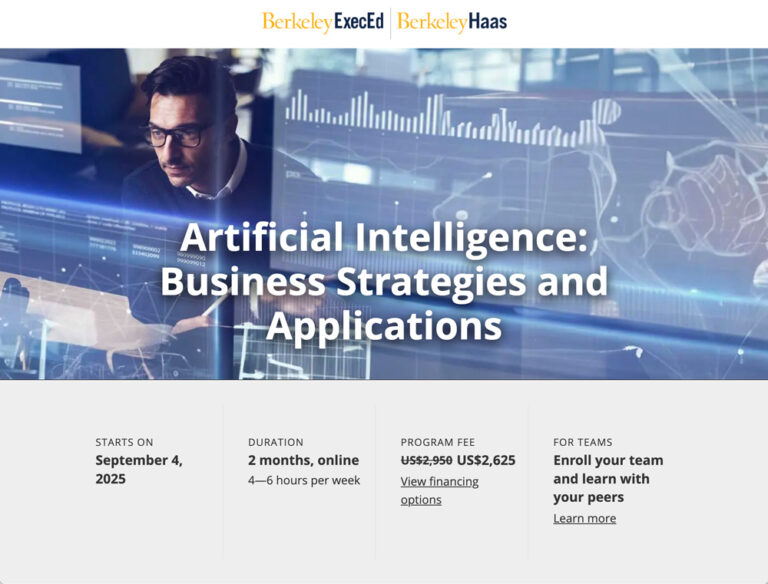
#5: Artificial Intelligence: Business Strategies and Applications — Berkeley ExecEd
Overview: Well-suited for business professionals leading digital strategy or transformation efforts, but finance professionals looking for more targeted applications (like in FP&A, private equity, or investment modeling) may benefit more from a finance-specific course.
Who it’s for: Senior leaders including C-suite executives overseeing the integration of AI into their organization, Data scientists and analysts, Mid-career professionals
What it solves: Teaches how to identify AI opportunities, assess vendor tools, and build an AI adoption roadmap
Industry relevance and recognition:
Berkeley Executive Education is widely respected for its leadership in innovation and technology, and this program reflects that reputation with a strong emphasis on strategic AI adoption across sectors. The curriculum is designed for cross-functional business leaders navigating AI integration in roles such as product, operations, and general management.
While relevant to finance professionals interested in broader applications of AI, it does not offer the finance-specific tools, use cases, or role alignment found in Columbia’s AI for Business & Finance Certificate.
Learning Experience:
Includes four live faculty sessions, recorded lectures, and peer discussions
Hands-on capstone project applies learnings directly to a real business initiative
Learning platform supports flexible access and interactive assignments
Unlike Columbia’s program, Berkeley’s access to course materials and updates may be time-limited post-program (not explicitly stated), whereas Columbia participants retain access to updated materials for 2 years
Curriculum:
Covers foundational AI topics: Introduces key concepts like machine learning, natural language processing, and predictive analytics.
Cross-industry lens: Case studies span various sectors—finance is included but not the primary focus.
Suited for general business audiences: Designed for leaders exploring AI strategy, not hands-on finance practitioners.
Technical level: No-code with optional technical exploration
Continue Reading Below
The AI in Business & Finance Certificate Program
Build a practical AI skillset and transform your career. No coding required! Enrollment is now open for upcoming cohort from Columbia Business School Executive Education and Wall Street Prep.
If you’re not ready to commit to an AI certification in finance, you can still build foundational knowledge and stay current on trends with free or low-effort options like:
Follow AI newsletters Stay up to speed with curated insights from The Algorithm (MIT Tech Review), Import AI, and industry roundups like McKinsey’s AI reports.
Read finance-focused case studies Companies like Goldman Sachs, Visa, and BlackRock regularly publish examples of how they're applying AI in investment banking, fraud detection, and asset management.
Watch short-form AI explainers YouTube channels like Two Minute Papers or Microsoft Research break down complex topics into digestible videos.
Explore free foundational courses Platforms like Coursera, edX, and Google AI offer no-cost intros to AI, machine learning, and prompt engineering.
These options offer a flexible way to start—but they often lack structure, support, and practical relevance to finance.
Why an AI for Finance Certificate Is Worth the Investment in 2026
Self-study courses are a great way to explore the basics. But if you’re serious about applying AI in your work—and standing out—structured, finance-specific training can take you further, faster.
There’s real opportunity here: Generative AI is expected to deliver $200–$340 billion in annual value to the banking and finance sector, according to McKinsey. And companies are actively looking for professionals who know how to turn that potential into results.
Consider this:
78% of CFOs say their teams need stronger AI skills to keep up with where the industry is headed 5
Employers are offering a 42% salary premium for finance pros who bring AI fluency to the table (PwC & AWS) 6
More than two-thirds of finance leaders plan to expand their teams in the next year as companies need more staff to support AI implementation, analysis, model governance, and strategic application. 7
On LinkedIn, AI-related job posts have jumped 17% year-over-year, and profiles listing AI skills have increased 142x since 2016 8
The takeaway is clear: As demand rises for AI-literate professionals in business and finance, those with the foresight to upskill now will be best positioned to lead future-ready teams.
Whether you're working in FP&A, private equity, corporate strategy, or risk management, AI literacy is quickly becoming essential for higher-impact roles, better pay, and greater influence.
Is an AI finance certificate worth it if you don't know how to code?
Yes, most AI for finance certificates, including Columbia and Wall Street Prep's program, are designed as low-code or no-code, meaning they teach just enough Python or SQL to apply AI tools without requiring prior programming experience. The goal of these programs is typically to make finance professionals fluent in using AI tools within their existing workflows, not to turn them into software engineers, so a non-technical background isn't a barrier to enrolling or succeeding.
How does the cost of an AI for finance certificate compare to an MBA?
AI for finance certificates typically run a few thousand dollars and take weeks rather than years to complete, compared to an MBA, which often costs well over $100,000 and takes one to two years of full-time study. Certificates are meant to build a specific, applied skill set quickly, while an MBA provides a much broader business education along with a credential and network that serves a different, longer-term career purpose.
Will an AI certificate actually help you get a promoted or land a new finance role?
An AI certificate can meaningfully strengthen a resume in the current market, given that employers are reportedly offering salary premiums for AI-fluent finance professionals and job postings mentioning AI skills have grown significantly. That said, a certificate alone rarely guarantees a promotion or new offer; it's most effective when paired with demonstrable, applied results, such as using AI tools to improve forecasting accuracy or speed up a real workflow in your current role.
Can you complete an AI for finance certificate while working full-time?
Yes, most of these programs are specifically designed for working professionals, using asynchronous video lessons, weekly deadlines, and self-paced modules rather than requiring full-time attendance. Programs typically run six to twelve weeks and are structured to fit around a standard work schedule, though the time commitment and live session requirements vary by program, so it's worth checking each course's specific format before enrolling.
What's the difference between a no-code AI course and one that teaches Python and SQL?
A no-code AI course focuses on strategic understanding, helping you evaluate AI tools and oversee their use without ever writing a line of code yourself. A course that includes Python and SQL goes a step further, giving you the hands-on ability to build or customize simple models, automate tasks, and work more directly with financial data, which tends to be more valuable for analysts and associates who apply these tools day-to-day rather than executives who primarily oversee AI strategy.
Are free AI courses enough for a finance career, or is a paid certificate necessary?
Free courses can be a reasonable starting point for building general AI literacy, but they typically lack the finance-specific case studies, structured curriculum, and applied practice that paid, finance-focused certificates provide. For someone who just wants basic familiarity with AI concepts, free resources may suffice, but for professionals looking to actually apply AI to tasks like forecasting or investment analysis in their day-to-day role, a structured program tends to deliver more practical, job-ready skill development.
How quickly is AI making certain finance skills obsolete?
AI is automating many of the more repetitive, lower-value tasks in finance, such as basic data gathering and first-pass model building, at a pace fast enough that most finance leaders now consider AI fluency a near-term necessity rather than a future consideration. This doesn't mean core financial skills like valuation judgment and deal structuring are becoming obsolete, but it does mean professionals who can't work alongside AI tools risk falling behind peers who can move faster and analyze more with the same amount of time.
Do employers actually recognize AI certificates on a resume?
Recognition varies by employer and industry, but certificates from well-known institutions, especially ones co-developed with a recognized business school, tend to carry more weight than generic online course completions. Employers are generally more interested in what you can actually do with the skill than the credential itself, so a certificate that includes applied projects or demonstrable outputs tends to be more persuasive in an interview than the certificate name alone.
What's the difference between an AI certificate and a data science bootcamp for finance professionals?
An AI for finance certificate is generally built around applying existing AI tools to specific finance workflows, like forecasting, risk modeling, or investment analysis, without requiring you to become a data scientist. A data science bootcamp goes much deeper into the technical foundations, including statistics, machine learning theory, and building models from scratch, which is more relevant if you're aiming for a data science or quantitative role rather than applying AI as a tool within a traditional finance function.
Is it better to learn AI skills through your employer's training budget or pay out of pocket?
Using an employer's training budget is generally the better option when available, since it removes the personal cost and often signals to your manager that you're proactively building relevant skills. If your employer doesn't offer this kind of support, paying out of pocket can still be a reasonable investment given the reported salary premiums for AI-fluent professionals, though it's worth asking your manager directly, since many companies have expanding AI training budgets that employees don't realize they can request.












No comments yet.