How Does the Wharton Online Value Investing Certificate Stack Up?
In this review, we take an in-depth look at the Wharton Value Investing Certificate Program, including its curriculum, time commitment, cost, learning format, and career relevance. We also compare it directly with other well-known value investing certificate programs from NYU and Columbia Business School, so you can see how each option differs in rigor, structure, and real-world applicability.
Research from the CFA Institute highlights growing skill gaps in valuation, modeling, and investment analysis—areas essential for anyone pursuing buy-side, hedge fund, or long-term investing roles.
For professionals looking to sharpen their judgment, strengthen their valuation skills, or build a real investment framework (not just learn theory), structured training offers a clear edge.
What Is the Wharton Online Applied Value Investing Certificate Program?
Built in collaboration with Wall Street Prep, it blends Wharton’s academic foundations with hedge fund–grade modeling, thesis development, and stock-pitch training.
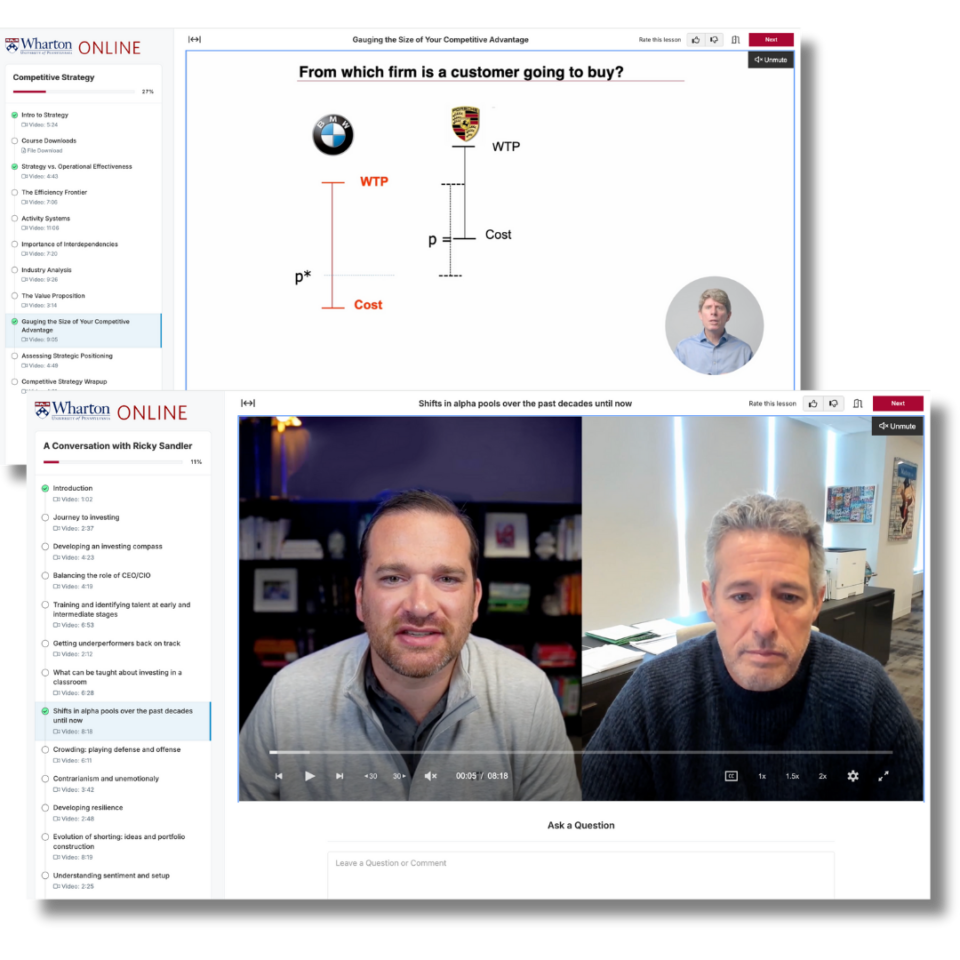
Although the program is fully online, Wharton intentionally incorporates real-time interaction through weekly office hours, live discussions, coaching, and structured networking moments so learners feel connected, supported, and accountable.
This hybrid structure helps participants stay engaged while still benefiting from a flexible, self-paced format.
How many hours per week does the Wharton Applied Value Investing program require?
Wharton recommends 8 to 10 hours per week for lectures, assignments, stock-pitch exercises, and optional live office hours.
This weekly structure helps learners stay on track without feeling overwhelmed, while still providing enough depth to build real buy-side–ready skills. The program is designed to be manageable for full-time professionals.
What is the format?
The Applied Value Investing Certificate is an 8-week, fully online program delivered through Wharton’s digital learning platform.
Students progress through weekly modules at their own pace, supported by live office hours, real-time discussions, coaching sessions, and structured networking events.
How difficult is the Wharton Applied Value Investing certificate?
The program is designed to challenge learners, but it’s also structured and well-supported.
Students dive into professional-grade topics such as valuation, intrinsic value, forecasting, competitive analysis, and stock pitching—skills typically taught inside hedge funds and long-only investment teams.
While the coursework is rigorous, weekly support, clear frameworks, and step-by-step modeling guidance make the material accessible for motivated learners.
Does the Wharton Applied Value Investing Certificate Program help with jobs?
Many learners find the program helpful for career advancement.
"This program is filled with practical information for finance professionals of all types," says program graduate and investment analyst Meredith Henderson. "I'm learning skills that I'm able to immediately apply to make me a better analyst."
The Wharton Online certificate is widely recognized among buy-side and advisory roles because it teaches the same analytical frameworks used at institutional investment firms.
Participants gain hands-on experience with stock analysis, modeling, and thesis development, which are skills directly applicable to roles in equity research, hedge funds, asset management, financial advisory, and family offices.
The program also includes access to a global graduate network, live meetups, and industry guest speakers, giving participants a direct line to new job opportunities and real insight into how hiring happens on the buy side.
Can beginners take it?
No prior buy-side experience is required. Having some familiarity with basic finance concepts—such as financial statements and valuation multiples—will make the experience smoother, but it’s not a prerequisite. Motivated newcomers often succeed because the program provides structured frameworks, clear explanations, and weekly opportunities to ask questions.
And to help everyone start on solid footing, participants receive access to pre-course materials and free financial modeling resources from Wall Street Prep, which can help you get up to speed quickly.
Curriculum Overview: What You’ll Learn in the Wharton Online Applied Value Investing Certificate Program
The Wharton Applied Value Investing Certificate Program follows a structured 8-week curriculum designed to teach the same analytical frameworks used at top hedge funds and investment firms.
Each module builds toward a complete, repeatable investment process—from understanding intrinsic value and market efficiency to constructing stock pitches, analyzing financial statements, and evaluating real-world catalysts.
Below is a breakdown of what students learn in each module so you can determine whether the program aligns with your skill-building and career goals. You can download the full program brochure here.
Module
You Will Be Able To
Module 1: Introduction to Value Investing
Grasp core value investing principles, including how price and intrinsic value relate.
Identify opportunities where a stock’s future value exceeds its current price.
Understand how professional investors evaluate businesses and form theses.
Module 2: Market Efficiency, Stock Price Movements, and Market Mispricing
Understand market efficiency concepts and why they matter in stock selection.
Attribute stock price movements using frameworks like Why Stocks Move Up & Down.
Evaluate investor expectations, catalysts, and variant perspectives to spot mispricing.
Module 3: Intrinsic Value
Understand how ROIC, growth, reinvestment, and cost of capital drive intrinsic value.
Build and interpret valuation models using both comps and DCF approaches.
Choose the right valuation method for different investment scenarios.
Module 4: Institutional-Grade Value Investing, Part 1
Build institutional-quality financial models using the FEV framework and structured forecasting.
Apply capital markets concepts, including IPO processes and model “must-haves.”
Module 5: Institutional-Grade Value Investing, Part 2
Assess competitive advantages and understand how barriers to entry and ROIC create sustained value.
Apply tools for developing contrarian theses, including sentiment and insider activity analysis.
Analyze the top drivers of business value creation and identify financial inflection points.
Module 6: Growth, Risk, and Uncertainty
Break down revenue growth into key drivers and distinguish between growth types.
Evaluate risk, variant views, and how uncertainty impacts valuation and stock behavior.
Analyze capital allocation decisions, shareholder activism, and governance.
Module 7: Process-Driven Value Investing
Use efficient research techniques (sniff test, “fish where the fish are”) to source ideas.
Apply behavioral finance to separate personal and market biases.
Strengthen analytical rigor using checklists, premortems, scenario analysis, and tools for unknown unknowns.
Module 8 (Elective & Capstone): Considerations for Investment Advisors and Institutional Investors
Understand how buy-side firms operate and what a career path from analyst to PM looks like.
Build and articulate a compelling stock pitch using institutional value investing principles.
Apply frameworks for managing risk, assessing downside scenarios, and communicating with PMs when thesis risks emerge.
Who Teaches the Wharton Applied Value Investing Program?
Wharton Online partners with seasoned buy-side professionals from Wall Street Prep to deliver a curriculum grounded in real institutional investing practice.
Nicolaj Siggelkow — David M. Knott Professor of Management, Wharton School
Award-winning Wharton professor and co-director of the Mack Institute for Innovation Management.
Published extensively in top management journals, including ASQ, Management Science, and Strategic Management Journal.
Holds degrees from Stanford, Harvard, and Harvard Business School, bringing rigorous academic grounding to the program.
Known for exceptional teaching, earning multiple MBA and undergraduate excellence awards.
David Musto — Ronald O. Perelman Professor in Finance, Wharton School
Senior finance faculty member and director of the Stevens Center for Innovation in Finance.
Former Senior Financial Economist at the U.S. Securities and Exchange Commission.
Research spans consumer finance, mutual funds, credit markets, and corporate governance.
Brings a rare combination of academic expertise and regulatory insight.
Andrew Carr — Applied Value Investing Program Co-director, Wall Street Prep
Former hedge fund and fintech/services investor at Balyasny, ExodusPoint, and Blackstone/Strycker View.
Hundreds of hours of analyst coaching experience, including leading teams to victories at major stock pitch competitions.
Specializes in training new analysts to think and operate like buy-side professionals.
MBA from Columbia Business School and BA from Cornell University.
Brett Caughran — Value Investing Program Director, Wall Street Prep
13 years of hedge fund experience at Maverick Capital, D.E. Shaw, Citadel, and Schonfeld.
Founder of Fundamental Edge, a firm dedicated to training the next generation of investment analysts.
Deep experience mentoring analysts and developing institutional research processes.
Paul Johnson — Value Investing Program Co-director, Wall Street Prep
35+ years of investment and advisory experience, including roles as managing director in equity research.
Longtime professor at Columbia Business School and Fordham, teaching securities analysis and value investing.
Founding partner of Nicusa Capital Partners, managing investments across sectors.
Co-author of influential investing texts including Pitch the Perfect Investment and The Gorilla Game.
Guest Speakers
The Wharton Applied Value Investing Program features an exceptional lineup of guest speakers—portfolio managers, hedge fund founders, researchers, and industry strategists who bring real-world credibility and insight into how top investors analyze businesses and generate returns.
These experts give learners direct exposure to the thought processes, frameworks, and market perspectives used at leading investment firms, adding tremendous depth and practical value to the program experience.
Shawn Badlani — Founder & CIO, Honest Capital
Nearly a decade of activist hedge fund experience at Marcato Capital and deep expertise managing concentrated, value-focused portfolios.
Freddy Brick — Partner, Muddy Waters Capital
A leading figure in activist short-selling, known for exposing business and accounting fraud to reveal a company’s true economic value.
Rocky Cahan — U.S. Strategist, Empirical Research Partners
A top-ranked quantitative strategist whose research bridges bottom-up stock selection with macroeconomic market insights.
Rishi Dixit — Senior Analyst, Valiant Capital
Brings more than a decade of long-term, fundamental investing experience focused on high-quality global businesses.
Michael Gatto — Partner, Silver Point Finance
Veteran credit and special situations investor with extensive experience structuring, underwriting, and teaching complex financial transactions.
Jeff Gramm — Founder & Managing Partner, Bandera Partners
Hedge fund manager and author of Dear Chairman, widely regarded as a definitive work on shareholder activism and corporate governance.
Robert Hagstrom — Chief Investment Officer, EquityCompass
Renowned value investor and author of The Warren Buffett Way, one of the most influential books on Buffett-style investing.
Howard Marks — Co-Founder, Oaktree Capital
One of the most respected voices in global investing, known for his widely read memos and mastery of risk, cycles, and distressed investing.
Michael Mauboussin — Head of Consilient Research, Counterpoint Global
One of the foremost experts on valuation, decision-making, and expectations investing, with decades of research shaping modern investment practice.
Matt Ober, CAIA — General Partner, Social Leverage
Former Chief Data Scientist at Third Point with deep expertise in applying data science and analytics to enhance investment performance.
Alix Pasquet — Managing Partner, Prime Macaya Capital Management
Leads a behavioral hedge fund leveraging insights into crowd behavior to identify mispriced securities.
David Samra — Managing Director, Artisan Partners
Highly regarded international value investor and long-tenured portfolio manager of the award-winning Artisan International Value Fund.
Ricky Sandler — Founder & CEO, Eminence Capital
Billion-dollar hedge fund CIO with more than 30 years of experience analyzing businesses and generating institutional-grade investment theses.
Guy Spier — General Partner, Aquamarine; Author of The Education of a Value Investor
Respected global value investor with a long-term Buffett-influenced approach and author of a widely acclaimed investing memoir.
François Trahan — President, Macro Specialist Designation
One of the top macro strategists in the world and the only portfolio strategist inducted into the Institutional Investor Analyst Hall of Fame.
What Is the Wharton Networking Experience Like?
Enrollment in a Wharton Online + Wall Street Prep certificate program gives you lifetime access to meet-ups, happy hours, and other networking events.
The Wharton Applied Value Investing Program offers a robust, community-focused networking experience that helps learners build meaningful professional relationships across the global investing landscape.
Key highlights include:
In-person networking events where participants and graduates connect with faculty, industry speakers, and peers to exchange insights and form long-term professional relationships.
Exclusive in-person info sessions that allow prospective and current learners to meet faculty, talk with program graduates, and connect with others considering the program. If you download the brochure, you’ll be notified of the next in-person information session, or you can attend one virtually.
Invitation-only LinkedIn and Slack groups offering direct access to a global network across 110+ countries for career advice, idea sharing, and ongoing professional development.
Lifetime access to in-person meetups, virtual events, and networking opportunities.
How Much Does the Wharton Applied Value Investing Certificate Cost?
The program fee is $5,000, though early-enrollment discounts, monthly payment plans, and a first-come, first-served $550 tuition assistance award can lower the cost.
Many participants also use employer-sponsored education reimbursement, so it’s worth confirming whether your company offers this benefit.
Compared to similar programs, Wharton sits in a mid-range pricing tier:
Columbia Business School Executive Education (Value Investing Online): $3,895
Wharton Online Applied Value Investing - $5,000 ($4,800 with early enrollment)
NYU Certificate in Alternative Investments: $5,760
While it may not be the lowest-cost option, Wharton delivers stronger career returns than many cheaper online alternatives thanks to its brand credibility, applied skill-building, and powerful networking ecosystem.
How Does the Wharton Applied Value Investing Certificate Program Compare with Others?
Program
Duration
Price
Live Networking
Best for
Overall Value for Career
Applied Value Investing
Wharton Online x Wall Street Prep
8 weeks online
with live office hours
$5,000
($4,800 with early enrollment)
✅ Lifetime access to community meetups
Aspiring or early-career investment professionals (hedge fund analysts, research analysts, equity research associates, quant analysts)
Individual investors seeking a structured, disciplined investment framework
Mid-career investors and portfolio managers deepening analytical rigor
Registered Investment Advisors (RIAs) and financial advisors
Allocators and family office professionals
Wealth managers and financial planners
Undergraduate and graduate students pursuing investing roles
★★★★★
Certificate in Alternative Investments
NYU
1–3 years
Online, self-paced
$5,760
❌ No
Early-career finance professionals seeking broad exposure to alternatives
Career starters building foundational knowledge before specialization
Professionals exploring a transition into alternatives at a high level
★★★
Value Investing (Online)
Columbia Business School Executive Education
9 weeks
6–8 hours per week
Online
$3,895
🟡 Limited
No mention of meetups beyond peer discussions
Full-time or aspiring investors seeking academic grounding in value investing
Portfolio managers, fund managers, and investment analysts
Professionals wanting a foundational (not heavily technical) valuation intro
★★★
Is Wharton Online’s Applied Value Investing Program Right for You?
This program is best suited for:
Learners who want to actively build investing skill, not just earn a certificate. This program requires applying concepts through modeling exercises, research assignments, and real case work, not passive watching.
People ready to commit 8–10 hours per week to studying, analyzing companies, completing exercises, and participating in live office hours and discussions.
Those who want to join a motivated professional community of peers interested in value investing, idea generation, and thoughtful long-term investing frameworks.
Learners who want feedback and interaction, including opportunities to engage with instructors, ask questions, and refine their analysis through hands-on practice.
When This Program Might Not Be the Right Fit
This is not the right program for:
Those looking for a passive, lecture-only experience. This program requires deep engagement with cases, modeling exercises, valuation work, and weekly study, not just watching videos.
Learners unwilling to dedicate 8–10 hours per week. Consistent practice is essential for mastering the value investing process taught in this certificate.
Anyone seeking quick tips, stock picks, or trading strategies. The curriculum focuses on long-term fundamental analysis, not short-term speculation.
People who prefer large, theoretical academic courses. This program is highly practical, hands-on, and designed for those who want to work through real investment cases and apply a structured investment framework.
Final Verdict: Is the Wharton Value Investing Certificate Worth It?
The Wharton Applied Value Investing Certificate is worth it for professionals who want to sharpen their investment judgment, deepen their analytical toolkit, and learn the same disciplined framework used by top buy-side investors. The program blends academic rigor with real-world case work, giving participants a practical, repeatable process for evaluating public companies.
Participants gain:
A Wharton Online certificate recognized globally across investment and financial markets
Hands-on valuation practice through real company case studies, modeling exercises, and scenario analysis
Insights from practitioners who manage real funds and bring decades of market experience
Community and networking opportunities, including optional in-person meetups, Slack and LinkedIn groups, and a cohort of peers serious about long-term investing
In a market where fundamental research skills are increasingly rare—and increasingly valuable—this program equips learners with the judgment, process, and brand signal to stand out.





No comments yet.